The problem
Tight-binding models are the workhorse of condensed-matter physics, but the tools are split. One package computes bands and Berry phases on a Bloch mesh, another computes transport through a finite device, and the same lattice has to be defined twice, in two APIs.
What tbkit does
In tbkit one model definition serves every calculation:
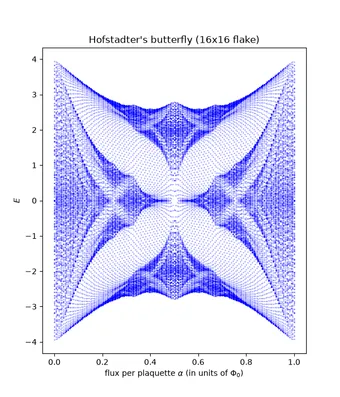
- Bands on periodic lattices and spectra of finite flakes, with magnetic fields and disorder.
- Topology: Chern, Z₂, Bott and higher-order invariants.
- Response: Kubo linear response.
- Transport: scattering matrices of devices with leads.
The documentation follows the history of the field, with chapters on models, fields, topology, response, interactions and driven systems, and each breakthrough has a runnable gallery example.
Results
- Results agree with Kwant and PythTB to within 10⁻¹².
- On Bloch meshes, speed is comparable to PythTB.
- With the MUMPS solver, scattering calculations run 1.1 to 2 times faster than Kwant, for devices of up to 4 × 10⁵ sites.
My role
I wrote tbkit. It grew out of tbee, a tight-binding package I started in 2015 during my postdoc at Lancaster University.
Get started
pip install tbkit
# or
conda install -c conda-forge tbkit
Cite a release through its Zenodo record.