earthsciencekit: Earth-System Models in Python#
EarthScienceKit makes the equations behind 7 Earth-science domains computable, inspectable and visualizable. Choose a domain to explore its history, run its examples and inspect its API. NumPy and SciPy provide the numerical foundations; this package connects them to Earth-system concepts.
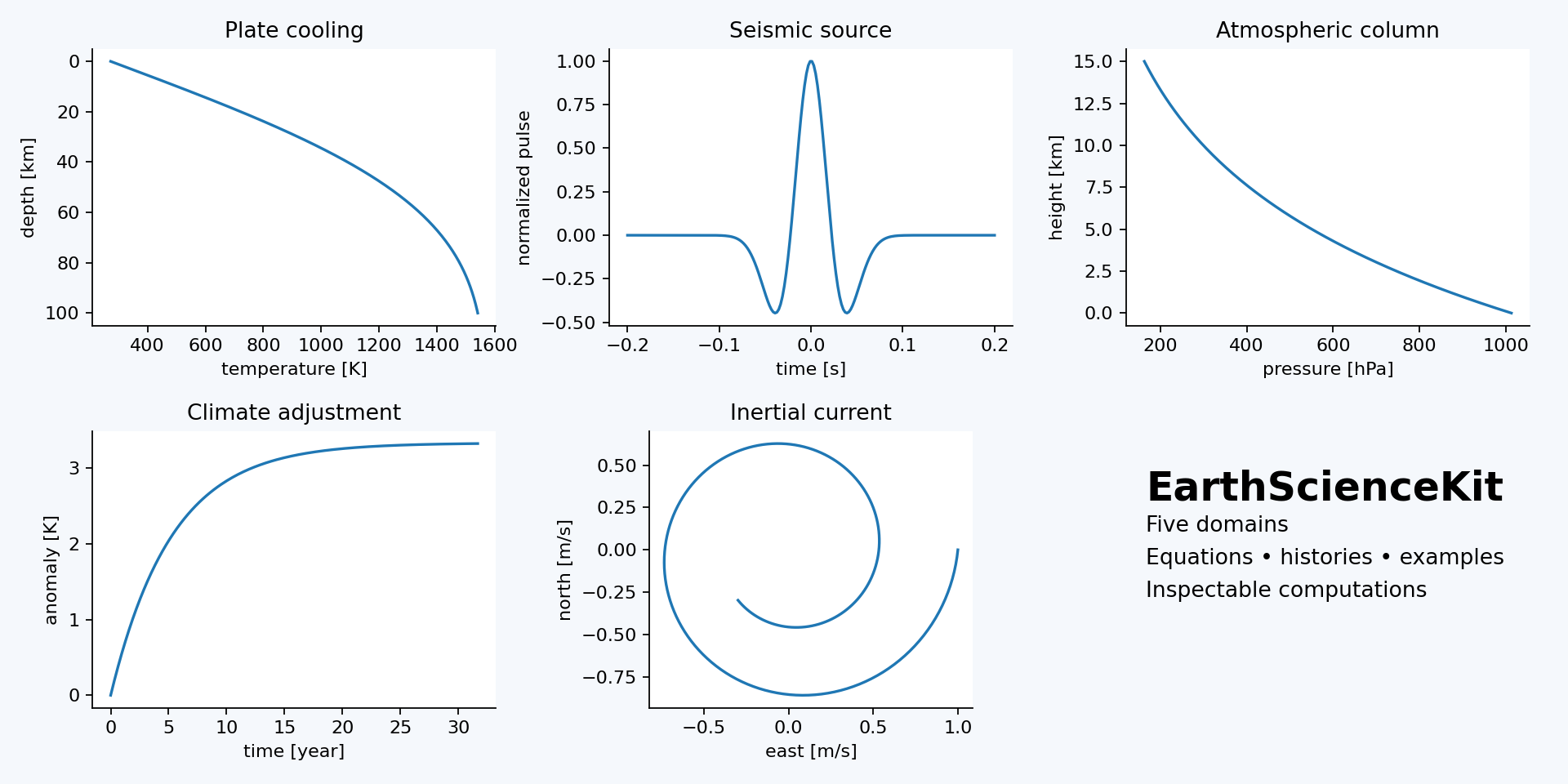
Browse by domain#
Solid Earth
Euler plate motion, spreading, subduction, isostasy, flexure and lithosphere cooling.
Elastic wave speeds, reflection, seismic moment, source pulses and damped response.
Radiometric dating, isotope and trace-element geochemistry, magma viscosity and ascent, ground deformation and eruption columns.
Gravity anomalies, the figure of the Earth, the geoid, the geomagnetic field, paleomagnetism and the dynamo.
Fluid Earth and Climate
Hydrostatic balance, dry thermodynamics, moisture, rotation and parcel ascent.
Radiative balance, forcing, heat storage, carbon baselines and climate adjustment.
Tides, waves, seawater density, geostrophy, the Ekman spiral, wind-driven gyres and thermohaline boxes.
Start here#
Quickstart introduces the API. Numerical methods and sampled results explains sampled histories and solver choices. The model guides give equations, units, conventions and applicability limits. Validation policy documents the evidence behind this release and Scope and limitations describes its scope.
import numpy as np
from earthsciencekit.climate import simulate_one_box
from earthsciencekit.units import convert

time = convert(np.linspace(0, 100, 201), "year", "s")
result = simulate_one_box(4, 1.2, 2e8, time)
print(result.summary())
figure, axes = result.plot()
Related toolkits
Sibling Python toolkits for learning and teaching, built the same way:
blockchainkit – cryptography, consensus and blockchain systems
chemistrykit – computational chemistry
engineeringkit – computational engineering
financialkit – quantitative finance
mathematicskit – computational mathematics
physicskit – computational physics
tbkit – tight-binding models, band topology and quantum transport