
Note
Go to the end to download the full example code or to run this example in your browser via JupyterLite.
Kupiec’s proportion-of-failures test#
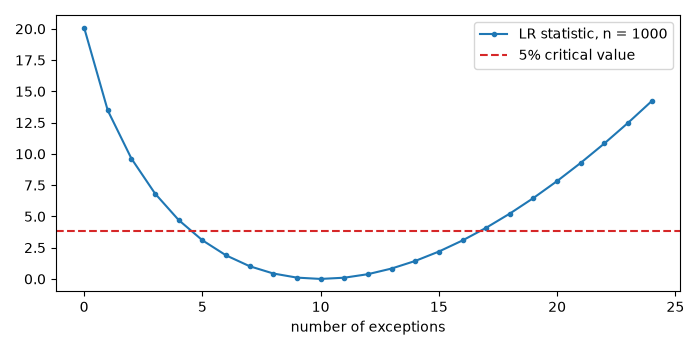
A 99% VaR should be exceeded on about 1% of days. Kupiec (1995) turned “about” into a likelihood-ratio test: with \(x\) exceptions in \(n\) days and \(\hat p = x/n\),
\[LR_{uc} = -2 \ln \frac{(1 - p)^{n - x} p^x}{(1 - \hat p)^{n - x} \hat p^x} \sim \chi^2_1.\]
He also showed how weak the test is on a year of data: a model that is badly wrong is often not rejected.
import matplotlib.pyplot as plt
import numpy as np

from financialkit.risk import kupiec_test, parametric_var, var_exceptions
Non-rejection regions#
n =  250: a 99% VaR passes with 1 to 6 exceptions (expected 2)
n =  500: a 99% VaR passes with 2 to 9 exceptions (expected 5)
n = 1000: a 99% VaR passes with 5 to 16 exceptions (expected 10)
Testing a model that underestimates volatility#
Returns have a 1.2% daily volatility; the model assumes 1%. With 250 days the test catches the error only about half the time; with four years, almost always.
rng = np.random.default_rng(0)
var = parametric_var(0.0, 0.01, 0.99)
power = {}
for n in (250, 1000):
    pnl = 0.012 * rng.standard_normal((1000, n))
    power[n] = np.mean([kupiec_test(var_exceptions(row, var)).reject() for row in pnl])
    print(f"n = {n:4d}: rejection rate {power[n]:.0%}")

pnl = 0.012 * rng.standard_normal(1000)
res = kupiec_test(var_exceptions(pnl, var))
print(f"one sample: {res.n_exceptions} exceptions vs {res.expected:.0f} expected, LR = {res.statistic:.2f}, p = {res.p_value:.4f}")

x = np.arange(0, 25)
fig, ax = plt.subplots(figsize=(7, 3.5))
ax.plot(x, [kupiec_test(np.arange(1000) < k).statistic for k in x], ".-", label="LR statistic, n = 1000")
ax.axhline(3.841, color="C3", ls="--", label="5% critical value")
ax.set_xlabel("number of exceptions")
ax.legend()
fig.tight_layout()

plt.show()
n =  250: rejection rate 48%
n = 1000: rejection rate 97%
one sample: 28 exceptions vs 10 expected, LR = 21.99, p = 0.0000
Total running time of the script: (0 minutes 0.553 seconds)
