Note
Go to the end to download the full example code or to run this example in your browser via JupyterLite.
The Byzantine generals problem (Lamport, Shostak and Pease 1982)#
Generals surrounding a city must agree to attack or retreat, communicating by messenger, while some of them are traitors who tell different generals different things. Lamport, Shostak and Pease proved agreement possible if and only if more than two thirds of the generals are loyal, and gave the oral-messages algorithm OM(m): every lieutenant relays what it heard, and everyone takes a majority.
What to look for#
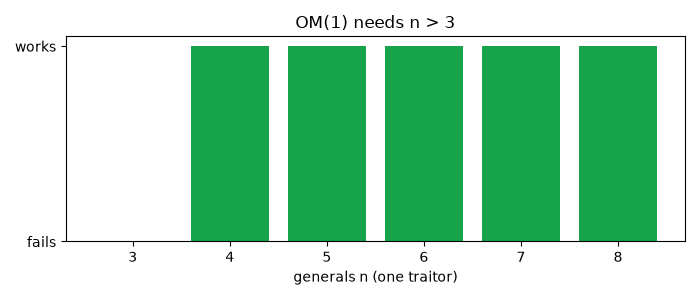
With four generals and one traitor, the loyal ones always agree, and follow a loyal commander. With three generals and one traitor, a loyal lieutenant can be talked out of the commander’s order: n > 3m is necessary. This 3f + 1 bound reappears in every Byzantine fault-tolerant blockchain.
The history behind this experiment: Breakthroughs in Consensus. See Exercises: consensus for a worked solution to the exercise.
Four generals, one traitor anywhere#
import matplotlib.pyplot as plt

import blockchainkit as bk

for traitor in range(4):
    result = bk.consensus.oral_messages(4, {traitor}, "attack", rounds=1)
    assert result.agreement and result.validity
    print(f"traitor {traitor}: loyal decisions {result.decisions}")
traitor 0: loyal decisions {1: 'retreat', 2: 'retreat', 3: 'retreat'}
traitor 1: loyal decisions {2: 'attack', 3: 'attack'}
traitor 2: loyal decisions {1: 'attack', 3: 'attack'}
traitor 3: loyal decisions {1: 'attack', 2: 'attack'}
Three generals are not enough#
result = bk.consensus.oral_messages(3, {2}, "attack", rounds=1)
print("loyal lieutenant 1 decides:", result.decisions[1], "although the commander said attack")
assert not result.validity
loyal lieutenant 1 decides: retreat although the commander said attack
When does OM(1) survive one traitor?#
sizes = range(3, 9)
survives = []
for n in sizes:
    runs = [bk.consensus.oral_messages(n, {t}, "attack", rounds=1) for t in range(n)]
    survives.append(all(r.agreement and r.validity for r in runs))
assert survives == [n > 3 for n in sizes]
fig, ax = plt.subplots(figsize=(7, 3))
ax.bar([str(n) for n in sizes], survives, color=["#16a34a" if ok else "#dc2626" for ok in survives])
ax.set(
    xlabel="generals n (one traitor)",
    yticks=[0, 1],
    yticklabels=["fails", "works"],
    title="OM(1) needs n > 3",
)
fig.tight_layout()
Exercise#
Run oral_messages(7, {a, b}, "attack", rounds=2) for every pair of
traitors, then with rounds=1. Why does tolerating m traitors need m + 1
rounds of relaying?
Total running time of the script: (0 minutes 0.074 seconds)
