Note
Go to the end to download the full example code or to run this example in your browser via JupyterLite.
Nothing at stake: why proof of stake needs penalties (Buterin 2014)#
A proof-of-work miner must divide its hashrate between competing forks; a proof-of-stake validator can sign every fork at no cost and collect the reward whichever one wins. If everyone does that, forks never resolve. Buterin’s Slasher proposal made such double-signing punishable: evidence of two conflicting signatures destroys the validator’s deposit.
What to look for#
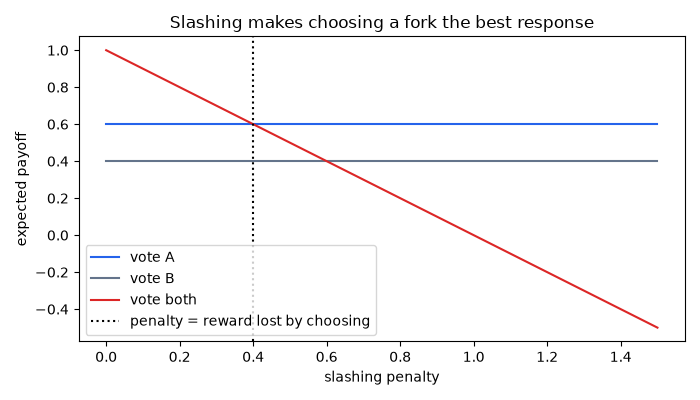
Without a penalty, signing both forks pays more than any honest choice. Once the penalty exceeds the reward lost by picking one side, picking a side wins. Every modern proof-of-stake protocol has slashing.
The history behind this experiment: Breakthroughs in Consensus.
Payoffs without slashing#
no penalty: {'A': 0.6, 'B': 0.4, 'both': 1.0}
Payoffs as the penalty grows#
penalties = np.linspace(0, 1.5, 61)
rows = [bk.consensus.fork_voting_payoffs(0.6, 1.0, p) for p in penalties]
fig, ax = plt.subplots(figsize=(7, 4))
for strategy, color in (("A", "#2563eb"), ("B", "#64748b"), ("both", "#dc2626")):
    ax.plot(penalties, [r[strategy] for r in rows], color=color, label=f"vote {strategy}")
crossover = 1.0 - 0.6
ax.axvline(crossover, color="black", linestyle=":", label="penalty = reward lost by choosing")
ax.set(
    xlabel="slashing penalty",
    ylabel="expected payoff",
    title="Slashing makes choosing a fork the best response",
)
ax.legend()
fig.tight_layout()
assert (
    bk.consensus.fork_voting_payoffs(0.6, 1.0, 0.5)["A"]
    > bk.consensus.fork_voting_payoffs(0.6, 1.0, 0.5)["both"]
)
Exercise#
Slashing only works while the deposit can still be taken. Explain the long-range attack: why could keys of validators who withdrew long ago be used to forge an alternative history, and what “weak subjectivity” asks new nodes to trust?
Total running time of the script: (0 minutes 0.183 seconds)
