Note
Go to the end to download the full example code or to run this example in your browser via JupyterLite.
The CAP theorem: consistency or availability (Brewer 2000, Gilbert and Lynch 2002)#
Brewer conjectured, and Gilbert and Lynch proved, that a replicated service cannot guarantee both consistency (every read returns the latest write) and availability (every request to a live replica gets an answer) when the network may partition. During a split, each side must either refuse requests or answer without the other side.
What to look for#
The same sequence of requests runs against two policies on five replicas split 2 to 3. The consistent register refuses every request on the minority side, and every read it does answer is up to date. The available register answers everything, but returns stale values during the split and silently discards one side’s write when the partition heals. Bitcoin is on the available side: both halves of a split keep extending their own chain, and the shorter chain’s blocks are discarded at reconnection.
The history behind this experiment: Breakthroughs in Peer-to-Peer Networking.
One workload, two policies#
import matplotlib.pyplot as plt

import blockchainkit as bk


def workload(mode):
    register = bk.network.ReplicatedRegister(5, mode=mode, initial="v0")
    register.partition([0, 1], [2, 3, 4])
    register.write(0, "left")
    register.read(1)
    register.read(3)
    register.write(3, "right")
    register.read(0)
    register.read(4)
    register.heal()
    register.read(0)
    return register


latest = {}
for mode in ("consistent", "available"):
    register = workload(mode)
    print(mode)
    for op in register.history:
        print(f"  {op.kind:5s} at replica {op.replica}: {op.value!s:6s} ok={op.ok}")
    latest[mode] = register

consistent, available = (latest[m].history for m in ("consistent", "available"))
assert [op.ok for op in consistent] == [False, False, True, True, False, True, True]
assert all(op.ok for op in available)
consistent
  write at replica 0: None   ok=False
  read  at replica 1: None   ok=False
  read  at replica 3: v0     ok=True
  write at replica 3: right  ok=True
  read  at replica 0: None   ok=False
  read  at replica 4: right  ok=True
  read  at replica 0: right  ok=True
available
  write at replica 0: left   ok=True
  read  at replica 1: left   ok=True
  read  at replica 3: v0     ok=True
  write at replica 3: right  ok=True
  read  at replica 0: left   ok=True
  read  at replica 4: right  ok=True
  read  at replica 0: right  ok=True
Count the anomalies#
A read is stale if some earlier successful write is not visible in it.
def anomalies(history):
    refused = sum(not op.ok for op in history)
    stale, last = 0, "v0"
    for op in history:
        if op.kind == "write" and op.ok:
            last = op.value
        elif op.kind == "read" and op.ok and op.value != last:
            stale += 1
    return refused, stale


counts = {mode: anomalies(latest[mode].history) for mode in latest}
print(counts)
assert counts["consistent"] == (3, 0)
assert counts["available"][1] >= 2
assert latest["available"].values() == ("right",) * 5  # "left" was lost at healing.

fig, ax = plt.subplots(figsize=(6, 3.5))
x = range(2)
ax.bar([i - 0.2 for i in x], [counts[m][0] for m in counts], 0.4, label="refused")
ax.bar([i + 0.2 for i in x], [counts[m][1] for m in counts], 0.4, label="stale reads")
ax.set_xticks(list(x), list(counts))
ax.set(ylabel="requests", title="Pick one during a partition")
ax.legend()
fig.tight_layout()
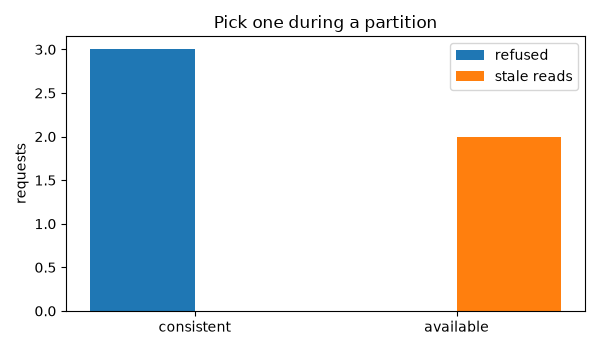
{'consistent': (3, 0), 'available': (0, 2)}
Exercise#
Partition the five replicas into three groups of sizes 2, 2 and 1. What can the consistent register still do? Relate the answer to why PBFT and Bitcoin behave so differently during a network split.
Total running time of the script: (0 minutes 0.093 seconds)
