Note
Go to the end to download the full example code or to run this example in your browser via JupyterLite.
Bytecode verification: check before you run (Gosling 1995)#
Java let browsers download and run code from strangers. Its virtual machine first verifies the bytecode: by following every path through the program without running it, it proves that no instruction can pop from an empty stack and that every instruction is always reached with the same stack height. Verified code needs no run-time stack checks and its maximum stack size is known in advance. Ethereum’s EOF format brings similar validation at deployment.
What to look for#
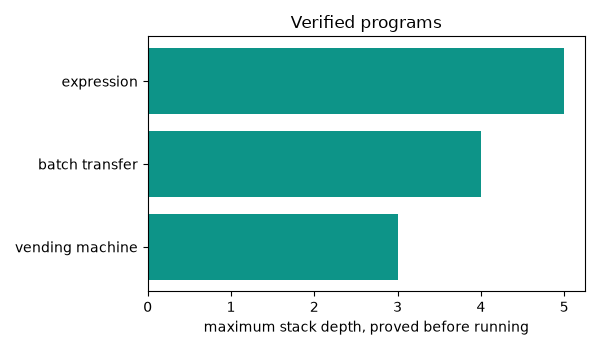
The verifier accepts the contracts in this package and computes their maximum stack depth, which matches the deepest stack any run reaches. It rejects a program with an underflow on a path that a test run happens not to take, and a loop that grows the stack on every turn.
The history behind this experiment: Breakthroughs in Replicated Execution.
Verify the library’s contracts#
import matplotlib.pyplot as plt

import blockchainkit as bk

programs = {
    "vending machine": (bk.vm.vending_machine(), 1),
    "batch transfer": (bk.vm.batch_transfer(1, [2, 3], checked=True), 1),
    "expression": (bk.vm.compile_expression("1 + (2 * (3 + (4 * 5)))"), 0),
}
bounds = {}
for name, (program, arguments) in programs.items():
    report = bk.vm.verify_bytecode(program, arguments=arguments)
    assert report.ok, report.errors
    bounds[name] = report.max_depth
print(bounds)
run = bk.vm.execute(programs["expression"][0], trace=True)
assert max(len(step.stack) for step in run.trace) == bounds["expression"]
{'vending machine': 3, 'batch transfer': 4, 'expression': 5}
A bug a test run can miss#
The ADD after zero underflows, but only when the input is 0.
buggy = bk.vm.assemble("""
    JZ zero
    PUSH 1
    PUSH 2
    ADD
    STOP
zero:
    ADD
""")
assert bk.vm.execute(buggy, arguments=(1,)).stack == (3,)  # The tested path works.
report = bk.vm.verify_bytecode(buggy, arguments=1)
print(report.errors)
assert not report.ok

growing = bk.vm.assemble("top:\n    PUSH 1\n    JMP top")
print(bk.vm.verify_bytecode(growing).errors)

fig, ax = plt.subplots(figsize=(6, 3.5))
ax.barh(list(bounds), list(bounds.values()), color="#0d9488")
ax.set(xlabel="maximum stack depth, proved before running", title="Verified programs")
fig.tight_layout()
('pc 5: ADD needs 2 values but only 0 can be on the stack',)
('pc 0: reached with stack heights 0 and 1',)
Exercise#
The verifier rejects every program whose stack height depends on the path, even some that would never fail. Write such a program, and explain why Java accepted this loss of expressiveness.
Total running time of the script: (0 minutes 0.075 seconds)
