Note
Go to the end to download the full example code or to run this example in your browser via JupyterLite.
Atomic transactions: all or nothing (Gray 1981)#
Jim Gray defined the transaction: a group of actions that is atomic (either all happen or none), consistent, and durable. A bank transfer that debits one account must also credit the other, or do neither, however it fails halfway. Ethereum gives every call this property: if execution fails, every storage write it made is discarded.
What to look for#
The trace shows the debit already written to the working storage before the transfer fails. The committed storage is unchanged all the same: the failure discarded the half-done write. A successful transfer conserves the total.
The history behind this experiment: Breakthroughs in Replicated Execution. See Exercises: execution for a worked solution to the exercise.
A transfer from slot 0 to slot 1#
import matplotlib.pyplot as plt

import blockchainkit as bk
from blockchainkit.vm.visualizers import plot_execution_trace

transfer = bk.vm.assemble("""
# stack: amount
    LOAD 0           # amount old
    OVER
    OVER             # amount old amount old
    SWAP
    SUB              # amount old old-amount
    STORE 0          # debit first (wraps if the balance is too small)
    OVER             # amount old amount
    LT               # was the balance too small? (old < amount)
    JZ credit
    REVERT
credit:
    LOAD 1
    ADD
    STORE 1
""")
accounts = {0: 100, 1: 20}
ok = bk.vm.execute(transfer, arguments=(30,), storage=accounts)
assert dict(ok.storage) == {0: 70, 1: 50} and sum(ok.storage.values()) == 120
Failing halfway#
try:
    bk.vm.execute(transfer, arguments=(150,), storage=accounts, trace=True)
except bk.vm.VMError as error:
    failed = error.trace
    print("reverted after", len(failed), "steps; working storage was", failed[-1].storage)
debit = next(step for step in failed if step.opcode == "STORE")
assert debit.storage[0] == (100 - 150) % 2**256  # The debit was written...
assert accounts == {0: 100, 1: 20}  # ...and never committed.

fig, ax = plt.subplots(figsize=(9, 4.5))
plot_execution_trace(failed, ax=ax)
fig.tight_layout()
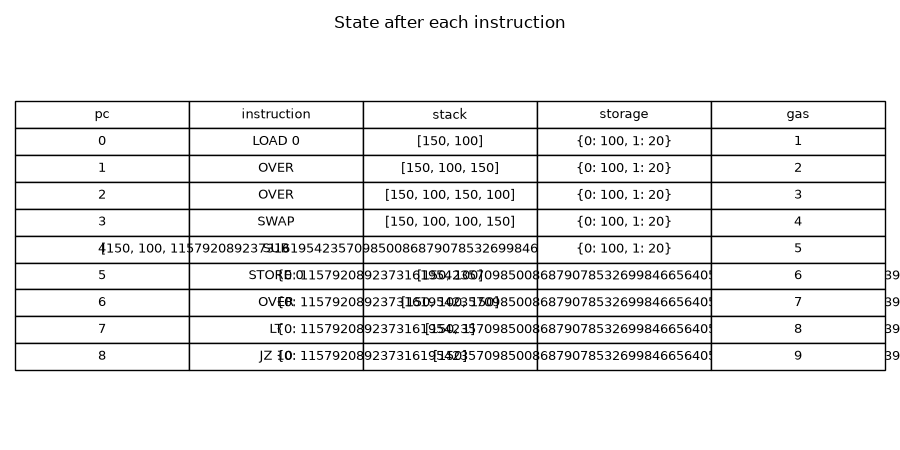
reverted after 9 steps; working storage was {0: 115792089237316195423570985008687907853269984665640564039457584007913129639886, 1: 20}
Exercise#
Move the balance check before the debit. Does the committed outcome change for any amount? What does atomicity let a contract get away with here, and why is the order of checks and effects still crucial once a contract calls out to another one (see the DAO example)?
Total running time of the script: (0 minutes 0.242 seconds)
