
Note
Go to the end to download the full example code or to run this example in your browser via JupyterLite.
Bates: jumps and stochastic volatility#
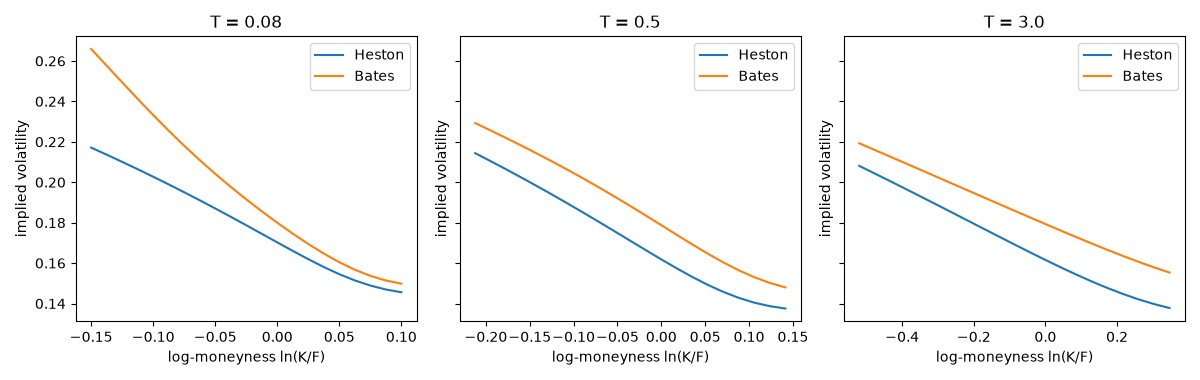
David Bates (1996), studying Deutsche mark options, found that neither jumps nor stochastic volatility alone fit the smile at every maturity. Diffusive stochastic volatility needs time to build up a skew, so Heston’s short-dated smiles are too flat; jumps act at once but their effect washes out with maturity. Putting Merton’s lognormal jumps on top of Heston gives both: the characteristic function is simply the product of the two.
phi_Bates = phi_Heston * phi_jumps: True
import matplotlib.pyplot as plt
import numpy as np

from financialkit.stochastic_volatility import BatesModel, HestonModel, MertonJumpModel
from financialkit.stochastic_volatility.visualizers import plot_smile

S, r = 100.0, 0.02
heston = HestonModel(0.03, 2.0, 0.03, 0.4, -0.6)
bates = BatesModel(0.03, 2.0, 0.03, 0.4, -0.6, lam=0.3, mu_j=-0.12, delta=0.08)

u = np.linspace(-10, 10, 5)
print(
    "phi_Bates = phi_Heston * phi_jumps:",
    np.allclose(bates.char_func(u, 1.0), heston.char_func(u, 1.0) * MertonJumpModel(0.0, 0.3, -0.12, 0.08).char_func(u, 1.0)),
)

fig, axes = plt.subplots(1, 3, figsize=(12, 3.8), sharey=True)
for ax, T in zip(axes, (0.08, 0.5, 3.0), strict=True):
    F = S * np.exp(r * T)
    K = F * np.exp(np.linspace(-0.3, 0.2, 21) * np.sqrt(max(T, 0.25)))
    plot_smile(K, heston.implied_vol(S, K, T, r), forward=F, ax=ax, label="Heston")
    plot_smile(K, bates.implied_vol(S, K, T, r), forward=F, ax=ax, label="Bates")
    ax.set_title(f"T = {T}")
fig.tight_layout()

plt.show()
Total running time of the script: (0 minutes 0.142 seconds)
