
Note
Go to the end to download the full example code or to run this example in your browser via JupyterLite.
Kou’s double-exponential jumps#
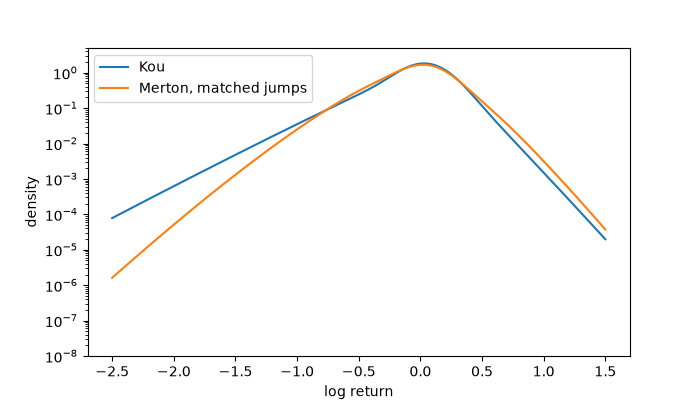
Steven Kou (2002) took the log jump sizes to be exponential, with rate \(\eta_1\) upward (probability \(p\)) and \(\eta_2\) downward. The two exponential tails give the asymmetric, leptokurtic returns seen in data, and because the exponential distribution is memoryless the overshoot over a barrier is again exponential, which makes barrier and lookback options tractable. The tails also cap the moments, \(E[S_T^{s}] < \infty\) only for \(-\eta_2 < s < \eta_1\).
import matplotlib.pyplot as plt
import numpy as np

from financialkit.stochastic_volatility import KouModel, MertonJumpModel, cos_density
from financialkit.stochastic_volatility.visualizers import plot_density

m = KouModel(sigma=0.16, lam=1.0, p=0.4, eta1=10.0, eta2=5.0)
print(f"call S = 100, K = 98, T = 0.5, r = 5%: {m.price(100.0, 98.0, 0.5, 0.05):.5f} (Kou 2002: 9.14732)")

x = m.sample_terminal(0.5, 200_000, rng=0)
pay = np.exp(-0.025) * np.maximum(100 * np.exp(0.025) * np.exp(x) - 98.0, 0.0)
print(f"Monte Carlo: {pay.mean():.4f} +/- {2 * pay.std() / np.sqrt(pay.size):.4f}")
call S = 100, K = 98, T = 0.5, r = 5%: 9.14732 (Kou 2002: 9.14732)
Monte Carlo: 9.1638 +/- 0.0539
Exponential against Gaussian jump tails#
A Merton model with the same jump intensity and the same jump mean and variance has Gaussian jump tails; on a log scale Kou’s tails are straight lines, Merton’s parabolas.
p, e1, e2 = m.p, m.eta1, m.eta2
mean = p / e1 - (1 - p) / e2
var = 2 * p / e1**2 + 2 * (1 - p) / e2**2 - mean**2
merton = MertonJumpModel(0.16, 1.0, mean, np.sqrt(var))
grid = np.linspace(-2.5, 1.5, 400)
fig, ax = plt.subplots(figsize=(7, 4))
plot_density(grid, np.maximum(cos_density(m, grid, 1.0, N=1024), 1e-12), ax=ax, label="Kou", log=True)
plot_density(grid, np.maximum(cos_density(merton, grid, 1.0, N=1024), 1e-12), ax=ax, label="Merton, matched jumps", log=True)
ax.set_ylim(1e-8, 5)

plt.show()
Total running time of the script: (0 minutes 0.073 seconds)
