Note
Go to the end to download the full example code or to run this example in your browser via JupyterLite.
Riemann’s mapping theorem: the upper half-plane mapped conformally onto the disk#
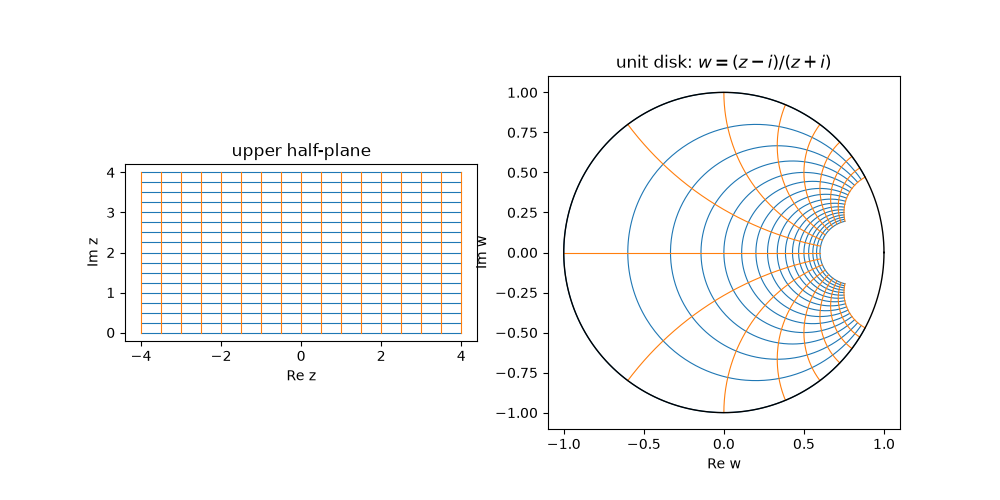
Riemann (1851) asserted that every simply connected proper subdomain of the plane can be mapped conformally onto the unit disk. For the upper half-plane the map is explicit: the Cayley transform \(w = (z - i)/(z + i)\), a Möbius transformation. The image of the Cartesian grid is a family of circles that still meet at right angles, because conformal maps preserve angles.
import numpy as np

from mathematicskit.complex_analysis import cauchy_riemann, map_grid, mobius_transform
from mathematicskit.complex_analysis.visualizers import plot_mapped_grid

cayley = lambda z: mobius_transform(z, 1, -1j, 1, 1j)
The grid and its image#
[<matplotlib.lines.Line2D object at 0x113346510>]
Conformality: holomorphic with nonzero derivative, and angle preserving#
rng = np.random.default_rng(1)
samples = rng.normal(size=5) + 1j * rng.uniform(0.1, 3, size=5)
print("max |w| over upper half-plane samples:", np.max(np.abs(cayley(samples))))
print("max Cauchy-Riemann residual:", max(cauchy_riemann(cayley, z).residual for z in samples))
h = 1e-6
for z in samples[:3]:
    d1, d2 = cayley(z + h) - cayley(z), cayley(z + 1j * h) - cayley(z)
    print(f"z = {z:.2f}: image angle between horizontal and vertical directions = {np.degrees(np.angle(d2 / d1)):.6f} deg")
max |w| over upper half-plane samples: 0.8213572340337841
max Cauchy-Riemann residual: 4.163336342344337e-11
z = 0.35+1.33j: image angle between horizontal and vertical directions = 89.999972 deg
z = 0.82+2.50j: image angle between horizontal and vertical directions = 89.999981 deg
z = 0.33+1.29j: image angle between horizontal and vertical directions = 89.999972 deg
Total running time of the script: (0 minutes 0.049 seconds)
