Examples#
This gallery walks through every public feature of mathematicskit.pde:
Fourier’s series solution of the heat equation, Crank-Nicolson and the
theta-method family, the method of lines in 2D, d’Alembert’s traveling
waves, Poisson’s and Laplace’s equations with direct and relaxation
solvers, the Courant-Friedrichs-Lewy condition, von Neumann stability
analysis, the Lax equivalence theorem, finite elements, multigrid,
Godunov’s method for shocks, the Hopf-Cole transformation, and Fourier
and Chebyshev spectral methods.
Each script in this gallery is self-contained and can be run directly with
python examples/pde/<section>/<script>.py.
Sections#
heat – Fourier’s sine-series solution, Crank-Nicolson against explicit FTCS and backward Euler, and the method of lines on a 2D plate.
wave – d’Alembert’s traveling-wave solution against a leapfrog finite-difference string.
advection – the Courant-Isaacson-Rees upwind, Lax-Friedrichs, and Lax-Wendroff schemes for linear advection.
conservation_laws – shocks in inviscid Burgers’ equation and Godunov’s method.
elliptic – Poisson’s equation on a square, Richardson-style relaxation (Jacobi, Gauss-Seidel, SOR) for Laplace’s equation, finite elements, and multigrid.
stability – the CFL condition for advection schemes, von Neumann amplification factors, and the Lax equivalence theorem.
spectral – Fourier pseudo-spectral Burgers’ equation, Chebyshev collocation for boundary-value problems, and the Hopf-Cole exact solution of viscous Burgers’ equation.
Advection schemes#
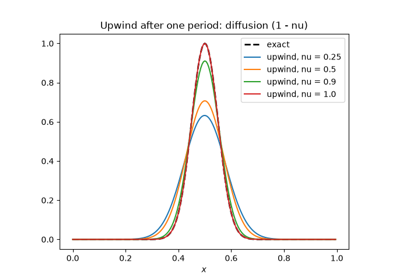
Upwind, Lax-Friedrichs, and Lax-Wendroff schemes for linear advection.
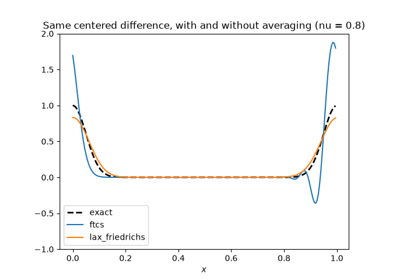
The Lax-Friedrichs scheme: stabilizing centered differences
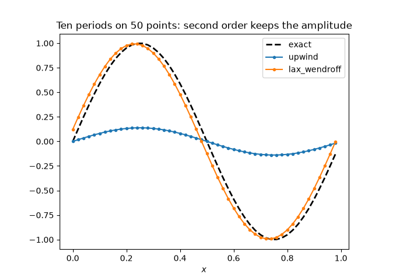
The Lax-Wendroff scheme: second order, and dispersive wiggles
Conservation laws and shocks#
Inviscid Burgers’ equation: shocks, rarefactions, and Godunov’s finite-volume method against oscillating second-order schemes.
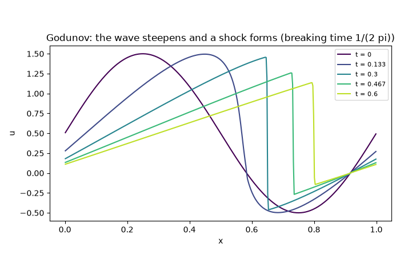
Godunov’s method: capturing shocks without oscillations
Poisson and Laplace equations#
Steady boundary-value problems: a sparse direct Poisson solve, the relaxation iterations that preceded it, finite elements, and multigrid.
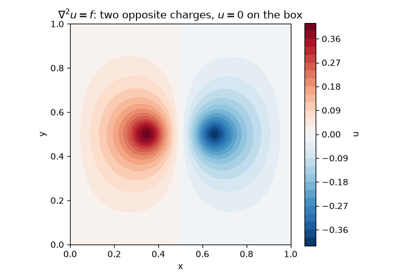
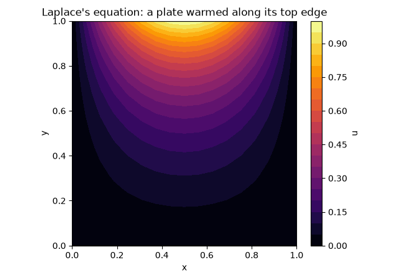
Richardson’s relaxation: iterating toward Laplace’s solution
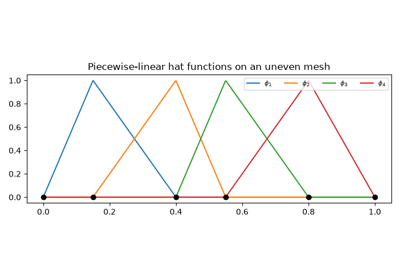
Finite elements: Galerkin’s hat functions on an uneven mesh
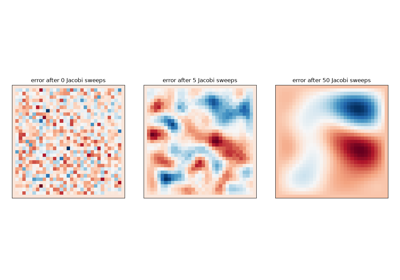
Multigrid: a solver whose cost does not grow with the grid
The heat equation#
Fourier’s series solution, the theta-method family (FTCS, Crank-Nicolson, backward Euler), and the method of lines on a 2D plate. An animation shows the fast Fourier modes dying first.
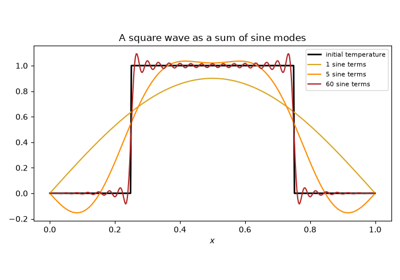
Fourier’s heat equation: a sine series whose modes decay
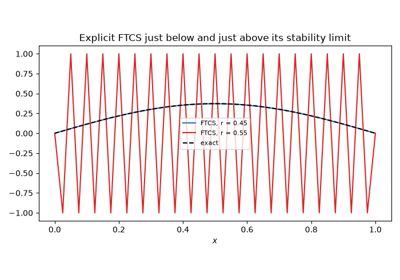
Crank-Nicolson: large, stable, second-order heat steps
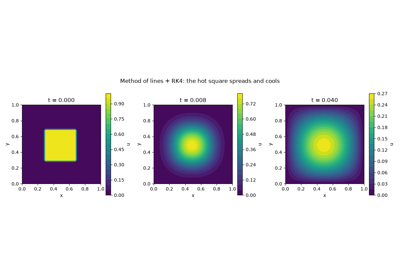
The method of lines: a hot plate as a system of ODEs
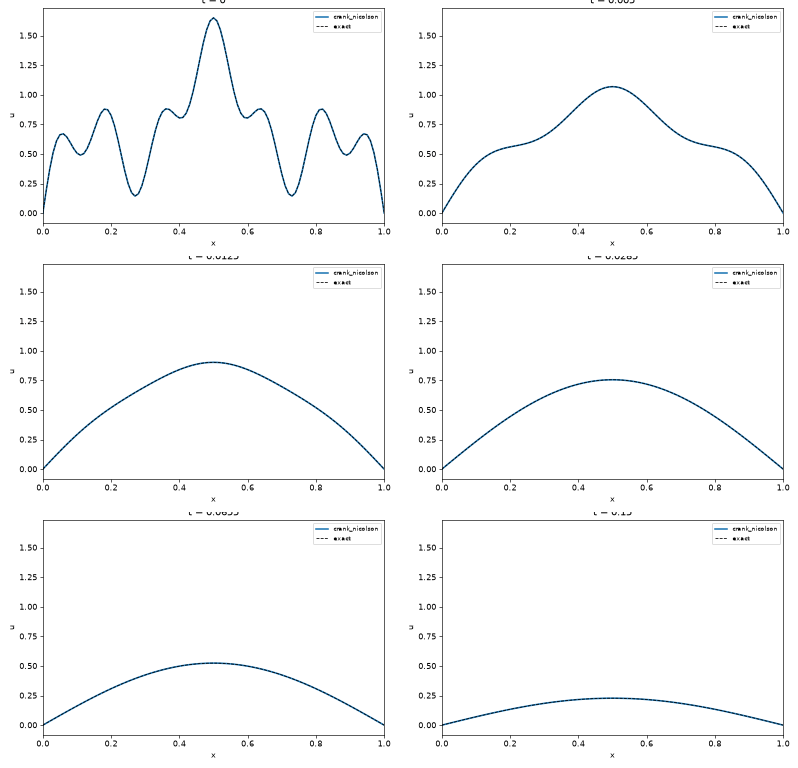
Animated: the heat equation smoothing a rough initial profile
Spectral methods#
Fourier pseudo-spectral time stepping for periodic problems, and Chebyshev collocation for boundary-value problems, checked against the Hopf-Cole exact solution of viscous Burgers’ equation.
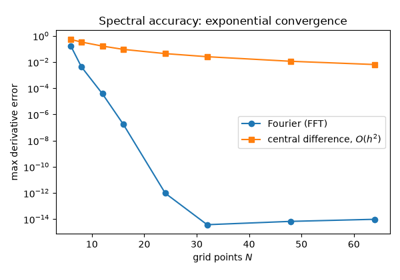
Fourier pseudo-spectral methods: Burgers’ equation
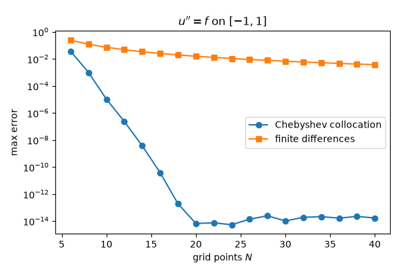
Chebyshev collocation: spectral accuracy without periodicity
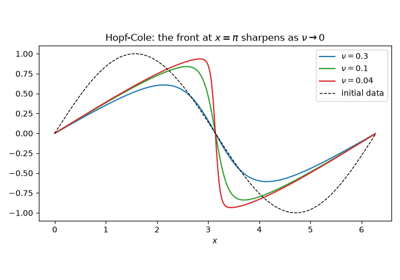
Burgers’ equation and the Hopf-Cole transformation
Stability: CFL and von Neumann#
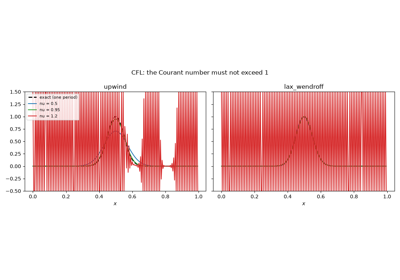
Why explicit schemes need small time steps: the Courant-Friedrichs-Lewy condition, von Neumann’s Fourier-mode analysis, and the Lax equivalence theorem.
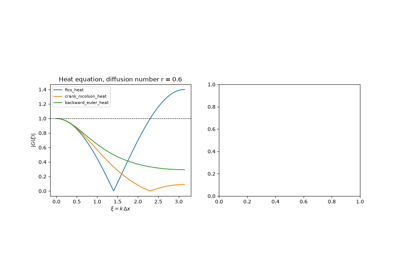
Von Neumann stability analysis: one Fourier mode at a time
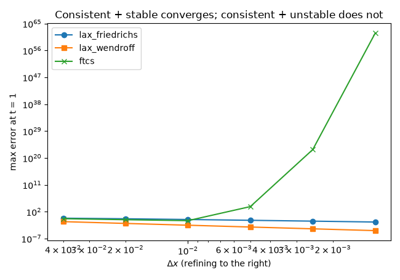
The Lax equivalence theorem: consistency + stability = convergence
The wave equation#
A plucked string: d’Alembert’s traveling-wave solution against a symplectic leapfrog finite-difference solve. An animation follows the string through one full period.
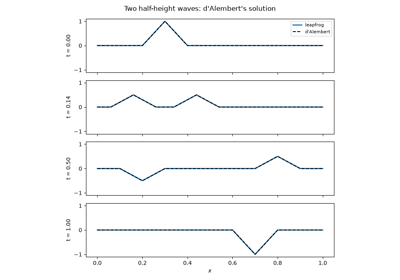
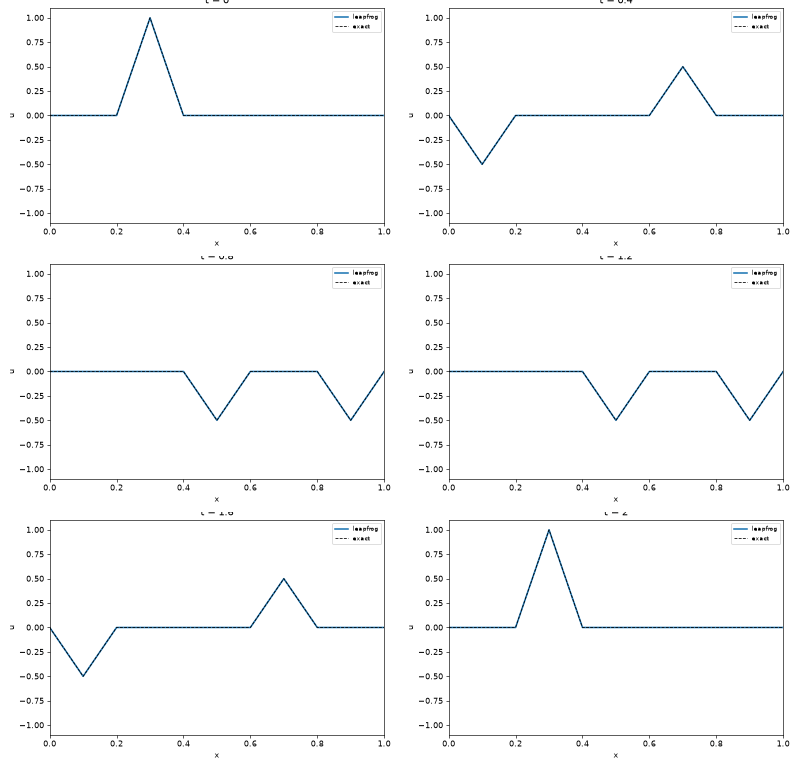
Animated: a plucked string splitting, reflecting, and recombining