Ctrl+K
mathematicskit logo mathematicskit logo
  • Subpackages
  • History
  • Examples
  • API
  • GitHub
  • PyPI
  • Subpackages
  • History
  • Examples
  • API
  • GitHub
  • PyPI

Section Navigation

  • mathematicskit.abstract_algebra
    • Group actions
    • Error-correcting codes
    • Finite fields
    • Groups
    • Homomorphisms
    • Polynomial ring arithmetic
    • Group structure
    • Subgroups and cosets
  • mathematicskit.calculus
    • Reverse-mode autodiff
    • Dual numbers
    • Method of exhaustion
    • Finite differences
    • Newton and Leibniz
    • Quadrature
    • Taylor series
  • mathematicskit.combinatorics
    • Counting
    • Combinatorial designs
    • Extremal combinatorics
    • Inclusion-exclusion
    • Matchings
    • Necklaces
    • Integer partitions
    • Pascal’s triangle
    • Integer sequences
    • Special numbers
    • Labeled trees
  • mathematicskit.fractals_chaos
    • Box-counting dimension
    • Cellular automata
    • Fractal curves
    • Aggregation
    • Iterated function systems
    • Lindenmayer systems
    • Lyapunov exponents
    • Mandelbrot and Julia sets
    • Discrete maps
  • mathematicskit.geometry
    • Bézier curves
    • Convex hull
    • Curves and the Frenet-Serret frame
    • Distances between shapes
    • Enclosing circles
    • Point-in-polygon
    • Polygon area
    • Polyhedra
    • Proximity
    • Line simplification
    • Surfaces
    • Voronoi diagrams and Delaunay triangulation
  • mathematicskit.graph_theory
    • Assignment
    • Graph coloring
    • Connected components
    • Eulerian paths
    • Extremal graph theory
    • Hamiltonian cycles
    • Bipartite matching
    • Maximum flow
    • Ranking
    • Heuristic search
    • Shortest paths
    • Minimum spanning tree
    • Spectral graph theory
  • mathematicskit.linalg
    • Cholesky decomposition
    • Classical matrix theory
    • Eigenvalue algorithms
    • Iterative solvers
    • LU decomposition
    • QR decomposition
    • Numerical stability
    • Singular value decomposition
  • mathematicskit.number_theory
    • Continued fractions
    • Chinese Remainder Theorem
    • Diophantine equations
    • Integer factorization
    • Modular arithmetic
    • Primality
    • Distribution of primes
    • Quadratic residues
    • Sums of squares
    • Multiplicative functions
    • The zeta function
  • mathematicskit.numerical_analysis
    • Function approximation
    • Runge’s phenomenon and Chebyshev nodes
    • Floating-point arithmetic
    • Interpolation
    • Polynomials
    • Least-squares regression
    • Root finding
    • Cubic splines
  • mathematicskit.ode_dynamics
    • Bifurcation normal forms
    • Chaotic flows
    • Epidemic models
    • Excitable systems
    • Limit cycles
    • The logistic map
    • Phase portraits
    • Poincare sections
    • Population models
    • Fixed-point stability
    • Synchronization
  • mathematicskit.optimization
    • Nonlinear conjugate gradient
    • Constrained optimization
    • Direct search
    • Dynamic programming
    • Game theory
    • Gradient descent
    • Nonlinear least squares
    • Linear programming
    • Momentum methods
    • Newton’s method and BFGS
    • One-dimensional search
    • Stochastic approximation
    • Benchmark functions
  • mathematicskit.probability
    • Kolmogorov’s axioms
    • Bayesian inference
    • Branching processes
    • Classical problems
    • Continuous distributions
    • Discrete distributions
    • Limit theorems and inequalities
    • Markov chains
    • Monte Carlo integration
    • Queueing theory
    • Random walks and Brownian motion
  • mathematicskit.special_functions
    • Airy functions
    • Bessel functions
    • Elliptic functions
    • Error function and Fresnel integrals
    • Discrete Fourier transform
    • Gamma and beta functions
    • Hypergeometric functions
    • Lambert W function
    • Mathieu functions
    • Orthogonal polynomials
    • Riemann zeta function
  • mathematicskit.statistics
    • Bootstrap resampling
    • Confidence intervals
    • Correlation
    • Descriptive statistics
    • Hypothesis tests
    • Likelihood
    • Multiple testing
    • Nonparametric tests
    • Linear regression
    • Shrinkage estimation
  • Examples
  • Examples
  • Integer sequences

Integer sequences#

Fibonacci numbers, Bernoulli numbers and sums of powers, and Gray codes.

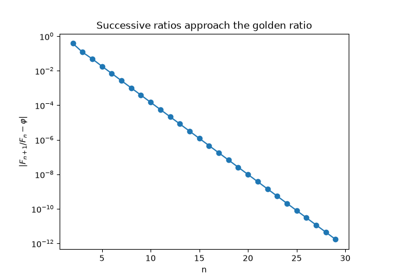
Fibonacci’s rabbits and domino tilings

Fibonacci's rabbits and domino tilings

Jacob Bernoulli’s numbers and sums of powers

Jacob Bernoulli's numbers and sums of powers

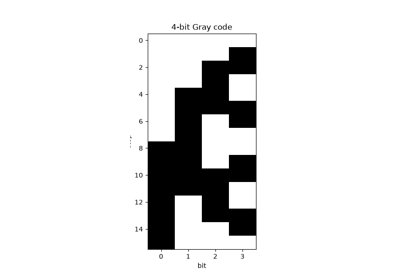
Gray codes: counting one bit at a time

Gray codes: counting one bit at a time
previous

Pascal’s triangle vs. scipy-computed binomial coefficients

next

Fibonacci’s rabbits and domino tilings

Show Source

© Copyright 2026, mathematicskit contributors.

Created using Sphinx 9.1.0.

Built with the PyData Sphinx Theme 0.21.0.