
Note
Go to the end to download the full example code or to run this example in your browser via JupyterLite.
Pascal’s triangle vs. scipy-computed binomial coefficients#
Builds Pascal’s triangle by hand via the addition recurrence and
confirms every entry matches scipy.special.comb.
from mathematicskit.combinatorics import combinations_count, pascals_triangle
from mathematicskit.combinatorics.visualizers.plots import plot_pascals_triangle
Build and cross-check#
n=0: [1]
n=1: [1, 1]
n=2: [1, 2, 1]
n=3: [1, 3, 3, 1]
n=4: [1, 4, 6, 4, 1]
n=5: [1, 5, 10, 10, 5, 1]
n=6: [1, 6, 15, 20, 15, 6, 1]
n=7: [1, 7, 21, 35, 35, 21, 7, 1]
n=8: [1, 8, 28, 56, 70, 56, 28, 8, 1]
n=9: [1, 9, 36, 84, 126, 126, 84, 36, 9, 1]

every entry matches scipy.special.comb
Visualize#
plot_pascals_triangle(triangle)
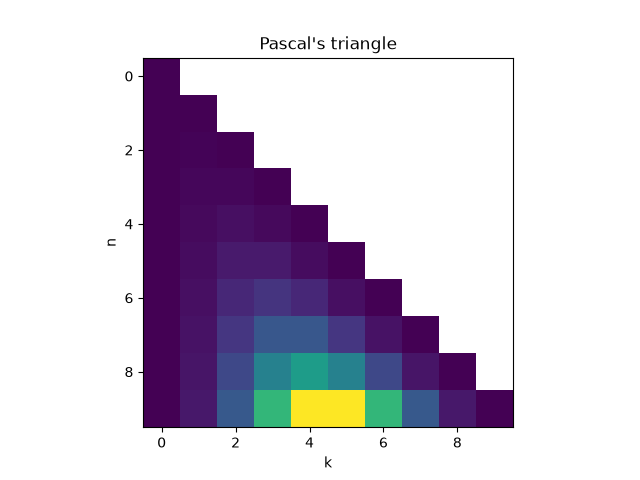
<Axes: title={'center': "Pascal's triangle"}, xlabel='k', ylabel='n'>
Total running time of the script: (0 minutes 0.017 seconds)
