Note
Go to the end to download the full example code or to run this example in your browser via JupyterLite.
Wessel and Argand’s complex plane: multiplication rotates and scales#
Caspar Wessel (1797) and Jean-Robert Argand (1806) drew \(a + bi\) as the point \((a, b)\). Addition is then vector addition, and multiplication by \(w = re^{i\varphi}\) rotates every point by \(\varphi\) and scales it by \(r\). Multiplying by \(i\) is a quarter turn, so \(i^2 = -1\) is a half turn.
import matplotlib.pyplot as plt
import numpy as np

from mathematicskit.complex_analysis import map_grid
from mathematicskit.complex_analysis.visualizers import plot_mapped_grid
Powers of i: four quarter turns#
fig, ax = plt.subplots(figsize=(5, 5))
z = 1.0 + 0.0j
for k in range(4):
    ax.annotate("", xy=(z.real, z.imag), xytext=(0, 0), arrowprops={"arrowstyle": "->", "lw": 2})
    ax.text(1.12 * z.real - 0.05, 1.12 * z.imag - 0.05, f"$i^{k}$")
    z *= 1j
theta = np.linspace(0, 2 * np.pi, 200)
ax.plot(np.cos(theta), np.sin(theta), "k:", lw=0.8)
ax.set_xlim(-1.4, 1.4)
ax.set_ylim(-1.4, 1.4)
ax.set_aspect("equal")
ax.set_title("Multiplying by i is a quarter turn")
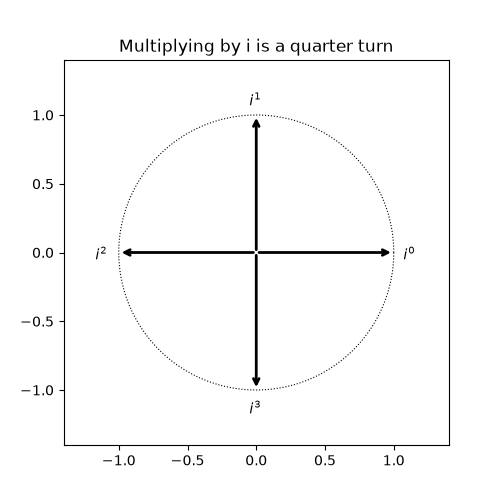
Text(0.5, 1.0, 'Multiplying by i is a quarter turn')
Multiplication by w = 1 + i: rotate 45 degrees, scale by sqrt 2#
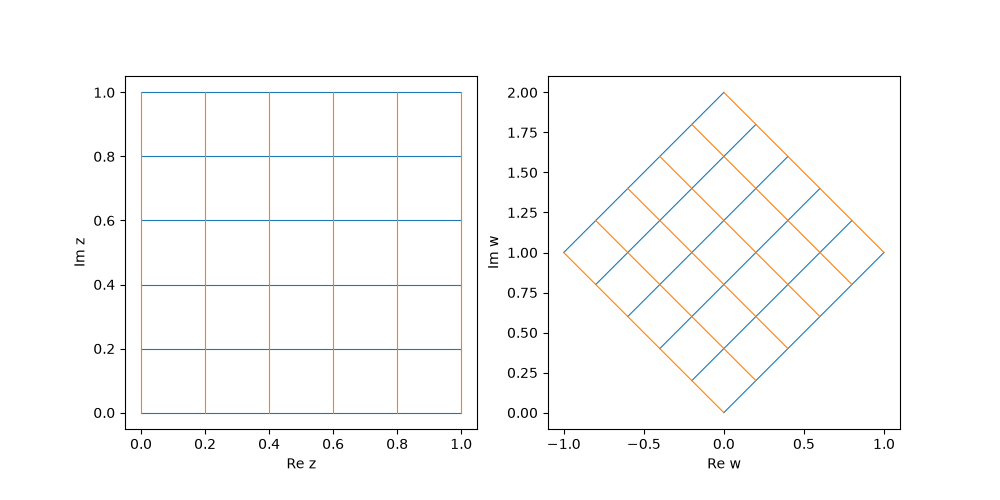
|w| = 1.414214, arg w = 45.0 degrees

array([<Axes: xlabel='Re z', ylabel='Im z'>,
       <Axes: xlabel='Re w', ylabel='Im w'>], dtype=object)
Moduli multiply, arguments add#
|z1 z2| = 3.000000  vs  |z1||z2| = 3.000000
arg(z1 z2) = 1.400000  vs  arg z1 + arg z2 = 1.400000
Total running time of the script: (0 minutes 0.057 seconds)
