Note
Go to the end to download the full example code or to run this example in your browser via JupyterLite.
Nakamoto consensus: a payment, a fork, and a reorganization (2008)#
This is the full teaching chain: keys authorize a transfer, a Merkle root commits to it, proof of work secures a header, and peers compare valid forks. The example uses an account ledger, not Bitcoin’s UTXO model.
What to look for#
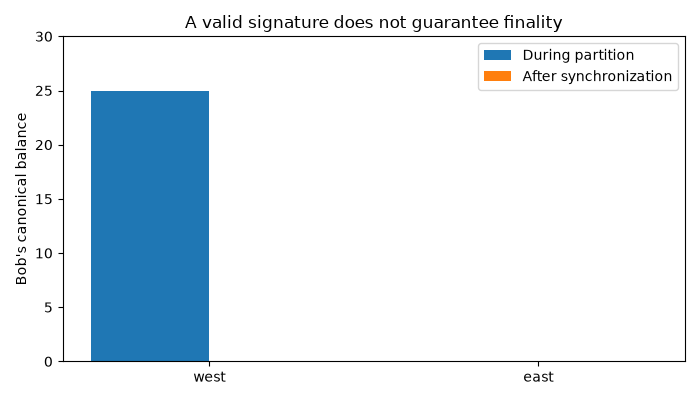
Follow Alice and Bob’s balances after a payment, then after a competing branch wins. The old payment’s signature can still verify even though its effect disappears from the selected ledger.
Read cells in order. An assert that produces no output has passed.
The final exercise asks you to change an input and explain the result.
The history behind this experiment: Breakthroughs in Consensus. See Exercises: ledgers and data structures for a worked solution to the exercise.
import matplotlib.pyplot as plt

import blockchainkit as bk

alice_private, bob_private = 7, 11
alice = bk.structures.address(bk.crypto.public_key(alice_private))
bob = bk.structures.address(bk.crypto.public_key(bob_private))
initial = bk.structures.Ledger({alice: 100})
genesis = bk.consensus.mine(bk.structures.Block(difficulty=5)).block
peers = {name: bk.structures.Blockchain(genesis, initial) for name in ("west", "east")}
transaction = bk.structures.Transaction(bk.crypto.public_key(alice_private), bob, 25, 0).signed(
    alice_private, signing_nonce=17
)
payment_block = bk.consensus.mine(bk.structures.Block(genesis.hash, (transaction,), 1, 1, 5)).block
Two partitions extend the same genesis independently#
Transport sends hash announcements; this in-memory registry supplies the corresponding immutable block objects. It is not a wire serialization layer.
alternate = bk.consensus.mine(bk.structures.Block(genesis.hash, (), 1, 2, 5)).block
extension = bk.consensus.mine(bk.structures.Block(alternate.hash, (), 2, 3, 5)).block
registry = {block.hash: block for block in (payment_block, alternate, extension)}


def receive(delivery):
    peers[delivery.recipient].add(registry[delivery.payload])


network = bk.network.SimulatedNetwork(peers, on_receive=receive)
network.broadcast("west", payment_block.hash)
network.broadcast("east", alternate.hash)
network.broadcast("east", extension.hash)
before = [peers[name].state.balances.get(bob, 0) for name in peers]
assert before == [25, 0]
Reconnect and synchronize parent before child#
network.connect("west", "east")
network.broadcast("west", payment_block.hash)
network.broadcast("east", alternate.hash)
network.run()
network.broadcast("east", extension.hash)
network.run()
assert peers["west"].tip == peers["east"].tip == extension
after = [peers[name].state.balances.get(bob, 0) for name in peers]
assert after == [0, 0]
assert peers["west"].state.nonces.get(alice, 0) == 0
print("Both peers chose the higher-work fork. Alice's payment is no longer confirmed.")
Both peers chose the higher-work fork. Alice's payment is no longer confirmed.
Inclusion remains true for the discarded block#
tree = bk.structures.MerkleTree(tx.to_bytes() for tx in payment_block.transactions)
assert bk.structures.verify_proof(transaction.to_bytes(), tree.proof(0), payment_block.merkle_root)
print("The payment still has an inclusion proof in its original side-fork block.")
The payment still has an inclusion proof in its original side-fork block.
fig, ax = plt.subplots(figsize=(7, 4))
xs = [0, 1]
ax.bar([x - 0.18 for x in xs], before, 0.36, label="During partition")
ax.bar([x + 0.18 for x in xs], after, 0.36, label="After synchronization")
ax.set(
    xticks=xs,
    xticklabels=list(peers),
    ylabel="Bob's canonical balance",
    title="A valid signature does not guarantee finality",
    ylim=(0, 30),
)
ax.legend()
fig.tight_layout()
Exercise#
Reinclude the payment on the winning fork, then attempt to replay it. Check that its first inclusion succeeds and its second fails on the account nonce. Change the chain ID and explain why the existing signature no longer works.
Total running time of the script: (0 minutes 0.160 seconds)
