Note
Go to the end to download the full example code or to run this example in your browser via JupyterLite.
GHOST: follow the heaviest subtree (Sompolinsky and Zohar 2013)#
When blocks are fast relative to network delay, honest miners often extend the same parent at once, and the longest chain discards their side blocks. That wasted work no longer protects the chain. GHOST (Greedy Heaviest Observed SubTree) counts it: at each fork, follow the child whose whole subtree carries the most work.
What to look for#
A single long branch wins the longest-chain rule, while a shorter but bushier branch, with more honest work behind it, wins under GHOST. Ethereum’s proof-of-work chain used a GHOST variant, with uncle rewards.
The history behind this experiment: Breakthroughs in Consensus.
Build a fork#
import blockchainkit as bk
from blockchainkit.structures.visualizers import plot_block_tree

genesis = bk.consensus.mine(bk.structures.Block(difficulty=3)).block
chain = bk.structures.Blockchain(genesis)


def extend(parent, timestamp):
    block = bk.structures.Block(
        parent.hash, height=parent.height + 1, timestamp=timestamp, difficulty=3
    )
    block = bk.consensus.mine(block).block
    chain.add(block)
    return block


a = extend(genesis, 1)
a = extend(a, 2)
a = extend(a, 3)  # Branch A: three blocks in a row.
b = extend(genesis, 4)
b_children = [extend(b, 10 + i) for i in range(3)]  # Branch B: one block, three children.
Two fork-choice rules, two answers#
ghost = bk.consensus.ghost_tip(chain)
assert chain.tip == a and ghost in b_children
print("longest chain picks height", chain.tip.height, "; GHOST picks height", ghost.height)
work_a = bk.consensus.subtree_work(
    chain, chain.blocks[chain.blocks[a.previous_hash].previous_hash].hash
)
work_b = bk.consensus.subtree_work(chain, b.hash)
print(f"subtree work: branch A {work_a}, branch B {work_b}")

ax = plot_block_tree(chain)
ax.set_title("Longest chain (blue) versus GHOST's heaviest subtree (branch B)")
ax.figure.tight_layout()
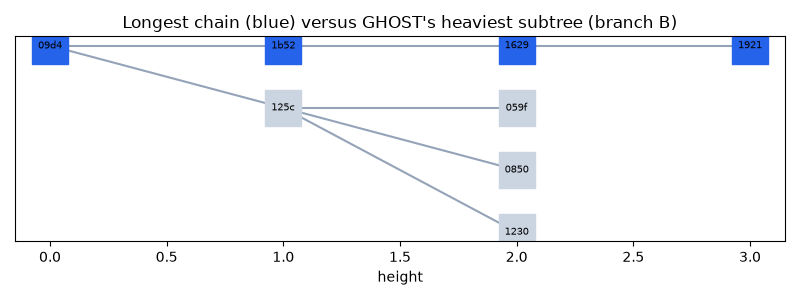
longest chain picks height 3 ; GHOST picks height 2
subtree work: branch A 24, branch B 32
Exercise#
With a 12-second block time, a large share of Ethereum’s blocks were uncles. Why would the longest-chain rule have let an attacker with less than half the hashrate win more often?
Total running time of the script: (0 minutes 0.123 seconds)
