Note
Go to the end to download the full example code or to run this example in your browser via JupyterLite.
Elliptic-curve cryptography: a finite group you can draw (Miller and Koblitz 1985)#
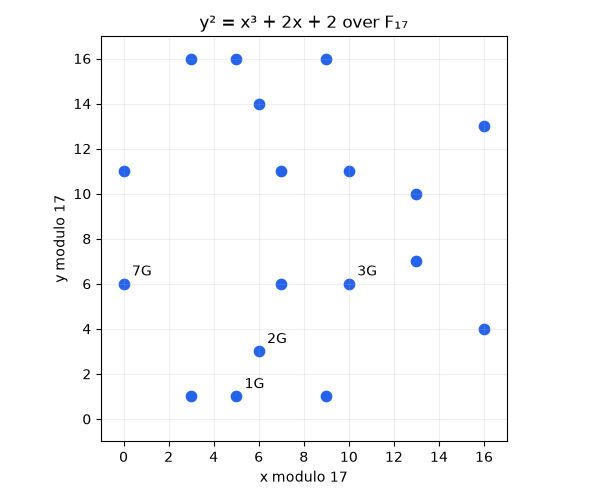
Replace modular exponentiation with repeated addition of curve points. The public key Q=xG is easy to compute; recovering x is the discrete-log problem. Our 19-element example is small enough to solve exhaustively.
What to look for#
Follow repeated addition around a tiny set of points. Exhaustive search recovers the private step count here because this example is deliberately small.
Read cells in order. An assert that produces no output has passed.
The final exercise asks you to change an input and explain the result.
The history behind this experiment: Breakthroughs in Cryptography. See Exercises: cryptography for a worked solution to the exercise.
import matplotlib.pyplot as plt

import blockchainkit as bk

curve = bk.crypto.TOY_CURVE
points = [(x, y) for x in range(curve.p) for y in range(curve.p) if curve.contains((x, y))]
assert len(points) + 1 == curve.order  # Include infinity.
assert bk.crypto.multiply(curve.order, curve.generator, curve) is None
public = bk.crypto.public_key(7, curve)
recovered = next(k for k in range(1, curve.order) if bk.crypto.public_key(k, curve) == public)
assert recovered == 7
print("Public key:", public, "; recovered tiny private key:", recovered)
Public key: (0, 6) ; recovered tiny private key: 7
fig, ax = plt.subplots(figsize=(6, 5))
ax.scatter(*zip(*points, strict=True), color="#2563eb", s=55)
for k in (1, 2, 3, 7):
    x, y = bk.crypto.public_key(k, curve)
    ax.annotate(f"{k}G", (x, y), xytext=(6, 6), textcoords="offset points")
ax.set(
    xlabel="x modulo 17",
    ylabel="y modulo 17",
    title="y² = x³ + 2x + 2 over F₁₇",
    xlim=(-1, 17),
    ylim=(-1, 17),
)
ax.set_aspect("equal")
ax.grid(alpha=0.2)
fig.tight_layout()
Larger parameters, same API#
large_public = bk.crypto.public_key(7)  # secp256k1 by default.
assert bk.crypto.SECP256K1.contains(large_public)
print("secp256k1 public point:", bk.crypto.encode_point(large_public).hex())
secp256k1 public point: 045cbdf0646e5db4eaa398f365f2ea7a0e3d419b7e0330e39ce92bddedcac4f9bc6aebca40ba255960a3178d6d861a54dba813d0b813fde7b5a5082628087264da
Exercise#
Verify G + (-G) = infinity and (a+b)G = aG+bG. Explain why the plot consists of isolated points rather than a smooth curve. Inspect double-and-add and identify where its control flow depends on private scalar bits.
Total running time of the script: (0 minutes 0.159 seconds)
