Breakthroughs in Cryptography#
Every later idea on these pages rests on cryptography: a way to agree on a
secret in public, to prove who authorized a message, and to commit to data
without revealing it. This chronology traces the ideas behind
blockchainkit.crypto, from the one-time pad to Schnorr multi-signatures.
Each entry has its own experiment in the gallery.
All snippets use the package’s conventional import: import blockchainkit as bk.
1917–1949 — The one-time pad and perfect secrecy#
In plain language. Add a random key, as long as the message, to the message itself. Without the key, every possible message of that length is equally believable. This is the only cipher proven unbreakable, and it is impractical for exactly the reason that makes it work: the key is as long as everything you send.
Reading the experiment. XOR (exclusive or) adds bits without carrying; doing it twice with the same key returns the original. For one ciphertext the experiment finds a different key for each candidate message, then reuses a key and shows the pad cancelling out.
Gilbert Vernam built a teleprinter in 1917 that combined each character of the message with a character of a key tape. Joseph Mauborgne added the rule that the tape must be random and never reused. Claude Shannon’s 1949 information theory of secrecy proved the result: with a uniformly random key at least as long as the message, used once, the ciphertext is statistically independent of the plaintext.
Reusing the key leaks \(c_1 \oplus c_2 = m_1 \oplus m_2\). Soviet reuse of one-time pads let the US Venona project read thousands of messages. Shannon’s theorem also says every perfectly secret cipher needs this much key: the key distribution problem that public-key cryptography would solve.
Implementation: blockchainkit.crypto.systems.one_time_pad.one_time_pad()
refuses a key of the wrong length; blockchainkit.crypto.systems.one_time_pad.xor_bytes()
is the underlying operation.
Experiment: the gallery example shows that one ciphertext fits every plaintext, that ciphertext bytes are uniform, and how a reused pad leaks.
References: G. S. Vernam, Cipher Printing Telegraph Systems for Secret Wire and Radio Telegraphic Communications, Journal of the American Institute of Electrical Engineers 45, 109–115 (1926). C. E. Shannon, Communication Theory of Secrecy Systems, Bell System Technical Journal 28(4), 656–715 (1949). DOI.
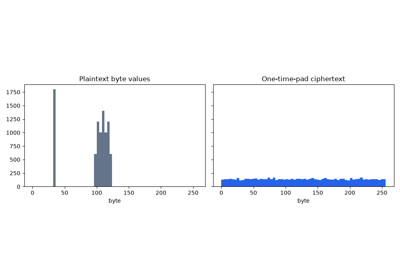
The one-time pad and perfect secrecy (Vernam 1917, Shannon 1949)
1971 — Baby-step giant-step: square-root discrete logs#
In plain language. Finding the secret exponent behind a public key by trying every possibility takes as many steps as the group has elements. A clever trade of memory for time needs only about the square root of that.
Reading the experiment. n is the group order. The algorithm stores m ≈ √n “baby steps” and then takes up to m “giant steps”; the plot compares its work with 2√n and with n.
Daniel Shanks described the method while studying class numbers of quadratic fields. Write the unknown exponent as \(x = im + j\) with \(m = \lceil\sqrt n\,\rceil\). Store \(g^j\) for every \(j < m\), then compute \(h\,g^{-im}\) for \(i = 0, 1, \dots\) until it appears in the table:
Generic algorithms cannot do fundamentally better: Shoup later proved that any algorithm that only uses the group operations needs about \(\sqrt n\) steps. That is why a 256-bit elliptic-curve group gives about 128-bit security.
Implementation: blockchainkit.crypto.systems.discrete_log.baby_step_giant_step()
returns the exponent and the number of table multiplications.
Experiment: the gallery example measures the work across safe-prime groups and compares it with \(2\sqrt n\).
References: D. Shanks, Class Number, a Theory of Factorization, and Genera, Proceedings of Symposia in Pure Mathematics 20, American Mathematical Society, 415–440 (1971).
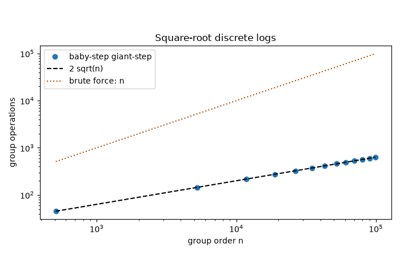
Baby-step giant-step: square-root discrete logs (Shanks 1971)
1974–1978 — Merkle’s puzzles: key agreement in public#
In plain language. Alice publishes many small locked boxes, each holding a key. Bob picks one at random and spends a little effort to open it, then tells Alice which one he opened. An eavesdropper does not know which box Bob chose and must open many of them.
Reading the experiment. Each puzzle hides an identifier and a session key under a weak key of a few bits. Bob’s work is one puzzle; the eavesdropper’s work grows with the number of puzzles.
As an undergraduate in 1974, Ralph Merkle proposed the first scheme for two parties to agree on a secret over a public channel. The idea was hard to publish: his paper appeared in 1978, after Diffie and Hellman’s. With \(N\) puzzles of difficulty \(N\), Alice and Bob each work about \(N\), while an eavesdropper needs about \(N^2/2\):
The gap is only quadratic, so it is not practical security; Diffie and Hellman’s exponential gap replaced it. But the puzzles showed public key exchange was possible at all, and the same quadratic barrier was later shown to be the best any scheme built only from a random function can achieve.
Implementation: blockchainkit.crypto.systems.puzzles.merkle_puzzles()
creates the puzzles and Alice’s table; blockchainkit.crypto.systems.puzzles.solve_puzzle()
opens one by brute force.
Experiment: the gallery example runs an exchange, plays the eavesdropper, and plots honest work against attack work.
References: R. C. Merkle, Secure Communications over Insecure Channels, Communications of the ACM 21(4), 294–299 (1978). DOI.
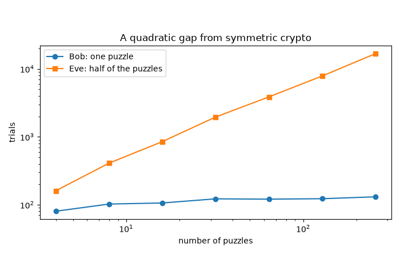
Merkle’s puzzles: the first public-key exchange (1974-1978)
1976 — Agreeing on a secret over a public channel#
In plain language. Two people publicly exchange specially calculated numbers, then each uses their own secret to arrive at the same value. An eavesdropper sees the exchange but should find the secret difficult to recover. This alone does not identify who is at the other end.
Reading the experiment. Here a and b are private numbers; A and B are the public results. The shared settings are g and a prime p. “mod p” means keep the remainder after dividing by p. The example returns True because both calculations agree.
Sharing an encryption key used to require a secret channel in advance. Diffie and Hellman’s public-key framework changed the question: could two people perform different private computations that reach the same secret from publicly exchanged information? Their construction uses exponentiation in a finite group.
An observer sees \(g,p,A,B\), but recovering a private exponent requires solving a discrete logarithm in the chosen group. The shared element still needs a key derivation function before use as an encryption key.
Implementation: blockchainkit.crypto.systems.asymmetric.DHGroup validates
the prime-order subgroup and peer elements.
Teaching vs production
Diffie-Hellman here runs in a 62-bit teaching group with no authentication. Deployments use 2048-bit groups or X25519, and authenticate the exchange to stop a man in the middle. See Exact conventions and model boundaries for this package’s exact conventions.
>>> group = bk.crypto.DHGroup()
>>> group.shared(group.public(7), 3) == group.shared(group.public(3), 7)
True
Experiment: Diffie-Hellman: agreeing on a secret over a public channel (1976) includes a key-substitution attack. Agreement on a secret is not authentication of the other person.
References: W. Diffie and M. E. Hellman, New Directions in Cryptography, IEEE Transactions on Information Theory 22(6), 644–654 (1976). DOI; author’s copy.
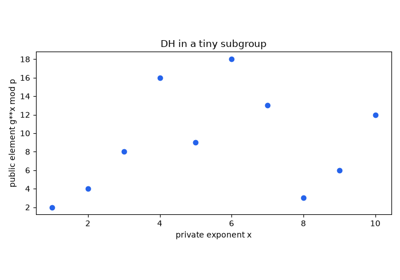
Diffie-Hellman: agreeing on a secret over a public channel (1976)
1978 — RSA and the public trapdoor#
In plain language. RSA separates a public operation from a private operation that reverses it. Think of a publicly usable lock with a private unlocking key, while remembering that the bare arithmetic here needs additional protections for practical use.
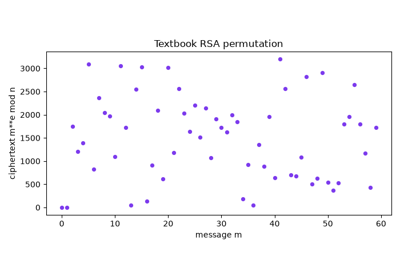
Reading the experiment. The message m becomes ciphertext c. The public key uses n and e; the private operation uses d. The example turns 65 into 2790 and then back into 65. The primes p and q are used to construct the keys.
Rivest, Shamir, and Adleman gave a concrete public-key construction based on modular exponentiation with a composite modulus. Choose distinct primes \(p,q\), publish \(n=pq\) and an exponent \(e\), and retain the inverse exponent \(d\).
Implementation: blockchainkit.crypto.systems.asymmetric.rsa_keypair()
exposes the arithmetic, including the familiar \(61\times53\) example.
The code accepts only small factors for inspectable experiments.
Teaching vs production
This is textbook RSA with tiny primes and no padding. Real RSA uses moduli of 2048 bits or more with OAEP (encryption) or PSS (signatures) padding; unpadded RSA is deterministic and malleable. See Exact conventions and model boundaries for this package’s exact conventions.
>>> key = bk.crypto.rsa_keypair()
>>> key.encrypt(65), key.decrypt(2790)
(2790, 65)
Experiment: RSA: a public trapdoor (Rivest, Shamir and Adleman 1978) demonstrates multiplicative malleability: altering a ciphertext can predictably alter its plaintext. Textbook RSA is deterministic and unpadded; this package does not present it as a secure encryption or signature interface. Public-key cryptography needs a complete encoding and protocol, not just an impressive formula.
References: R. L. Rivest, A. Shamir, and L. Adleman, A Method for Obtaining Digital Signatures and Public-Key Cryptosystems, Communications of the ACM 21(2), 120–126 (1978). DOI.
RSA: a public trapdoor (Rivest, Shamir and Adleman 1978)
1978 — Pohlig–Hellman: why the group order needs a large prime factor#
In plain language. A discrete-log problem in a big group can secretly be many small problems glued together. If the group’s size factors into small primes, each small problem is easy, and so is the whole.
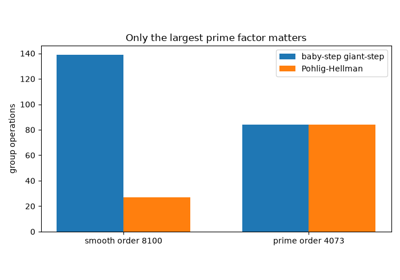
Reading the experiment. The order of a group is how many elements it has. The experiment compares a group whose order is 2²·3⁴·5² with a group of prime order of similar size.
Pohlig and Hellman showed that if \(n = \prod p_i^{e_i}\), a logarithm modulo \(n\) follows from logarithms modulo each \(p_i^{e_i}\), recombined with the Chinese Remainder Theorem. Each of those is computed one base-\(p_i\) digit at a time in a subgroup of order \(p_i\):
The cost depends on the largest prime factor of \(n\), not on \(n\). This is
why Diffie–Hellman and Schnorr run in a subgroup of large prime order, and why
blockchainkit.crypto.systems.asymmetric.TEACHING_GROUP uses a safe prime
\(p = 2q + 1\).
Implementation: blockchainkit.crypto.systems.discrete_log.pohlig_hellman()
factors the order by trial division, solves each prime-power part with
baby-step giant-step, and combines the answers.
Experiment: the gallery example breaks a smooth-order group with a fraction of the work, and shows no gain in a prime-order group.
References: S. Pohlig and M. Hellman, An Improved Algorithm for Computing Logarithms over GF(p) and Its Cryptographic Significance, IEEE Transactions on Information Theory 24(1), 106–110 (1978). DOI.
Pohlig-Hellman: why the group order must have a large prime factor (1978)
1979 — Shamir’s threshold secret sharing#
In plain language. Split a secret among five people so any three can recover it, while one or two learn nothing about its value under the scheme’s assumptions. Each person holds a share, rather than a readable third of the secret.
Reading the experiment. The threshold t is the number of shares needed. The secret s is the value of a polynomial f at zero. A polynomial is a sum of powers of x; shares are points on it. Enough points determine the value at zero, using arithmetic modulo the prime p.
Storing a secret in one place creates a single point of loss or compromise. Shamir’s scheme distributes it so that a threshold of participants can recover it together. Choose a random degree-at-most-\(t-1\) polynomial over a prime field with secret constant term \(s\).
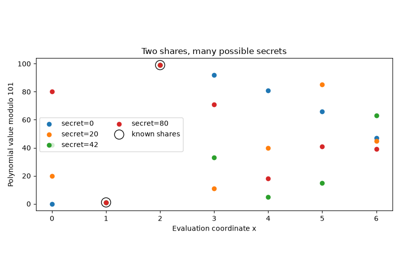
Any \(t\) distinct evaluations determine \(f(0)\) by Lagrange interpolation. With uniform coefficients, fewer than \(t\) shares are compatible with every possible secret; this is an information-theoretic property rather than a computational hardness assumption.
Implementation: blockchainkit.crypto.systems.sharing.split_secret() and
blockchainkit.crypto.systems.sharing.recover_secret() use integer field arithmetic.
Experiment: Shamir’s secret sharing: reconstruct a secret without storing it whole (1979) reconstructs from every three-of-five subset and draws several polynomials compatible with two shares. Plain sharing does not detect forged shares. Nor does reconstructing a key implement a threshold signing protocol: those are separate capabilities.
References: A. Shamir, How to Share a Secret, Communications of the ACM 22(11), 612–613 (1979). DOI.
Shamir’s secret sharing: reconstruct a secret without storing it whole (1979)
1979 — Lamport’s one-time signatures from a hash#
In plain language. Publish the fingerprints of 512 secret strings. To sign, reveal one secret from each pair, chosen by the bits of the message’s fingerprint. Anyone can check that each revealed string has the published fingerprint.
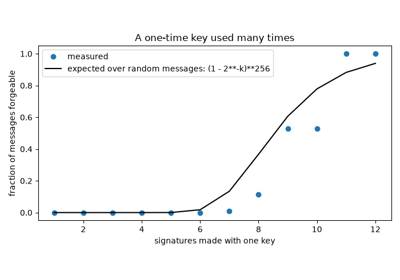
Reading the experiment. A preimage is an input that hashes to a given output. Each signature reveals 256 of the 512 secrets. The plot shows how many new messages become forgeable as one key signs more and more messages.
Leslie Lamport showed that a one-way function alone suffices for digital signatures. For each bit \(b_i\) of \(H(m)\), the signer reveals \(x_{i,b_i}\), and the verifier checks \(H(x_{i,b_i}) = y_{i,b_i}\):
After \(k\) signatures, a random message can be forged with probability about \((1 - 2^{-k})^{256}\), so a key must sign once. Merkle’s trees, invented the same year, authenticate many one-time keys under one root. Because they rely only on hashing, these signatures resist quantum computers: the standardized SPHINCS+ (SLH-DSA) descends from them.
Implementation: blockchainkit.crypto.systems.lamport.lamport_keypair(),
blockchainkit.crypto.systems.lamport.lamport_sign(), and
blockchainkit.crypto.systems.lamport.lamport_verify().
Teaching vs production
Keys here are full Lamport pairs. Deployed hash-based signatures (XMSS, SPHINCS+) shrink them with Winternitz chains and many-time trees. See Exact conventions and model boundaries for this package’s exact conventions.
Experiment: the gallery example signs, verifies, and measures how quickly key reuse makes forgeries possible.
References: L. Lamport, Constructing Digital Signatures from a One Way Function, Technical Report CSL-98, SRI International (1979).
Lamport one-time signatures: signing with only a hash (1979)
1979 — Yuval’s birthday attack#
In plain language. Finding two people with the same birthday in a room is much easier than finding someone with your birthday. Finding two documents with the same fingerprint is likewise much easier than matching a given fingerprint.
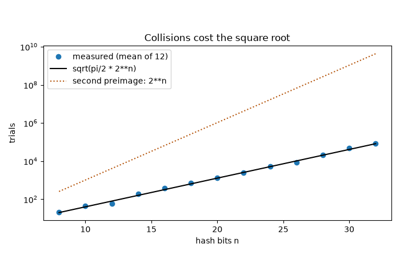
Reading the experiment. The hash is cut to n bits so collisions are reachable. The plot compares the trials needed with \(\sqrt{2^n}\) and with \(2^n\).
Gideon Yuval showed how to exploit this against signatures: prepare many harmless and many harmful variants of a contract until one of each shares a hash, have the victim sign the harmless one, and the signature also fits the harmful one. Among \(q\) random \(n\)-bit values a repeat appears with probability about \(q^2/2^{n+1}\):
So an \(n\)-bit hash gives only \(n/2\) bits of collision resistance. SHA-256’s 256-bit output is chosen for 128-bit collision security.
Implementation: blockchainkit.crypto.systems.hashing.find_collision()
searches truncated SHA-256; blockchainkit.crypto.systems.hashing.truncated_hash()
does the truncation.
Experiment: the gallery example finds collisions from 8 to 32 bits and compares the cost with the birthday bound.
References: G. Yuval, How to Swindle Rabin, Cryptologia 3(3), 187–191 (1979). DOI.
The birthday attack on hash functions (Yuval 1979)
1981 — Coin flipping by telephone: commitments#
In plain language. Seal your guess in an envelope, let the other person flip the coin, then open the envelope. Neither of you can cheat: you cannot change the guess, and they cannot read it before flipping.
Reading the experiment. A commitment is the sealed envelope; the salt is a random value that keeps it from being guessed. Opening means revealing the message and salt so anyone can recompute the commitment.
Manuel Blum asked how two people who do not trust each other can flip a fair coin over the telephone. The answer is a commitment scheme: binding, so the committer cannot open it to a different value, and hiding, so it reveals nothing before opening. With a hash:
Binding rests on collision resistance; hiding rests on the random salt \(r\). Commitments became a basic building block: a Schnorr prover commits to \(R\) before seeing a challenge, and a block header commits to its transactions.
Implementation: blockchainkit.crypto.systems.commitments.commit() adds
domain separation and explicit salt framing;
blockchainkit.crypto.systems.commitments.verify_commitment() compares in
constant time.
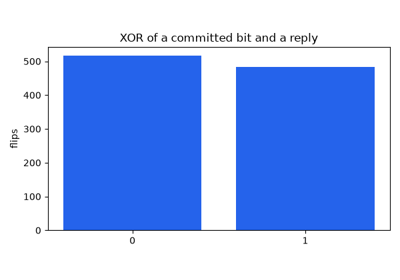
Experiment: the gallery example plays a coin toss, shows that an unsalted hash of a guessable value hides nothing, and checks fairness over a thousand flips.
References: M. Blum, Coin Flipping by Telephone: A Protocol for Solving Impossible Problems, CRYPTO ‘81, 11–15 (1981); reprinted in ACM SIGACT News 15(1), 23–27 (1983). DOI.
Coin flipping by telephone: hash commitments (Blum 1981)
1982–1983 — Chaum’s blind signatures and private payments#
In plain language. Imagine asking someone to stamp an envelope without seeing the message inside, then removing the envelope while retaining a checkable stamp. Blind signatures provide a mathematical version of this idea.
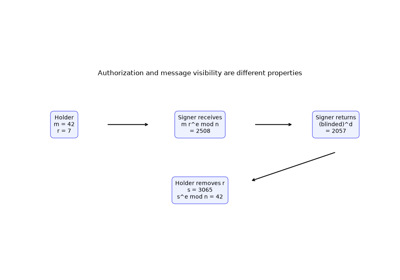
Reading the experiment. The original message is m and the obscured message is m prime. The random factor r hides it during signing; its inverse removes that factor afterward. The final s can be checked as a signature on the original message.
A signer may need to authorize a token without learning the token it signs. Chaum introduced blind signatures at CRYPTO ‘82, with proceedings published in 1983. RSA’s algebra lets a requester obscure a message with an invertible random factor and remove that factor after signing.
Then \(s^e=m\pmod n\). The requester obtains an ordinary signature while the signer processes the blinded value.
Implementation: blockchainkit.crypto.systems.asymmetric.rsa_blind() and
blockchainkit.crypto.systems.asymmetric.rsa_unblind() expose this identity.
Teaching vs production
Blind signatures here use textbook RSA over a tiny modulus. Standardized blind RSA (RFC 9474) hashes and pads the message and uses full-size keys. See Exact conventions and model boundaries for this package’s exact conventions.
Experiment: Chaum’s blind signatures: authenticate a message the signer cannot see (1982) follows each value through the exchange. These bare integer operations are not a complete anonymous cash system: issuance policy, message encoding, and a mechanism to detect repeated spending remain necessary. Privacy and decentralized agreement are different design questions.
References: D. Chaum, Blind Signatures for Untraceable Payments, CRYPTO ‘82, 199–203 (proceedings 1983). DOI.
Chaum’s blind signatures: authenticate a message the signer cannot see (1982)
1985 — Elliptic curves as a cryptographic group#
In plain language. Public keys can be built by repeatedly combining points using a special addition rule. Going forward is easy; recovering how many steps were taken should be difficult for a carefully chosen large system.
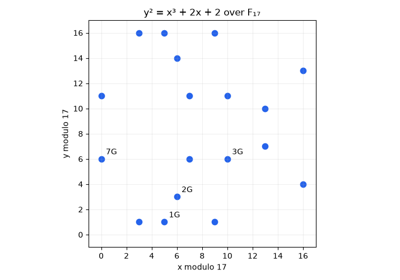
Reading the experiment. G is a starting point, x is a secret step count, and Q is the resulting public point. In Q=xG, multiplication means repeated group addition. The coordinates in the curve equation wrap modulo p, so the plot shows separate points, not a continuous curve.
Miller proposed elliptic curves for public-key cryptography at CRYPTO ‘85; Koblitz independently developed elliptic-curve cryptosystems. The relevant object is a finite group of curve points, not a smooth curve drawn over the real numbers.
Repeated addition efficiently computes \(Q\). Recovering \(x\) from \(G,Q\) is an elliptic-curve discrete-log problem. Group and parameter selection matter; arbitrary curves do not inherit security merely by name.
Implementation: blockchainkit.crypto.systems.curves.Curve,
blockchainkit.crypto.systems.curves.add(), and
blockchainkit.crypto.systems.curves.multiply() implement the group law,
including infinity, inverse points, and doubling. TOY_CURVE has 19 points;
SECP256K1 supplies a larger, established parameter set.
Teaching vs production
Curve arithmetic here is variable-time Python. Production libraries such as libsecp256k1 use constant-time code, because timing can leak private scalars. See Exact conventions and model boundaries for this package’s exact conventions.
Experiment: Elliptic-curve cryptography: a finite group you can draw (Miller and Koblitz 1985) plots the tiny group and recovers a private scalar by enumeration. The same API handles secp256k1, but this readable Python implementation is variable-time and not hardened.
References: V. S. Miller, Use of Elliptic Curves in Cryptography, CRYPTO ‘85, LNCS 218, 417–426 (proceedings 1986). DOI. N. Koblitz, Elliptic Curve Cryptosystems, Mathematics of Computation 48(177), 203–209 (1987). DOI.
Elliptic-curve cryptography: a finite group you can draw (Miller and Koblitz 1985)
1985 — Zero knowledge: proofs that reveal nothing#
In plain language. A person may prove they know a secret without handing over the secret. The important distinction is between responding live to an unpredictable challenge and merely displaying a record of a conversation.
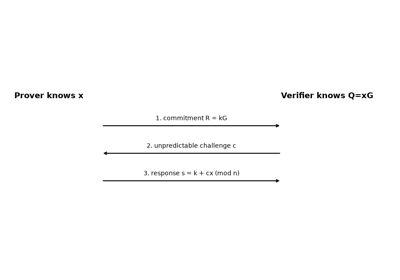
Reading the experiment. A transcript is that conversation record: commitment R, challenge c, and response s. G is a starting curve point and Q is the public key. A record constructed after choosing the challenge need not prove that its creator knew the secret.
Goldwasser, Micali, and Rackoff formalized a striking possibility: an interaction can convince a verifier while revealing no additional knowledge, in a precise simulation-based sense. A proof is zero-knowledge if a simulator, without the secret, can produce transcripts indistinguishable from real ones: then the real ones cannot have taught the verifier anything.
Blockchainkit illustrates the idea with Schnorr’s later identification protocol. An honest-verifier transcript can be simulated by choosing \(c,s\) first and computing \(R=sG-cQ\):
An actual prover must commit to \(R\) before receiving an unpredictable \(c\). The order is crucial: it is the only thing separating a proof from a simulation.
Implementation: blockchainkit.crypto.systems.signatures.verify_transcript()
checks the group equation; blockchainkit.crypto.systems.signatures.simulate_transcript()
is the simulator.
Experiment: Zero-knowledge proofs: convincing without revealing (Goldwasser, Micali and Rackoff 1985) runs an honest proof and a simulated one, and draws who sends what in which order. It explains honest-verifier zero-knowledge intuition; it does not implement a general proof system.
References: S. Goldwasser, S. Micali, and C. Rackoff, The Knowledge Complexity of Interactive Proof-Systems, STOC ‘85, 291–304 (1985). DOI.
Zero-knowledge proofs: convincing without revealing (Goldwasser, Micali and Rackoff 1985)
1986 — The Fiat–Shamir heuristic: from interaction to signatures#
In plain language. Instead of waiting for a verifier to pick a random challenge, the prover computes it as a fingerprint of everything said so far. The proof no longer needs a live conversation, and binding the message into the fingerprint turns it into a signature.
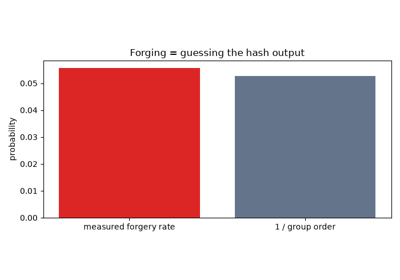
Reading the experiment. \(H\) is a hash; \(c = H(R, Q, m)\) replaces the verifier’s random choice. A forger who picks \(c\) first must then hope the hash of the resulting \(R\) equals it.
Fiat and Shamir proposed replacing the verifier’s random challenge with a hash of the transcript so far:
If \(H\) behaves like a random function, the prover cannot choose \(R\) after knowing \(c\), so the simulator’s trick no longer works. Pointcheval and Stern later proved such signatures secure in the random-oracle model. Schnorr signatures, EdDSA, and most zero-knowledge proof systems used by blockchains (SNARKs, STARKs) rely on this transform; bugs in what goes into the hash have broken real systems.
Implementation: blockchainkit.crypto.systems.signatures.challenge()
hashes the message, public key, commitment, and curve domain.
Experiment: The Fiat-Shamir heuristic: from interaction to signatures (1986) shows the challenge changing with the message, a simulated forgery failing, and on a 19-point curve, forgeries succeeding about one time in 19: the forger must guess the hash.
References: A. Fiat and A. Shamir, How To Prove Yourself: Practical Solutions to Identification and Signature Problems, CRYPTO ‘86, LNCS 263, 186–194 (proceedings 1987). DOI.
The Fiat-Shamir heuristic: from interaction to signatures (1986)
1987 — Feldman’s verifiable secret sharing#
In plain language. In plain secret sharing, everyone must trust the person who hands out the shares. Feldman’s version lets each share holder check privately that their share is consistent with everyone else’s.
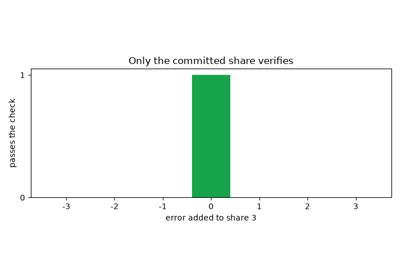
Reading the experiment. The dealer publishes a commitment \(g^{a_j}\) to each polynomial coefficient. A share is \((x, f(x))\); it passes when it lies on the committed polynomial.
Paul Feldman made Shamir’s scheme verifiable without interaction. The dealer publishes \(C_j = g^{a_j}\); share holder \(i\) checks
Because exponentiation turns the polynomial’s sum into a product, the check holds exactly for points on the committed polynomial. The price is that \(C_0 = g^{s}\) is public, so the secret is only computationally hidden. Verifiable sharing is the basis of distributed key generation, which threshold wallets use to create a key no single party ever holds.
Implementation: blockchainkit.crypto.systems.sharing.feldman_split() and
blockchainkit.crypto.systems.sharing.feldman_verify(), over
blockchainkit.crypto.systems.asymmetric.TEACHING_GROUP.
Teaching vs production
The commitments live in the 62-bit teaching group, where discrete logs are easy to compute. Real verifiable secret sharing needs a group of cryptographic size and a broadcast channel for complaints. See Exact conventions and model boundaries for this package’s exact conventions.
Experiment: the gallery example verifies honest shares, recovers the secret from every threshold subset, and catches a corrupted share.
References: P. Feldman, A Practical Scheme for Non-interactive Verifiable Secret Sharing, 28th Symposium on Foundations of Computer Science (FOCS), 427–438 (1987). DOI.
1989 — The Merkle–Damgård construction and length extension#
In plain language. A hash function chews through a long message one block at a time, passing a fixed-size summary from block to block. The final summary is the fingerprint. Anyone who has it can keep chewing.
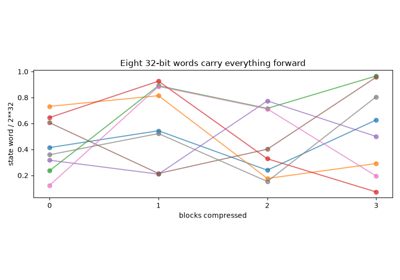
Reading the experiment. The compression function mixes one 64-byte block into eight 32-bit state words. The padding ends with the message length. The attack continues hashing from a published digest.
Ralph Merkle and Ivan Damgård independently showed at CRYPTO ‘89 that a collision-resistant compression function \(f\) yields a collision-resistant hash for messages of any length, provided the padding encodes the length:
MD5, SHA-1 and SHA-256 all follow this design. Its side effect: since \(H(m)\) is the chaining state, anyone can compute \(H(m \,\|\, \text{pad} \,\|\, s)\) from \(H(m)\) and \(|m|\) alone. A “MAC” computed as \(H(k \,\|\, m)\) is therefore forgeable.
Implementation: blockchainkit.crypto.systems.merkle_damgard.merkle_damgard_sha256()
reimplements SHA-256 block by block (checked against the standard library);
blockchainkit.crypto.systems.merkle_damgard.length_extension() performs the
attack.
Experiment: the gallery example hashes block by block and forges a naive MAC without its key.
References: R. C. Merkle, One Way Hash Functions and DES, CRYPTO ‘89, LNCS 435, 428–446 (1990). DOI. I. B. Damgård, A Design Principle for Hash Functions, CRYPTO ‘89, LNCS 435, 416–427 (1990). DOI.
The Merkle-Damgard construction and length extension (1989)
1989–1991 — Schnorr identification and compact signatures#
In plain language. A short signature lets others check that a particular key authorized a message, and nobody else’s. Its one-time secret must be fresh: the 2010–2013 entry below shows what happens when it is not.
Reading the experiment. Here x is the private key, Q its public key, k the secret signing nonce, R a temporary public point, c a challenge, and s the response. G is the starting point and n is its group order (the number of points in its cycle). The experiment checks the verification equation by hand and tampers with each part.
Schnorr’s identification and signature work made discrete-log proofs compact and efficient. In additive notation, a prover with secret \(x\) commits using fresh \(k\), then responds to challenge \(c\):
Applying the Fiat–Shamir transform with \(c = H(R, Q, m)\) turns the identification protocol into a signature \((R, s)\). Schnorr signatures are linear: when keys add, signatures add, which later enabled multi-signatures (see the 2018 entry). A patent kept them out of standards until it expired in 2008; Bitcoin adopted them in 2021 as BIP-340.
Implementation: blockchainkit.crypto.systems.signatures.sign(),
blockchainkit.crypto.systems.signatures.verify(), and
blockchainkit.crypto.systems.signatures.recover_reused_nonce_key() use a
domain-separated teaching scheme over a prime-order elliptic-curve subgroup.
The historical paper uses multiplicative groups; this is an additive adaptation.
Teaching vs production
The challenge encoding differs from BIP-340 (no x-only keys or its tagged hash), so these signatures do not verify in Bitcoin. See Exact conventions and model boundaries for this package’s exact conventions.
Experiment: Schnorr signatures: short, fast, and linear (1989-1991) signs a payment, checks \(sG = R + cQ\) step by step, and shows that changing the message, key, \(R\), or \(s\) breaks verification. The scheme is not BIP-340.
References: C. P. Schnorr, Efficient Signature Generation by Smart Cards, Journal of Cryptology 4, 161–174 (1991); following the CRYPTO ‘89 work. DOI.
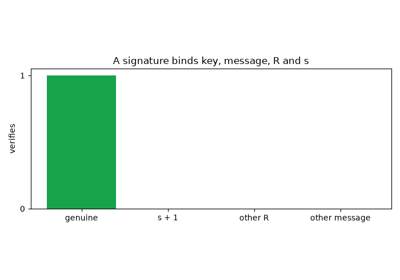
Schnorr signatures: short, fast, and linear (1989-1991)
1991 — Pedersen commitments: perfectly hiding and additive#
In plain language. A commitment that hides its contents perfectly, even from an attacker with unlimited computing power, and where adding sealed envelopes adds the amounts inside them.
Reading the experiment. \(g\) and \(h\) are two generators of the same prime-order group; \(r\) is a random blinding factor. Multiplying commitments adds both the values and the blinding factors.
Torben Pedersen introduced the commitment
For any other value \(v'\) there is a blinding \(r'\) with the same \(C\), so hiding is perfect. Opening to two values would reveal \(\log_g h\), so binding is computational, which is why \(h\) is derived by hashing. The additive property lets anyone check that hidden inputs equal hidden outputs: the basis of confidential transactions in Monero and Mimblewimble.
Implementation: blockchainkit.crypto.systems.commitments.pedersen_commit() and
blockchainkit.crypto.systems.commitments.pedersen_generators().
Teaching vs production
The generators here are in the teaching group, so binding holds only as long as its small discrete logarithm stays unknown; production uses 256-bit elliptic- curve groups. See Exact conventions and model boundaries for this package’s exact conventions.
Experiment: the gallery example balances hidden transaction amounts, opens one commitment as three different values in a tiny group, and shows that commitments look the same whatever the value.
References: T. P. Pedersen, Non-Interactive and Information-Theoretic Secure Verifiable Secret Sharing, CRYPTO ‘91, LNCS 576, 129–140 (1992). DOI.
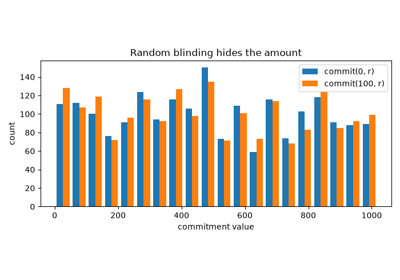
Pedersen commitments: perfectly hiding and additive (1991)
1996 — HMAC: keyed hashing done right#
In plain language. To prove a message came from someone who knows a shared key, mix the key into the hash twice, in a way that leaves an attacker nothing to continue from.
Reading the experiment. ipad and opad are two fixed byte patterns that
derive an inner and an outer key. The experiment retries the length-extension
forgery against both MACs.
Bellare, Canetti and Krawczyk defined HMAC and proved it secure under assumptions about the compression function:
The outer hash hides the inner chaining state, so length extension fails. HMAC became RFC 2104 in 1997 and is everywhere: TLS, key derivation (HKDF), and the deterministic nonces of RFC 6979.
Implementation: blockchainkit.crypto.systems.mac.hmac_sha256(), contrasted
with the broken blockchainkit.crypto.systems.mac.naive_mac().
Experiment: the gallery example shows the forgery succeed against \(H(k \,\|\, m)\) and fail against HMAC.
References: M. Bellare, R. Canetti, and H. Krawczyk, Keying Hash Functions for Message Authentication, CRYPTO ‘96, LNCS 1109, 1–15 (1996). DOI.
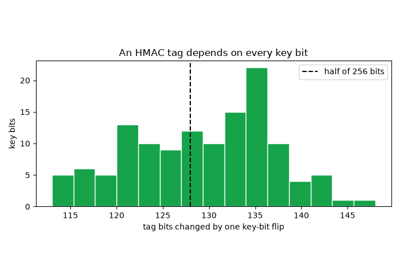
HMAC: keyed hashing that resists length extension (1996)
2002 — SHA-256 as a standardized hash primitive#
In plain language. Different programs need to calculate the same fingerprint for the same data. A standardized hash gives them a shared rule and known examples against which to check their implementations.
Reading the experiment. The displayed result is hexadecimal: two characters represent each byte. Changing an input bit usually changes many output bits. A scrambled-looking output does not, by itself, establish that a hash is secure.
NIST’s FIPS 180-2 specified SHA-256 alongside other secure hash algorithms. Hashes became shared building blocks that independent systems could implement and test against common vectors. A fixed-size output gives a compact fingerprint; it does not encrypt the input.
Implementation: blockchainkit.crypto.systems.hashing.sha256() delegates to
Python’s standard-library implementation;
blockchainkit.crypto.systems.merkle_damgard.merkle_damgard_sha256() is a
readable reimplementation (see the 1989 entry) that the tests check against it.
>>> bk.crypto.sha256(b"abc").hex()
'ba7816bf8f01cfea414140de5dae2223b00361a396177a9cb410ff61f20015ad'
Experiment: SHA-256 and the avalanche effect (FIPS 180-2, 2002) flips each input bit and compares the changed output bits with a Binomial(256, 1/2) distribution. This illustrates diffusion, not a proof of security. Earlier milestones above use SHA-256 as a modern teaching primitive, not as a historical implementation.
References: NIST, Secure Hash Standard, FIPS PUB 180-2 (2002). Historical standard record. This is cited for historical context, not as the latest standards guidance.
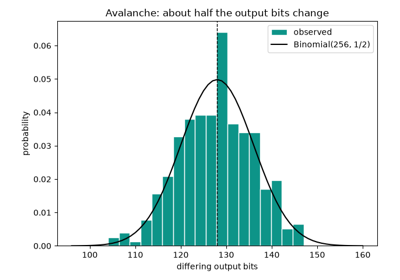
SHA-256 and the avalanche effect (FIPS 180-2, 2002)
2010–2013 — Nonce reuse in practice, and deterministic nonces#
In plain language. A signature hides the private key behind a fresh random number. If the same number is used twice, the key can be calculated. This happened to a games console, and the fix was to stop needing randomness at all.
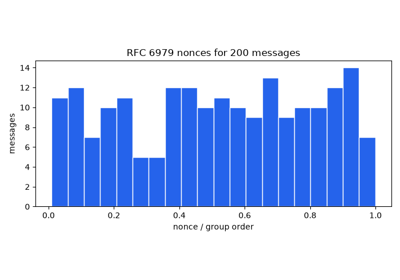
Reading the experiment. \(k\) is the signing nonce; \(s_i\) and \(c_i\) are the responses and challenges of two signatures. The deterministic nonce is derived with HMAC from the private key and the message.
With \(s_i = k + c_i x\), two signatures sharing \(k\) give
In December 2010 the fail0verflow team showed that Sony’s PlayStation 3 signed software with a constant ECDSA nonce, and recovered Sony’s private key. Weak random number generators in Android wallets led to Bitcoin thefts in 2013. Thomas Pornin’s RFC 6979 derives the nonce as an HMAC-based deterministic random bit generator seeded with the private key and the message hash: no randomness needed, distinct messages get distinct nonces, and the nonce is unpredictable without the key.
Implementation: blockchainkit.crypto.systems.signatures.recover_reused_nonce_key()
performs the extraction; blockchainkit.crypto.systems.signatures.deterministic_nonce()
implements RFC 6979 section 3.2 with SHA-256 and reproduces the RFC’s test vectors.
Teaching vs production
deterministic_nonce follows RFC 6979 and matches its test vectors, but it
feeds this package’s Schnorr signatures, not ECDSA, and adds no protection
against fault attacks. See Exact conventions and model boundaries for this package’s exact
conventions.
Experiment: the gallery example recovers a key from a reused nonce and generates deterministic nonces, checking one against the RFC.
References: fail0verflow (bushing, marcan, sven), Console Hacking 2010: PS3 Epic Fail, 27th Chaos Communication Congress (2010). T. Pornin, Deterministic Usage of the Digital Signature Algorithm (DSA) and Elliptic Curve Digital Signature Algorithm (ECDSA), RFC 6979 (2013). DOI.
Nonce reuse in practice, and deterministic nonces (2010-2013)
2018 — MuSig: Schnorr multi-signatures and the rogue-key attack#
In plain language. Several people jointly sign so that the result looks like one ordinary signature from one key. Done naively, the last person to announce a key can make the joint key their own.
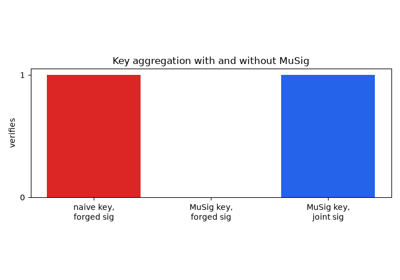
Reading the experiment. \(Q_i\) are the signers’ public keys and \(a_i\) their MuSig coefficients. The rogue key is chosen to cancel the honest key in a plain sum.
Schnorr signatures are linear, so partial signatures for keys \(Q_i\) add up to a signature for \(\sum Q_i\). An attacker announcing \(Q_{\text{rogue}} = xG - Q_{\text{honest}}\) controls that sum alone. Maxwell, Poelstra, Seurin and Wuille’s MuSig weights every key by a hash of the whole list \(L\):
No participant can choose a key that cancels the others, because changing any key changes every coefficient. Bitcoin’s Taproot upgrade (2021) made such aggregate spends indistinguishable from single-signer spends.
Implementation: blockchainkit.crypto.systems.multisig.musig_coefficients(),
blockchainkit.crypto.systems.multisig.aggregate_public_keys(), and
blockchainkit.crypto.systems.multisig.musig_sign(). As a teaching
simplification, signing runs every signer in one process; real MuSig first
exchanges nonce commitments.
Teaching vs production
All signers run in one process here. Real MuSig needs a round of nonce commitments (or MuSig2’s two nonces per signer) to resist attacks across concurrent signing sessions. See Exact conventions and model boundaries for this package’s exact conventions.
Experiment: the gallery example mounts the rogue-key attack on naive aggregation, shows MuSig stopping it, and verifies a three-party signature.
References: G. Maxwell, A. Poelstra, Y. Seurin, and P. Wuille, Simple Schnorr Multi-Signatures with Applications to Bitcoin, Designs, Codes and Cryptography 87, 2139–2164 (2019); preprint IACR ePrint 2018/068. DOI.
MuSig: Schnorr multi-signatures and the rogue-key attack (2018)