Note
Go to the end to download the full example code or to run this example in your browser via JupyterLite.
The one-time pad and perfect secrecy (Vernam 1917, Shannon 1949)#
Vernam’s teleprinter cipher added a key tape to the message, character by character. Shannon later proved that if the key is truly random, as long as the message, and used once, the ciphertext reveals nothing: every plaintext of that length is equally consistent with it.
What to look for#
For one ciphertext, find a key that “decrypts” it to any message you like: that is perfect secrecy. Then reuse a key for two messages and watch the pad cancel out, leaving the XOR of the plaintexts.
The history behind this experiment: Breakthroughs in Cryptography.
Encrypt and decrypt with the same operation#
import matplotlib.pyplot as plt
import numpy as np

import blockchainkit as bk

message = b"ATTACK AT DAWN"
key = bytes([23, 199, 5, 88, 241, 7, 130, 61, 17, 250, 92, 3, 144, 66])  # Fixed for the lesson.
ciphertext = bk.crypto.one_time_pad(message, key)
assert bk.crypto.one_time_pad(ciphertext, key) == message
print("ciphertext:", ciphertext.hex())
ciphertext: 56935119b24ca27c45da1842c70c
Every plaintext is possible#
For each candidate there is exactly one key: candidate XOR ciphertext. Without the key, an eavesdropper cannot rule any of them out.
for candidate in (b"ATTACK AT DAWN", b"RETREAT AT TEN", b"HOLD POSITION!"):
    fitting_key = bk.crypto.xor_bytes(ciphertext, candidate)
    assert bk.crypto.one_time_pad(ciphertext, fitting_key) == candidate
    print(candidate.decode(), "<- key", fitting_key.hex()[:12], "...")
ATTACK AT DAWN <- key 17c70558f107 ...
RETREAT AT TEN <- key 04d6054bf70d ...
HOLD POSITION! <- key 1edc1d5d921c ...
Reusing the pad breaks it#
The “two-time pad”: XORing two ciphertexts removes the key. Soviet reuse of one-time pads is what the Venona project exploited.
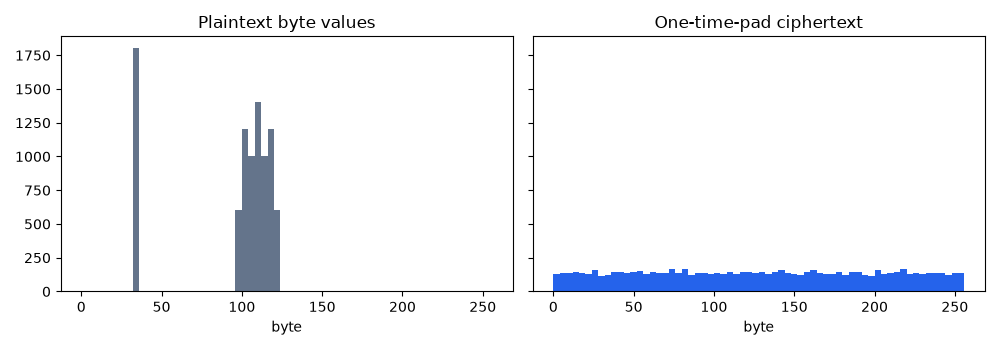
Ciphertext bytes are uniform; plaintext bytes are not#
rng = np.random.default_rng(1949)
text = b"the quick brown fox jumps over the lazy dog " * 200
pad = rng.integers(0, 256, len(text), dtype=np.uint8).tobytes()
fig, axes = plt.subplots(1, 2, figsize=(10, 3.5), sharey=True)
axes[0].hist(list(text), bins=64, range=(0, 256), color="#64748b")
axes[0].set(title="Plaintext byte values", xlabel="byte")
axes[1].hist(list(bk.crypto.one_time_pad(text, pad)), bins=64, range=(0, 256), color="#2563eb")
axes[1].set(title="One-time-pad ciphertext", xlabel="byte")
fig.tight_layout()
Exercise#
The pad needs as much key as message. Count the key bytes needed to encrypt one gigabyte, and explain why Diffie-Hellman (1976) was needed to agree on short keys instead. Why does a repeated short key (a Vigenere cipher) fail?
Total running time of the script: (0 minutes 0.295 seconds)
