Breakthroughs in Authenticated Data Structures#
A hash turns any record into a short fingerprint. Arranged in chains and trees,
fingerprints let anyone check that a history has not changed, or that one
record belongs to a large set, without trusting whoever stores it. This
chronology traces the ideas behind blockchainkit.structures, from
double-entry bookkeeping to Merkle mountain ranges. Each entry has its own
experiment in the gallery.
All snippets use the package’s conventional import: import blockchainkit as bk.
1494 — Double-entry bookkeeping: value is moved, never created#
In plain language. Every payment is written down twice: taken from one account and added to another. Adding up all accounts therefore always gives the same total, so a mistake or a fraud shows up as books that do not balance.
Reading the experiment. The total supply is the sum of all balances. The experiment applies hundreds of random transfers and checks that the sum never moves, then submits a batch that overdraws an account.
Luca Pacioli’s Summa de arithmetica (Venice, 1494) contained the first printed description of the double-entry method used by Venetian merchants: each entry is recorded as a debit in one account and an equal credit in another, so that
A blockchain ledger enforces this rule in code rather than by an accountant’s review: a transfer is valid only if it debits and credits the same amount, and a batch is applied atomically or not at all. New money appears only through an explicit issuance rule, such as Bitcoin’s block reward.
Implementation: blockchainkit.structures.systems.ledger.Ledger.total_supply
and blockchainkit.structures.systems.ledger.Ledger.apply(), which returns a
new ledger or raises without changing the old one.
Experiment: the gallery example runs 300 random transfers with constant supply and shows a failed batch leaving every balance untouched.
References: L. Pacioli, Summa de arithmetica, geometria, proportioni et proportionalità, Venice (1494), section Particularis de computis et scripturis.
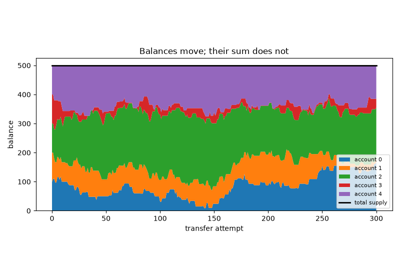
Double-entry bookkeeping: value is moved, never created (Pacioli 1494)
1970 — Bloom filters: compact, approximate membership#
In plain language. A small array of bits can answer “have I seen this?” using far less space than a list, at the price of sometimes answering yes for something it has never seen. It never answers no for something it has.
Reading the experiment. m is the number of bits, k the number of positions set per item, and n the number of items. The false-positive rate is measured and compared with the formula.
Burton Bloom proposed setting \(k\) hash-chosen bits of an \(m\)-bit array for each item and testing membership by checking those bits. After \(n\) insertions,
Bitcoin’s BIP 37 (2012) let a light wallet send a full node a Bloom filter of its addresses, so the node could forward only matching transactions; the false positives were meant to hide which ones were the wallet’s. Later analyses showed that they leaked most of that privacy, and compact block filters (BIP 157/158) reversed the roles: the node publishes a filter and the wallet tests it.
Implementation: blockchainkit.structures.systems.bloom.BloomFilter,
with false_positive_rate()
and optimal_hash_count().
Teaching vs production
Bit positions here come from SHA-256. BIP 37 filters use MurmurHash3 with a per-filter tweak, and Bitcoin Core has since disabled them by default. See Exact conventions and model boundaries for this package’s exact conventions.
Experiment: the gallery example filters a wallet’s addresses and compares measured false positives with Bloom’s formula.
References: B. H. Bloom, Space/Time Trade-offs in Hash Coding with Allowable Errors, Communications of the ACM 13(7), 422–426 (1970). DOI.
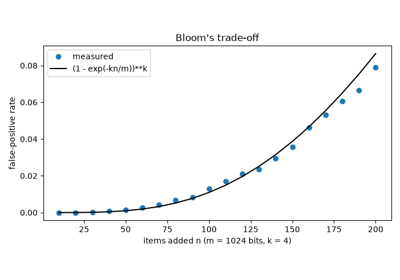
Bloom filters: membership with false positives (Bloom 1970)
1979–1987 — Merkle trees and compact authentication#
In plain language. You can check whether one payment belongs to a large batch without downloading every payment. Keep the batch’s trusted fingerprint, then combine the payment with a short trail of supporting fingerprints.
Reading the experiment. H means a hash function and the vertical double bar means joining bytes. A leaf is a bottom-level item; parents combine child fingerprints. Prefixes 0 and 1 distinguish hashing a record from hashing a pair of tree nodes. “Canonical” below means the history currently selected by the chain rules.
Authenticating a large collection need not require sending the whole collection. Merkle’s work on public-key systems and hash-based authentication supplied a tree construction in which hashes of children determine their parent’s hash. A trusted root can authenticate a leaf using the sibling digests on its path.
The prefix bytes above are blockchainkit’s domain-separation convention, not a claim about Merkle’s original wire format. Our root additionally binds the leaf count; an unmatched node is promoted rather than duplicated.
Implementation: blockchainkit.structures.systems.merkle.MerkleTree and
blockchainkit.structures.systems.merkle.verify_proof() check index, shape,
payload, and count.
Experiment: Merkle trees: authenticate one item with a short proof (Merkle 1979) measures logarithmic proof size and rejects modified payloads. It also distinguishes two trust claims: membership in a list is not proof that the list is valid or canonical.
References: R. C. Merkle, Secrecy, Authentication, and Public Key Systems, PhD thesis, Stanford University (1979). Author’s bibliography. R. C. Merkle, A Digital Signature Based on a Conventional Encryption Function, CRYPTO ‘87, LNCS 293, 369–378 (proceedings 1988). DOI.
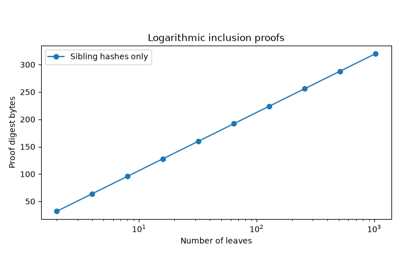
Merkle trees: authenticate one item with a short proof (Merkle 1979)
1981 — Hash chains and one-time passwords#
In plain language. Hash a secret over and over and give the server only the final result. Each time you log in, reveal the value one step earlier in the chain. The server checks it by hashing once; a stolen password is useless, because the next one is the value before it.
Reading the experiment. \(H^i(s)\) means the seed hashed \(i\) times. The anchor is the last value the server accepted.
Leslie Lamport proposed this scheme for authenticating over an insecure network. The server stores \(H^n(s)\); the \(i\)-th login sends \(H^{n-i}(s)\), accepted when
Producing the next password from a captured one would require inverting \(H\). The scheme became S/KEY (RFC 1760, 1995). Hash chains recur throughout this package’s subject: Lamport’s own one-time signatures, commit-reveal randomness beacons, and the hash-linked records of the next entries.
Implementation: blockchainkit.structures.systems.hash_chain.hash_chain()
and blockchainkit.structures.systems.hash_chain.verify_one_time_password().
Experiment: the gallery example logs in five times and shows a captured password failing on replay.
References: L. Lamport, Password Authentication with Insecure Communication, Communications of the ACM 24(11), 770–772 (1981). DOI.
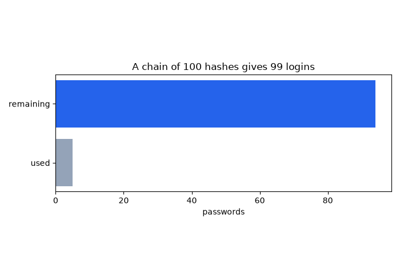
1991 — Hash-linked timestamps and tamper evidence#
In plain language. Include the previous record’s fingerprint in each new record. Editing an earlier record then breaks later links unless those records are recalculated too. Detecting such changes still requires something trustworthy to compare against.
Reading the experiment. The subscript i means the current block, and i−1 the preceding block. H hashes an encoded bundle containing the previous hash, the current payment-batch root, and descriptive fields such as height and timestamp.
Haber and Stornetta investigated how to establish when a digital document existed without trusting easily edited metadata. Linking commitments to earlier records makes an alteration affect subsequent commitments.
Implementation: blockchainkit.structures.systems.block.Block hashes a
canonical header containing the parent hash, transaction root, height,
timestamp, difficulty, and mining nonce. Changing any of those fields changes
the block digest.
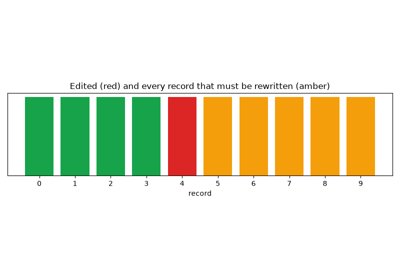
Experiment: Linked timestamps: tamper evidence by hashing the past (Haber and Stornetta 1991) links ten records, edits one, and shows every later link breaking. A hash link alone cannot make one history authoritative: somebody can recompute an entire alternative chain, which is why the latest hash must be widely witnessed. The timestamps here are caller-chosen simulation integers, not trusted real-world time certificates.
References: S. Haber and W. S. Stornetta, How to Time-Stamp a Digital Document, Journal of Cryptology 3, 99–111 (1991). DOI.
Linked timestamps: tamper evidence by hashing the past (Haber and Stornetta 1991)
1993 — Batching timestamps with a Merkle tree#
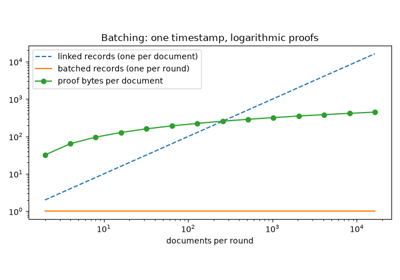
In plain language. Instead of linking every document into the chain one by one, collect a round of documents, combine them into one Merkle root, and timestamp only the root. Each document keeps a short proof that it was part of that round.
Reading the experiment. One header timestamps a thousand documents through its Merkle root; each document’s proof has about \(\log_2 1000 \approx 10\) hashes.
Bayer, Haber and Stornetta improved their timestamping scheme by grouping the documents of each round into a Merkle tree:
This is precisely the structure of a block: a header linked to its predecessor and committing to its transactions through a Merkle root. Bitcoin’s whitepaper cites both Haber–Stornetta papers. OpenTimestamps uses the same batching today to anchor arbitrary documents in Bitcoin.
Implementation: blockchainkit.structures.systems.block.BlockHeader
holds a merkle_root; blockchainkit.structures.systems.block.Block
computes it from its transactions.
Experiment: the gallery example timestamps 1000 documents with one root and compares batched and linked record counts.
References: D. Bayer, S. Haber, and W. S. Stornetta, Improving the Efficiency and Reliability of Digital Time-Stamping, in Sequences II: Methods in Communication, Security and Computer Science, Springer, 329–334 (1993). DOI.
Batching timestamps with a Merkle tree (Bayer, Haber and Stornetta 1993)
2008 — Coins, not accounts: the unspent-output model#
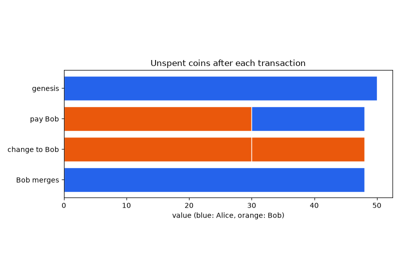
In plain language. Bitcoin keeps no balances. Money exists as separate coins, each owned by someone. To pay, you hand over whole coins and get change back as a new coin, just as with banknotes.
Reading the experiment. An outpoint names a coin: the transaction that created it and the output’s position. A transaction lists coins to consume and new coins to create; the difference is the miner’s fee.
Nakamoto defined an electronic coin as a chain of digital signatures, each owner signing the coin over to the next. Transactions combine and split value with multiple inputs and outputs (whitepaper, section 9):
A coin is spent at most once; preventing a second spend of the same output is what the rest of the system (timestamps, proof of work, longest chain) exists to do. Because transactions touching different coins are independent, they can be validated in parallel, and a wallet’s balance is just the sum of its coins.
Implementation: blockchainkit.structures.systems.utxo.UTXOSet and
blockchainkit.structures.systems.utxo.UTXOTransaction, with
blockchainkit.structures.core.base.OutPoint and
blockchainkit.structures.core.base.Coin. The account-based
blockchainkit.structures.systems.ledger.Ledger is the alternative model.
Teaching vs production
UTXO transactions here are signed with this package’s Schnorr over a canonical encoding. Bitcoin locks outputs with scripts, signs with ECDSA or BIP-340, uses its own serialization, and charges fees. See Exact conventions and model boundaries for this package’s exact conventions.
Experiment: the gallery example pays with change, rejects a double spend, and merges coins.
References: S. Nakamoto, Bitcoin: A Peer-to-Peer Electronic Cash System (2008), sections 2 and 9. Paper.
Coins, not accounts: the unspent-output model (Nakamoto 2008)
2008 — Simplified payment verification: light clients#
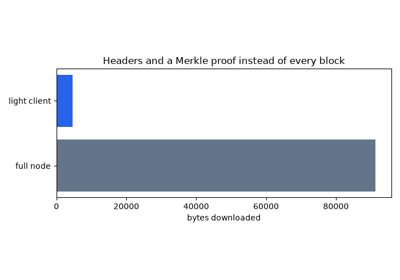
In plain language. A phone cannot store every block. It can store just the short header of each one, check that the headers link and that miners did the work, and ask for a proof that a payment sits inside one of them.
Reading the experiment. A header carries the previous block’s hash, the Merkle root of the transactions, and the proof-of-work nonce. The light client downloads headers plus one Merkle proof.
Section 8 of the Bitcoin whitepaper describes simplified payment verification: a user keeps the headers of the longest proof-of-work chain and obtains the Merkle branch linking a transaction to a block,
The client cannot check the transactions themselves; it trusts that the heaviest chain is valid because honest miners would not extend an invalid one. That trust assumption is the price of downloading kilobytes instead of the whole chain.
Implementation: blockchainkit.structures.systems.headers.verify_header_chain()
checks links and proof of work over
blockchainkit.structures.systems.block.BlockHeader values;
blockchainkit.structures.systems.merkle.verify_proof() checks inclusion.
Teaching vs production
Headers here are this package’s encoding and difficulty counts leading zero bits; Bitcoin headers are 80 bytes with a compact-encoded target. See Exact conventions and model boundaries for this package’s exact conventions.
Experiment: the gallery example verifies a payment from 20 headers and one proof and compares the download with a full node’s.
References: S. Nakamoto, Bitcoin: A Peer-to-Peer Electronic Cash System (2008), section 8. Paper.
Simplified payment verification: light clients (Nakamoto 2008)
2012 — Two lists, one root: the duplicated-leaf ambiguity#
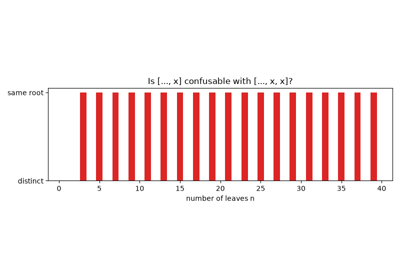
In plain language. Bitcoin’s Merkle tree fills an odd row by copying its last node. So a list and the same list with its last item repeated get the same root, and an attacker can present a block in a form the network wrongly rejects.
Reading the experiment. Each list size is tested: is [..., x]
confusable with [..., x, x]?
Bitcoin’s tree duplicates the last node of any odd level before pairing, with no domain separation and no leaf count. In 2012 Forrest Voight reported that the transaction lists \((t_1, \dots, t_n)\) and \((t_1, \dots, t_n, t_n)\) then share a root. A node receiving the mutated, invalid block marked its hash as invalid, and later refused the valid block with the same hash: a denial-of-service and chain-split risk, tracked as CVE-2012-2459 and fixed by rejecting duplicated transactions.
blockchainkit’s tree avoids the whole class: odd nodes are promoted unchanged, leaves and nodes have different prefixes, and the root binds the leaf count.
Implementation: blockchainkit.structures.systems.merkle.bitcoin_merkle_root()
reproduces Bitcoin’s convention for comparison with
blockchainkit.structures.systems.merkle.MerkleTree.
Teaching vs production
bitcoin_merkle_root reproduces Bitcoin’s rule exactly. Bitcoin itself
closed CVE-2012-2459 by rejecting blocks with duplicate transactions, not by
changing the tree. See Exact conventions and model boundaries for this package’s exact conventions.
Experiment: the gallery example finds the collision and maps which list sizes are ambiguous.
References: National Vulnerability Database, CVE-2012-2459 (2012). Record.
Two lists, one root: the duplicated-leaf ambiguity (CVE-2012-2459)
2013 — Certificate Transparency: proving a log only appends#
In plain language. A public log promises never to delete or change an entry. Anyone holding yesterday’s fingerprint of the log can demand a short proof that today’s log still contains yesterday’s, unchanged, at its start.
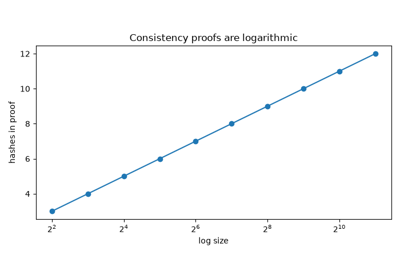
Reading the experiment. The old and new roots summarize the log at two sizes. The consistency proof lists the subtree hashes needed to rebuild both.
After certificate authorities were compromised in 2011, Laurie, Langley and Kasper designed Certificate Transparency: every certificate is appended to public Merkle-tree logs, and browsers require proof of logging. A log of size \(n\) proves that its first \(m\) leaves are an earlier version with \(O(\log n)\) subtree digests, from which a verifier recomputes both roots:
Monitors that gossip signed tree heads then detect a log showing different histories to different people.
Implementation: blockchainkit.structures.systems.merkle.MerkleTree.consistency_proof()
and blockchainkit.structures.systems.merkle.verify_consistency() follow
RFC 6962 and RFC 9162 (blockchainkit’s tree has the same shape; because its roots
also bind the leaf count, a power-of-two old tree’s digest is carried in the
proof).
Teaching vs production
Leaf and node prefixes follow RFC 6962, but this package’s roots also bind the leaf count, so they differ from Certificate Transparency’s roots. See Exact conventions and model boundaries for this package’s exact conventions.
Experiment: the gallery example proves a 600-entry log is a prefix of a 1000-entry one, rejects a rewritten history, and plots proof size.
References: B. Laurie, A. Langley, and E. Kasper, Certificate Transparency, RFC 6962 (2013). DOI.
Append-only logs: consistency proofs (Certificate Transparency 2013)
2014 — The account model and transaction nonces#
In plain language. Ethereum keeps a balance per account, like a bank, instead of separate coins. To stop the same signed payment from being replayed, every account counts the transactions it has sent, and each transaction must carry the next number.
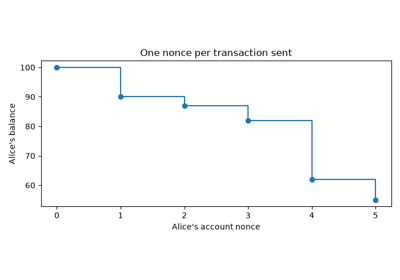
Reading the experiment. The account nonce is the number of transactions the sender has sent so far. A replay reuses an old nonce; a later transaction waits for the gap before it.
Ethereum’s design (Buterin’s whitepaper, formalized in Wood’s yellow paper) keeps a world state mapping each address to a balance and a nonce. A transaction from \(a\) is valid only if
Accounts make balances and smart-contract state simple; the cost is a strict per-sender order, where coins allowed independent spends.
Implementation: blockchainkit.structures.systems.ledger.Ledger
stores balances and next nonces and rejects replayed or out-of-order transfers.
Teaching vs production
Transactions here are signed canonical JSON with a string chain ID; Ethereum uses RLP encoding, ECDSA signatures with recovery, and gas fees. See Exact conventions and model boundaries for this package’s exact conventions.
Experiment: the gallery example rejects a replay, holds an out-of-order transfer until its gap is filled, and plots nonce against balance.
References: G. Wood, Ethereum: A Secure Decentralised Generalised Transaction Ledger (yellow paper, 2014), section 4. Paper.
2014–2017 — Transaction malleability and segregated witness#
In plain language. A transaction’s id was a fingerprint of everything in it, including the signature. Someone relaying it could change the signature’s form without making it invalid, and so change its id, confusing anyone tracking payments by id.
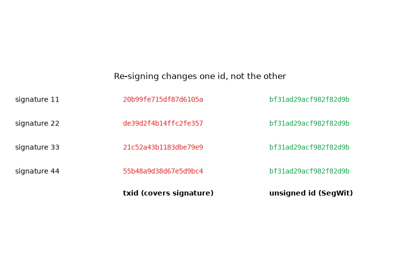
Reading the experiment. txid hashes the signed transaction;
unsigned_id hashes only what was signed. The same payment is signed twice.
Bitcoin’s ECDSA signatures could be re-encoded or negated (\(s \mapsto n-s\)) by third parties without invalidating them. In 2014 the Mt. Gox exchange blamed this malleability for lost withdrawals; Decker and Wattenhofer’s measurements found it explained only a small part of the losses. Segregated witness (BIP 141, activated in 2017) moved signatures into a separate “witness” excluded from the txid:
A fixed id let a transaction safely spend an unconfirmed parent, which payment channels such as Lightning depend on.
Implementation: blockchainkit.structures.systems.transaction.Transaction.txid
covers the signature, like Bitcoin’s original id;
blockchainkit.structures.systems.transaction.Transaction.unsigned_id
covers only the payload, like SegWit’s txid.
Teaching vs production
unsigned_id models only SegWit’s key idea, an identifier that excludes the
signature. Bitcoin’s witness serialization, weight units and script versions
are not modeled. See Exact conventions and model boundaries for this package’s exact conventions.
Experiment: the gallery example re-signs one payment, shows the txid changing and the unsigned id staying fixed.
References: C. Decker and R. Wattenhofer, Bitcoin Transaction Malleability and MtGox, ESORICS 2014, LNCS 8713, 313–326 (2014). DOI. E. Lombrozo, J. Lau, and P. Wuille, Segregated Witness (Consensus layer), BIP 141 (2015). BIP.
Transaction malleability and segregated witness (2014-2017)
2016 — Merkle mountain ranges: an append-only accumulator#
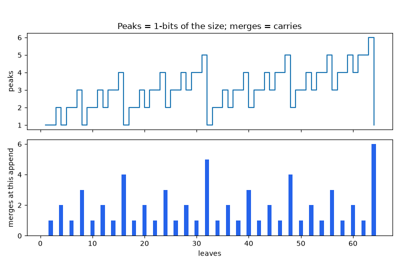
In plain language. Keep a list of complete Merkle trees of shrinking sizes, like mountains in a range. Adding an item adds a tiny tree and merges any two trees of equal size, the way carrying works when you add one in binary.
Reading the experiment. The peaks are the roots of the perfect trees; there is one for each 1-bit of the number of leaves. A merge combines two equal peaks.
Peter Todd described Merkle mountain ranges for OpenTimestamps. With \(n\) leaves written in binary as \(n = \sum_i 2^{e_i}\), the range holds one perfect tree of \(2^{e_i}\) leaves for each term:
Appending never rewrites an old peak and costs two hashes on average. Grin and Mimblewimble chains commit to their outputs and headers this way, and FlyClient light clients use mountain ranges over headers.
Implementation: blockchainkit.structures.systems.mmr.MerkleMountainRange
and blockchainkit.structures.systems.mmr.verify_mmr_proof().
Teaching vs production
Peak bagging here binds the size and differs from deployed MMRs (Grin, Zcash’s FlyClient), so roots are not interoperable. See Exact conventions and model boundaries for this package’s exact conventions.
Experiment: the gallery example grows a range to 64 leaves, counts peaks and merges, and proves an old leaf.
References: P. Todd, Merkle Mountain Ranges, OpenTimestamps documentation (2016). Document.
Merkle mountain ranges: an append-only accumulator (Todd 2016)
2016 — Replay protection across chains#
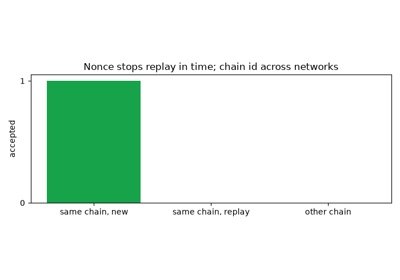
In plain language. When one blockchain splits into two, the same keys control coins on both. A payment signed for one chain could be copied onto the other. Signing the chain’s name into every transaction makes a signature valid on one chain only.
Reading the experiment. chain_id is part of the signed payload; each
ledger accepts only its own.
When Ethereum and Ethereum Classic split in July 2016, transactions were valid on both chains and were replayed, moving users’ funds on the chain they had not meant to touch. Buterin’s EIP-155 included the chain identifier in the signed data:
The account nonce prevents replay in time on one chain; the chain id prevents replay across chains.
Implementation: blockchainkit.structures.systems.transaction.Transaction
signs its chain_id; blockchainkit.structures.systems.ledger.Ledger
accepts only transactions for its own chain id.
Teaching vs production
The chain ID here is a string inside the signed message. EIP-155 folds a
numeric chain ID into the signature’s recovery value v. See
Exact conventions and model boundaries for this package’s exact conventions.
Experiment: the gallery example signs a payment on one chain and shows it rejected on the other and on replay.
References: V. Buterin, EIP-155: Simple Replay Attack Protection (2016). EIP.
Replay protection with a chain identifier (EIP-155, 2016)
2016 — Sparse Merkle trees: committing to a whole state#
In plain language. Imagine a Merkle tree with a slot for every possible account, almost all empty. Each account always lands in the same slot, so the tree’s root is the same however the accounts were added, and you can prove that an account does not exist by showing its slot is empty.
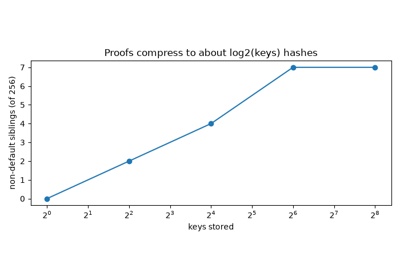
Reading the experiment. Keys are hashed to a 256-bit position. Siblings that are empty subtrees have fixed default digests, so a proof’s interesting part is about \(\log_2(\text{keys})\) hashes.
Laurie and Kasper used sparse Merkle trees for certificate revocation (2012); Dahlberg, Pulls and Peeters made them efficient with caching and gave secure membership and non-membership proofs. With a precomputed default digest for an empty subtree of each height,
only the paths to stored keys are ever computed. Committing to an entire state with one root is how blockchains let light clients check balances; Ethereum uses a related structure, the Merkle Patricia trie.
Implementation: blockchainkit.structures.systems.sparse_merkle.SparseMerkleTree
and blockchainkit.structures.systems.sparse_merkle.verify_sparse_proof().
Teaching vs production
The tree has fixed depth 256 and stores every empty subtree’s default hash. Production state trees (Ethereum’s Patricia trie, Diem’s Jellyfish) compress empty paths. See Exact conventions and model boundaries for this package’s exact conventions.
Experiment: the gallery example commits to balances in two orders, proves a balance and an absence, and counts the non-default siblings.
References: R. Dahlberg, T. Pulls, and R. Peeters, Efficient Sparse Merkle Trees: Caching Strategies and Secure (Non-)Membership Proofs, NordSec 2016, LNCS 10014, 199–215 (2016). DOI.
Sparse Merkle trees: proofs of absence (Dahlberg, Pulls and Peeters 2016)