Note
Go to the end to download the full example code or to run this example in your browser via JupyterLite.
Hash chains and one-time passwords (Lamport 1981)#
Lamport proposed logging in without ever sending a reusable password. Hash a secret seed n times and give the server only the last value. Each login reveals the value before it: the server hashes it once and compares. A captured password is useless, because the next one is its preimage. This became S/KEY (1995), and hash chains reappear in blockchains as commit-reveal randomness and in Lamport-style signatures.
What to look for#
Each password verifies against the previous anchor, and the anchor moves back along the chain. Replaying a captured password fails, and the attacker cannot step backwards without inverting SHA-256.
The history behind this experiment: Breakthroughs in Authenticated Data Structures. See Exercises: ledgers and data structures for a worked solution to the exercise.
Log in five times#
import matplotlib.pyplot as plt

import blockchainkit as bk

chain = bk.structures.hash_chain(b"Alice's secret seed", 100)
anchor = chain[-1]  # Registered with the server once.
used = []
for login in range(5):
    password = chain[-2 - login]
    assert bk.structures.verify_one_time_password(password, anchor)
    used.append(password)
    anchor = password  # The server keeps the newest accepted value.
print("5 logins accepted; the server now stores", anchor.hex()[:16], "...")
5 logins accepted; the server now stores 0768bbf7b5a19e83 ...
A captured password cannot be replayed#
eavesdropped = used[-1]
assert not bk.structures.verify_one_time_password(eavesdropped, anchor)
next_password = chain[-7]
assert bk.crypto.sha256(next_password) == anchor  # Only the seed holder can produce this.
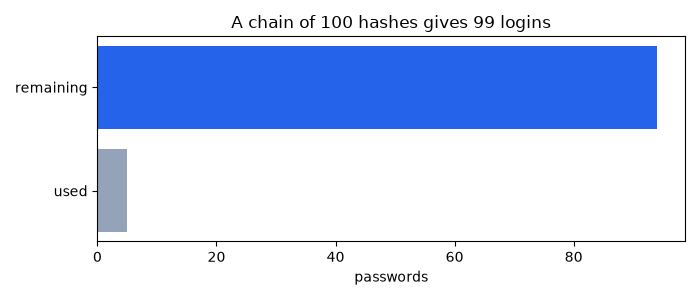
Remaining logins#
fig, ax = plt.subplots(figsize=(7, 3))
ax.barh(
    ["used", "remaining"], [len(used), len(chain) - 1 - len(used)], color=["#94a3b8", "#2563eb"]
)
ax.set(xlabel="passwords", title="A chain of 100 hashes gives 99 logins")
fig.tight_layout()
Exercise#
Why must passwords be revealed in reverse order of computation? What does a server learn if it is breached, compared with storing a password hash?
Total running time of the script: (0 minutes 0.066 seconds)
