Note
Go to the end to download the full example code or to run this example in your browser via JupyterLite.
Linked timestamps: tamper evidence by hashing the past (Haber and Stornetta 1991)#
Haber and Stornetta asked how to timestamp a digital document so that not even the timestamping service could backdate it. Their answer: each certificate includes the hash of the previous one. Changing any old record changes its hash, which breaks every later link. A blockchain is this chain of linked timestamps, with blocks as the records.
What to look for#
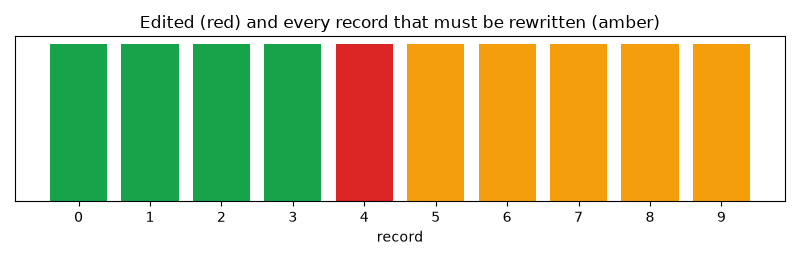
Edit one record in the middle and every link after it fails. Rewriting history requires recomputing every later record, and anyone holding a recent hash detects the change.
The history behind this experiment: Breakthroughs in Authenticated Data Structures.
Link ten records#
from dataclasses import replace

import matplotlib.pyplot as plt

import blockchainkit as bk

documents = [f"lab notebook, page {page}".encode() for page in range(10)]
records = []
previous = bytes(32)
for time, document in enumerate(documents):
    header = bk.structures.BlockHeader(previous, bk.crypto.sha256(document), time, time, 0, 0)
    records.append(header)
    previous = header.hash


def broken_links(chain):
    return [i for i in range(1, len(chain)) if chain[i].previous_hash != chain[i - 1].hash]


assert broken_links(records) == []
Backdate page 4#
broken links after editing page 4: [5]
Repairing the break means rewriting everything after it#
fig, ax = plt.subplots(figsize=(8, 2.6))
status = ["#16a34a"] * 4 + ["#dc2626"] + ["#f59e0b"] * 5
ax.bar(range(10), [1] * 10, color=status)
ax.set(
    xticks=range(10),
    yticks=[],
    xlabel="record",
    title="Edited (red) and every record that must be rewritten (amber)",
)
fig.tight_layout()
Exercise#
Haber and Stornetta also proposed publishing the latest hash in a newspaper. Why does one widely witnessed hash protect every earlier record? What plays the newspaper’s role in Bitcoin?
Total running time of the script: (0 minutes 0.087 seconds)
