Note
Go to the end to download the full example code or to run this example in your browser via JupyterLite.
Double-entry bookkeeping: value is moved, never created (Pacioli 1494)#
Luca Pacioli’s Summa de arithmetica gave the first printed account of Venetian double-entry bookkeeping: every transaction is recorded twice, as a debit in one account and a credit in another, so the books always balance. A blockchain ledger enforces the same invariant mechanically: transfers move value between accounts, so the total supply never changes.
What to look for#
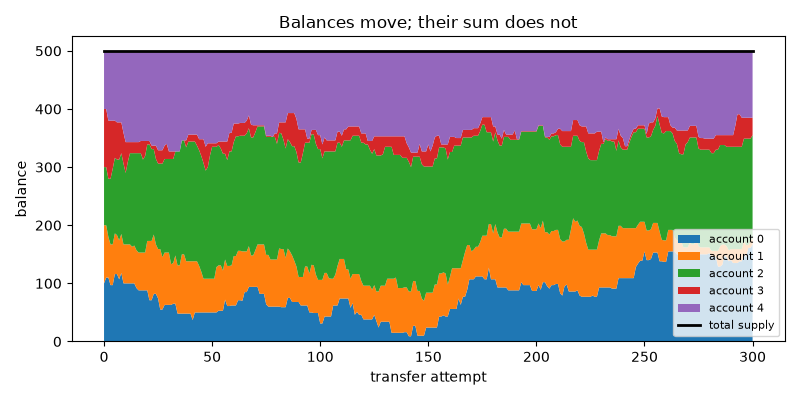
Thousands of random transfers leave the total supply exactly where it started. A transfer that would overdraw an account is rejected as a whole, and the ledger is left untouched: no half-recorded entries.
The history behind this experiment: Breakthroughs in Authenticated Data Structures.
Random transfers among five accounts#
from contextlib import suppress
from random import Random

import matplotlib.pyplot as plt

import blockchainkit as bk

keys = [3, 5, 7, 11, 13]
publics = [bk.crypto.public_key(k) for k in keys]
accounts = [bk.structures.address(p) for p in publics]
ledger = bk.structures.Ledger({a: 100 for a in accounts})
rng = Random(1494)
supply, balances = [ledger.total_supply], [[ledger.balances[a] for a in accounts]]
for _ in range(300):
    i, j = rng.sample(range(5), 2)
    amount = rng.randint(1, 20)
    tx = bk.structures.Transaction(
        publics[i], accounts[j], amount, ledger.nonces.get(accounts[i], 0)
    )
    tx = tx.signed(keys[i], signing_nonce=bk.crypto.deterministic_nonce(keys[i], tx.payload()))
    with suppress(ValueError):  # Insufficient funds: rejected whole.
        ledger = ledger.apply([tx])
    supply.append(ledger.total_supply)
    balances.append([ledger.balances.get(a, 0) for a in accounts])
assert set(supply) == {500}
print(ledger)
Ledger(chain_id='blockchainkit-demo', accounts=5, supply=500)
A failed batch changes nothing#
richest = max(range(5), key=lambda k: ledger.balances[accounts[k]])
nonce = ledger.nonces.get(accounts[richest], 0)
ok = bk.structures.Transaction(publics[richest], accounts[0], 1, nonce).signed(
    keys[richest], signing_nonce=1
)
overdraw = bk.structures.Transaction(publics[richest], accounts[0], 10_000, nonce + 1).signed(
    keys[richest], signing_nonce=2
)
before = dict(ledger.balances)
try:
    ledger.apply([ok, overdraw])
except ValueError as error:
    print("Rejected:", error)
assert dict(ledger.balances) == before  # Even the valid first transfer was not recorded.
Rejected: insufficient funds
fig, ax = plt.subplots(figsize=(8, 4))
ax.stackplot(
    range(len(balances)),
    list(zip(*balances, strict=True)),
    labels=[f"account {k}" for k in range(5)],
)
ax.plot(supply, color="black", linewidth=2, label="total supply")
ax.set(xlabel="transfer attempt", ylabel="balance", title="Balances move; their sum does not")
ax.legend(loc="lower right", fontsize=8)
fig.tight_layout()
Exercise#
Bitcoin creates new coins in each block’s coinbase transaction. Where would that break this example’s invariant, and what rule replaces it (“supply grows exactly by the block reward”)?
Total running time of the script: (0 minutes 8.264 seconds)
