Note
Go to the end to download the full example code or to run this example in your browser via JupyterLite.
Merkle trees: authenticate one item with a short proof (Merkle 1979)#
A root commits to an ordered collection. An inclusion proof reveals the sibling digests needed to recompute that root, rather than the full dataset. The verifier must already trust the root by some independent mechanism.
What to look for#
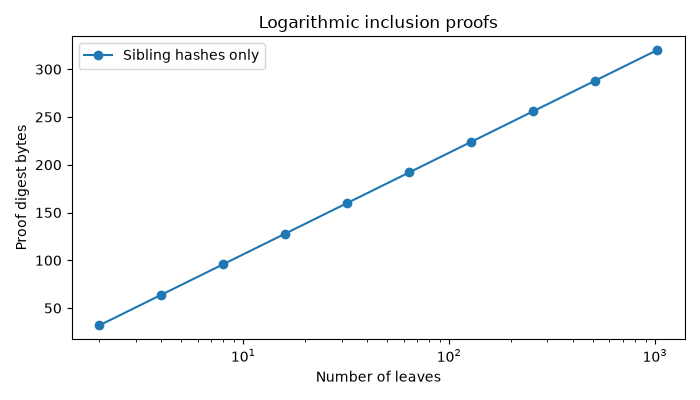
Watch a genuine membership proof pass and an altered payment fail. In the size plot, proof length grows much more slowly than the number of records.
Read cells in order. An assert that produces no output has passed.
The final exercise asks you to change an input and explain the result.
The history behind this experiment: Breakthroughs in Authenticated Data Structures. See Exercises: ledgers and data structures for a worked solution to the exercise.
import matplotlib.pyplot as plt

import blockchainkit as bk
from blockchainkit.structures.visualizers import plot_merkle_tree, plot_proof_trace

leaves = [b"Alice pays Bob", b"Bob pays Carol", b"Carol pays Dave"]
tree = bk.structures.MerkleTree(leaves)
proof = tree.proof(1)
assert bk.structures.verify_proof(leaves[1], proof, tree.root)
assert not bk.structures.verify_proof(b"Bob pays Mallory", proof, tree.root)
print("Root:", tree.root.hex())
print("Proof:", proof)
Root: 66f70ae9b2f3e848a49b5cbec27b9f237bb7a2bedb1cbec523441988d8ee78d4
Proof: MerkleProof(index=1, leaf_count=3, siblings=(b'\x17au\x82X/\xf1\x8d,\xc0\xc5\xb2\x0e\xdd\x98*\xfd\xd6\xe5\xc4\xd8\xce\xaf \xdb>\xc5\xeae\xafU7', b'Cv1\xb4\xca\xb8\xb9\x88 \x95:1)i\x07\xe16\x93\xb0\x7fWf\xfb>\x9b\xc8\xd6\xbc\x10U\xf8\x17'))
Shape is part of the commitment#
Our convention promotes odd nodes and commits the count into the root. It does not duplicate odd leaves, and is intentionally not Bitcoin’s format.
assert tree.root != bk.structures.MerkleTree(leaves + [leaves[-1]]).root
print("Last leaf's missing sibling is represented explicitly:", tree.proof(2).siblings[0])
Last leaf's missing sibling is represented explicitly: None
sizes = [2**power for power in range(1, 11)]
proof_bytes = []
for size in sizes:
    sample = bk.structures.MerkleTree(str(i).encode() for i in range(size))
    proof_bytes.append(sum(32 for sibling in sample.proof(0).siblings if sibling is not None))
fig, ax = plt.subplots(figsize=(7, 4))
ax.plot(sizes, proof_bytes, "o-", label="Sibling hashes only")
ax.set(
    xscale="log",
    xlabel="Number of leaves",
    ylabel="Proof digest bytes",
    title="Logarithmic inclusion proofs",
)
ax.legend()
fig.tight_layout()
Exercise#
Change the leaf index or leaf count in the proof and check verification. Explain why inclusion in a committed list does not establish that a payment was authorized, funded, or finalized by a consensus protocol.
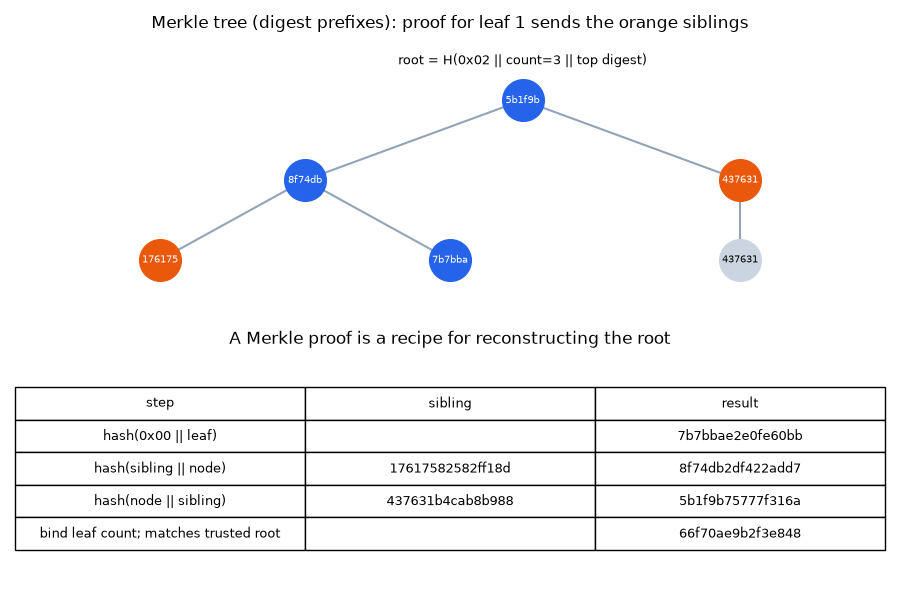
Trace one proof from its leaf to the trusted root#
Index 1 is a right child: its sibling goes on the left before hashing. At the next level our node is on the left, so the order reverses. The final step binds the leaf count before comparing with the trusted root.
trace = bk.structures.trace_proof(leaves[1], proof, tree.root)
assert trace.valid and [step.side for step in trace.steps] == ["left", "right"]
fig, (tree_ax, table_ax) = plt.subplots(2, 1, figsize=(9, 6), height_ratios=[1.2, 1])
plot_merkle_tree(tree, highlight=1, ax=tree_ax)
plot_proof_trace(trace, ax=table_ax)
fig.tight_layout()
Total running time of the script: (0 minutes 0.489 seconds)
