Note
Go to the end to download the full example code or to run this example in your browser via JupyterLite.
Shamir’s secret sharing: reconstruct a secret without storing it whole (1979)#
The secret is the constant coefficient of a random polynomial. Any threshold number of evaluations determines it; fewer evaluations leave it undetermined. Arithmetic takes place in a prime field, not over floating-point reals.
What to look for#
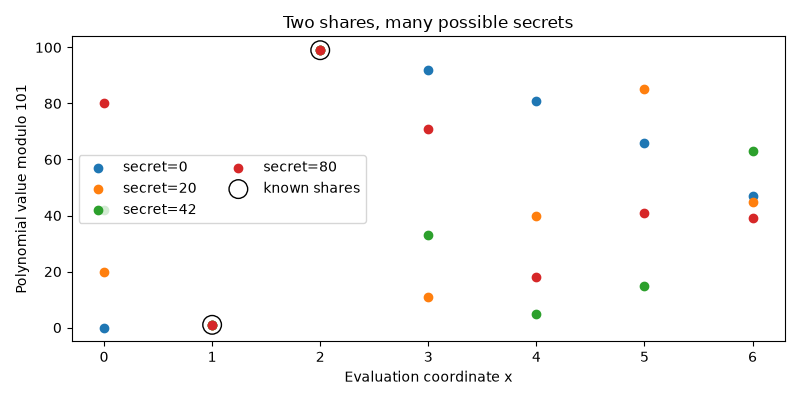
Watch every three-person subset recover the same secret. Two shares fit several possible secrets; the curves illustrate why the missing share matters.
Read cells in order. An assert that produces no output has passed.
The final exercise asks you to change an input and explain the result.
The history behind this experiment: Breakthroughs in Cryptography. See Exercises: cryptography for a worked solution to the exercise.
from itertools import combinations
from random import Random

import matplotlib.pyplot as plt

import blockchainkit as bk

secret, prime = 42, 101
shares = bk.crypto.split_secret(secret, 3, 5, prime, randbelow=Random(7).randrange)
for subset in combinations(shares, 3):
    assert bk.crypto.recover_secret(subset, prime) == secret
print("Five shares:", shares)
print("Every one of the ten three-share subsets recovers", secret)
Five shares: ((1, 1), (2, 99), (3, 33), (4, 5), (5, 15))
Every one of the ten three-share subsets recovers 42
Two points admit every possible secret in a quadratic sharing scheme#
For each candidate constant, solve for the remaining two coefficients.
(x1, y1), (x2, y2) = shares[:2]
candidate_polynomials = []
for candidate in (0, 20, 42, 80):
    # y_i - candidate = a*x_i + b*x_i**2
    determinant = (x1 * x2**2 - x2 * x1**2) % prime
    a = ((y1 - candidate) * x2**2 - (y2 - candidate) * x1**2) * pow(determinant, -1, prime) % prime
    b = (x1 * (y2 - candidate) - x2 * (y1 - candidate)) * pow(determinant, -1, prime) % prime
    candidate_polynomials.append((candidate, a, b))
    assert (candidate + a * x1 + b * x1**2) % prime == y1
    assert (candidate + a * x2 + b * x2**2) % prime == y2
fig, ax = plt.subplots(figsize=(8, 4))
xs = list(range(7))
for candidate, a, b in candidate_polynomials:
    ax.scatter(
        xs, [(candidate + a * x + b * x**2) % prime for x in xs], label=f"secret={candidate}"
    )
ax.scatter([x1, x2], [y1, y2], s=180, facecolors="none", edgecolors="black", label="known shares")
ax.set(
    xlabel="Evaluation coordinate x",
    ylabel="Polynomial value modulo 101",
    title="Two shares, many possible secrets",
)
ax.legend(ncol=2)
fig.tight_layout()
Exercise#
Change a share before reconstruction. The result may be wrong without any error: plain Shamir sharing does not authenticate shares. What additional mechanism would participants need to detect dishonest contributions?
Total running time of the script: (0 minutes 0.181 seconds)
