Note
Go to the end to download the full example code or to run this example in your browser via JupyterLite.
The Merkle-Damgard construction and length extension (1989)#
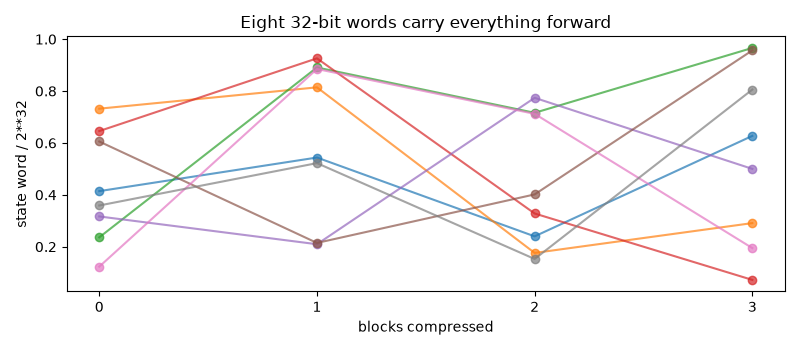
Merkle and Damgard independently showed how to build a hash for messages of any length from a fixed-size compression function: pad the message, append its length, and chain the blocks through the function. SHA-256 is built this way. The digest is the final chaining state, which has a famous consequence.
What to look for#
blockchainkit’s step-by-step SHA-256 matches the standard library. Then an attacker who sees only H(key || message) computes a valid H(key || message || padding || suffix) without the key: the length-extension attack that breaks naive secret-prefix MACs.
The history behind this experiment: Breakthroughs in Cryptography.
Hashing as a chain of compressions#
import hashlib

import matplotlib.pyplot as plt

import blockchainkit as bk

message = b"x" * 150
padded = message + bk.crypto.sha256_padding(len(message))
states = [bk.crypto.SHA256_IV]
for start in range(0, len(padded), 64):
    states.append(bk.crypto.sha256_compress(states[-1], padded[start : start + 64]))
digest = b"".join(word.to_bytes(4, "big") for word in states[-1])
assert digest == hashlib.sha256(message).digest() == bk.crypto.merkle_damgard_sha256(message)
print(len(message), "bytes ->", len(padded) // 64, "blocks")
150 bytes -> 3 blocks
Extend a hash without knowing the secret#
secret = b"server-side key!"  # The attacker never sees this...
order = b"user=alice&amount=10"
tag = bk.crypto.naive_mac(secret, order)  # ...only the order and its tag.
glue, forged_tag = bk.crypto.length_extension(tag, len(secret) + len(order), b"&amount=1000000")
forged_order = order + glue + b"&amount=1000000"
assert bk.crypto.naive_mac(secret, forged_order) == forged_tag
print("Forged order accepted:", forged_order[-16:])
Forged order accepted: b' &amount=1000000'
The chaining state through the blocks#
fig, ax = plt.subplots(figsize=(8, 3.5))
for word in range(8):
    ax.plot(range(len(states)), [s[word] / 2**32 for s in states], "o-", alpha=0.7)
ax.set(
    xlabel="blocks compressed",
    ylabel="state word / 2**32",
    title="Eight 32-bit words carry everything forward",
)
ax.set_xticks(range(len(states)))
fig.tight_layout()
Exercise#
The forged message contains the padding bytes “glue”. Print them and explain where the 0x80 byte and the trailing length come from. Why does hashing twice, H(H(m)), as Bitcoin does, also stop length extension?
Total running time of the script: (0 minutes 0.102 seconds)
