Note
Go to the end to download the full example code or to run this example in your browser via JupyterLite.
SHA-256 and the avalanche effect (FIPS 180-2, 2002)#
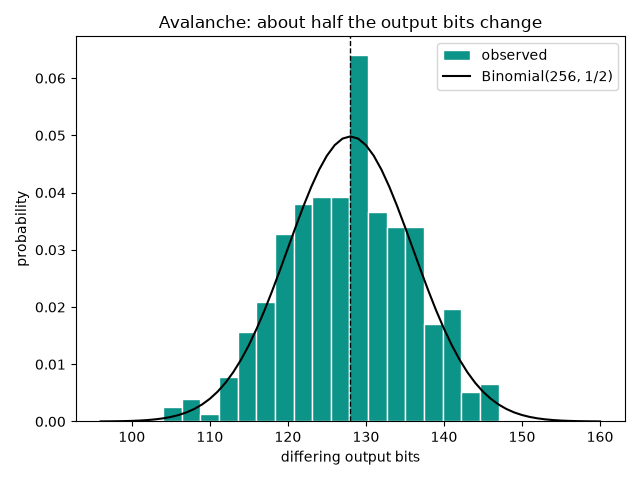
SHA-256 became the standardized hash behind Bitcoin’s block hashes, addresses, and Merkle trees. A good hash behaves like a random function: flipping one input bit flips each output bit with probability one half.
What to look for#
Flip every bit of a message in turn. The number of changed output bits clusters around 128 of 256, following a Binomial(256, 1/2) distribution. This is useful intuition, not a proof of collision or preimage resistance.
The history behind this experiment: Breakthroughs in Cryptography. See Exercises: cryptography for a worked solution to the exercise.
import blockchainkit as bk
from blockchainkit.crypto.visualizers import plot_hamming_distances

message = b"blockchainkit: a reproducible experiment"
digest = bk.crypto.sha256(message)
assert digest.hex() == bk.crypto.merkle_damgard_sha256(message).hex()
distances = []
for bit in range(len(message) * 8):
    flipped = bytearray(message)
    flipped[bit // 8] ^= 1 << (bit % 8)
    distances.append(bk.crypto.hamming_distance(digest, bk.crypto.sha256(bytes(flipped))))
mean = sum(distances) / len(distances)
assert 120 < mean < 136
print("Mean changed digest bits:", mean, "out of 256")
Mean changed digest bits: 127.66875 out of 256
ax = plot_hamming_distances(distances)
ax.figure.tight_layout()
Exercise#
Hash only the first byte of each digest and find collisions. Compare the number of trials to the birthday estimate. Why is this not an attack on the full SHA-256 output?
Total running time of the script: (0 minutes 0.152 seconds)
