Note
Go to the end to download the full example code or to run this example in your browser via JupyterLite.
The Fiat-Shamir heuristic: from interaction to signatures (1986)#
Fiat and Shamir removed the live verifier: compute the challenge as a hash of the commitment and the message, c = H(R, Q, m). If the hash behaves like a random function, the prover cannot choose R after knowing c, and the transcript becomes a non-interactive proof bound to the message: a signature.
What to look for#
The hashed challenge changes completely with the message. The simulator trick from the zero-knowledge example fails, because R must be fixed before the hash reveals c. Schnorr signatures, EdDSA, and most zero-knowledge proof systems used by blockchains rely on this transformation.
The history behind this experiment: Breakthroughs in Cryptography.
The challenge is a hash of everything said so far#
import matplotlib.pyplot as plt

import blockchainkit as bk

x, k = 42, 17
Q, R = bk.crypto.public_key(x), bk.crypto.public_key(k)
c_bob = bk.crypto.challenge(b"pay Bob", R, Q)
c_carol = bk.crypto.challenge(b"pay Carol", R, Q)
assert c_bob != c_carol
print("challenge for 'pay Bob':  ", hex(c_bob)[:20], "...")
print("challenge for 'pay Carol':", hex(c_carol)[:20], "...")
challenge for 'pay Bob':   0x414a0ed1464beee1c9 ...
challenge for 'pay Carol': 0x794a9db7abda9064c4 ...
Simulation no longer works#
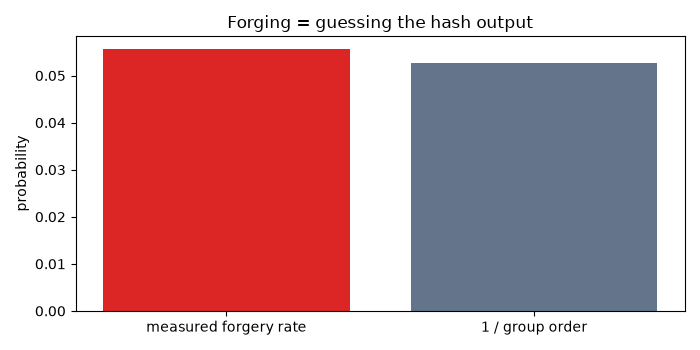
A forger picks s and c, sets R = sG - cQ, but the hash then demands a different c for that R.
Searching for a lucky challenge on a tiny curve#
On a 19-element curve a forger succeeds when the hash happens to hit the chosen c: about 1 time in 19. On secp256k1, 1 time in 2**256.
toy = bk.crypto.TOY_CURVE
Q_toy = bk.crypto.public_key(5, toy)
hits = []
for attempt in range(400):
    s_try, c_try = attempt % (toy.order - 1) + 1, 3
    if s_try == c_try * 5 % toy.order:
        continue  # s = c*x would make R the point at infinity.
    R_try = bk.crypto.simulate_transcript(Q_toy, c_try, s_try, toy)
    message = f"attempt {attempt}".encode()
    hits.append(bk.crypto.challenge(message, R_try, Q_toy, toy) == c_try)
rate = sum(hits) / len(hits)
assert 0.01 < rate < 0.12
fig, ax = plt.subplots(figsize=(7, 3.5))
ax.bar(
    ["measured forgery rate", "1 / group order"],
    [rate, 1 / toy.order],
    color=["#dc2626", "#64748b"],
)
ax.set(ylabel="probability", title="Forging = guessing the hash output")
fig.tight_layout()
Exercise#
Bind less into the hash: compute c = H(R, m) without Q. Read the
documentation of blockchainkit.crypto.systems.signatures.challenge() and explain what
including the public key and curve parameters protects against.
Total running time of the script: (0 minutes 0.114 seconds)
