Note
Go to the end to download the full example code or to run this example in your browser via JupyterLite.
Lamport clocks: ordering events without a shared clock (Lamport 1978)#
Peers’ clocks drift, so wall-clock timestamps cannot say which of two events came first. Lamport replaced physical time with happened before: an event precedes the later events at its own process, a message’s send precedes its receive, and the relation is transitive. A counter that ticks at every event and jumps past every timestamp it receives respects that order.
What to look for#
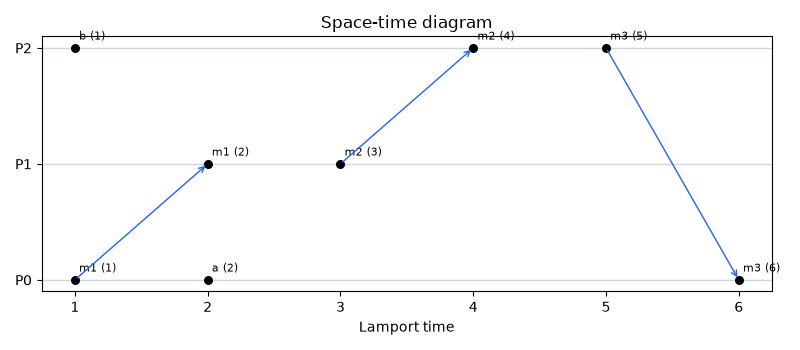
Every arrow in the space-time diagram points forward in Lamport time: that
is the clock condition. Ordering events by (timestamp, process) gives one
total order that all processes can compute alike, which Lamport used for
mutual exclusion and which underlies state-machine replication. But a
smaller timestamp does not prove an event came first: events that are
concurrent still receive ordered numbers.
The history behind this experiment: Breakthroughs in Peer-to-Peer Networking. See Exercises: networking for a worked solution to the exercise.
Three processes exchange three messages#
import matplotlib.pyplot as plt

import blockchainkit as bk
from blockchainkit.network.visualizers import plot_space_time

history = [
    [("send", "m1"), ("local", "a"), ("receive", "m3")],
    [("receive", "m1"), ("send", "m2")],
    [("local", "b"), ("receive", "m2"), ("send", "m3")],
]
stamps = bk.network.lamport_timestamps(history)
print(stamps)
assert stamps == ((1, 2, 6), (2, 3), (1, 4, 5))
((1, 2, 6), (2, 3), (1, 4, 5))
The clock condition#
Each receive is stamped later than its send, and each process’s stamps increase, so every chain of causes has increasing timestamps.
sends = {
    label: stamps[p][i]
    for p, events in enumerate(history)
    for i, (kind, label) in enumerate(events)
    if kind == "send"
}
for p, events in enumerate(history):
    assert list(stamps[p]) == sorted(set(stamps[p]))
    for i, (kind, label) in enumerate(events):
        if kind == "receive":
            assert stamps[p][i] > sends[label]
One total order everyone agrees on#
Break timestamp ties by process number.
['P0:m1', 'P2:b', 'P0:a', 'P1:m1', 'P1:m2', 'P2:m2', 'P2:m3', 'P0:m3']
The converse fails#
Local event b (time 1) and local event a (time 2) are not causally
related: no chain of messages links them. Their timestamps are ordered
anyway, so a Lamport timestamp cannot detect concurrency.
assert stamps[2][0] < stamps[0][1]

fig, ax = plt.subplots(figsize=(8, 3.5))
plot_space_time(history, ax=ax)
fig.tight_layout()
Exercise#
Add a message from P0 to P2 sent right after a and received before
b. Which timestamps change, and is a still concurrent with b?
Total running time of the script: (0 minutes 0.152 seconds)
