Note
Go to the end to download the full example code or to run this example in your browser via JupyterLite.
Vector clocks: detecting concurrency (Fidge and Mattern 1988)#
A Lamport timestamp orders events but cannot tell whether two events are
causally related. Fidge and Mattern independently gave each process a vector
of counters, one per process. Entry q of an event’s vector counts the
events at process q that happened before or at it, so comparing two
vectors entry by entry answers exactly whether one event caused the other
or the two are concurrent.
What to look for#
For every pair of events, vectors and Lamport timestamps never disagree on a causal pair, but only vectors recognize the concurrent pairs. Concurrent updates are the ones a replicated system must reconcile; two conflicting transactions broadcast at the same time are concurrent in exactly this sense.
The history behind this experiment: Breakthroughs in Peer-to-Peer Networking. See Exercises: networking for a worked solution to the exercise.
The same history as the Lamport example#
import itertools

import matplotlib.pyplot as plt
import numpy as np

import blockchainkit as bk

history = [
    [("send", "m1"), ("local", "a"), ("receive", "m3")],
    [("receive", "m1"), ("send", "m2")],
    [("local", "b"), ("receive", "m2"), ("send", "m3")],
]
vectors = bk.network.vector_timestamps(history)
lamport = bk.network.lamport_timestamps(history)
events = [(p, i) for p, row in enumerate(history) for i in range(len(row))]
names = [f"P{p}:{history[p][i][1]}" for p, i in events]
for name, (p, i) in zip(names, events, strict=True):
    print(f"{name:7s} Lamport {lamport[p][i]}  vector {vectors[p][i]}")
P0:m1   Lamport 1  vector (1, 0, 0)
P0:a    Lamport 2  vector (2, 0, 0)
P0:m3   Lamport 6  vector (3, 2, 3)
P1:m1   Lamport 2  vector (1, 1, 0)
P1:m2   Lamport 3  vector (1, 2, 0)
P2:b    Lamport 1  vector (0, 0, 1)
P2:m2   Lamport 4  vector (1, 2, 2)
P2:m3   Lamport 5  vector (1, 2, 3)
Classify every pair#
relation = np.zeros((len(events), len(events)))
for (x, (p, i)), (y, (q, j)) in itertools.product(enumerate(events), repeat=2):
    a, b = vectors[p][i], vectors[q][j]
    if bk.network.happened_before(a, b):
        relation[x, y] = 1
        assert lamport[p][i] < lamport[q][j]  # Causal order implies Lamport order.
    elif bk.network.happened_before(b, a):
        relation[x, y] = -1
concurrent = int((relation[np.triu_indices(len(events), 1)] == 0).sum())
print(concurrent, "concurrent pairs")
assert bk.network.concurrent(vectors[0][1], vectors[2][0])  # "a" and "b".

fig, ax = plt.subplots(figsize=(6, 5))
ax.imshow(relation, cmap="coolwarm", vmin=-1, vmax=1)
ax.set_xticks(range(len(events)), names, rotation=60)
ax.set_yticks(range(len(events)), names)
ax.set_title("row -> column (red), column -> row (blue), concurrent (grey)")
fig.tight_layout()
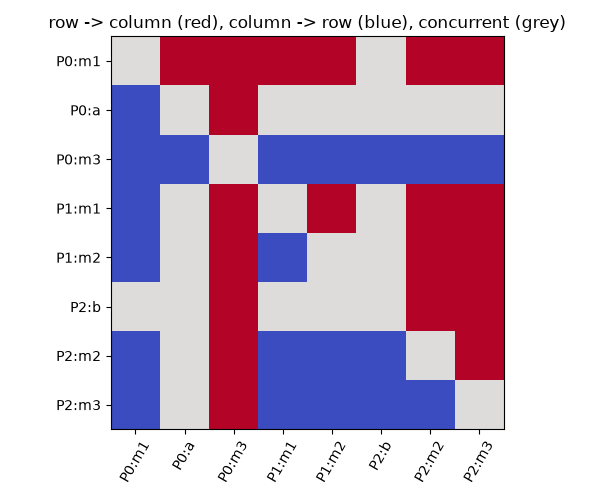
8 concurrent pairs
Exercise#
A vector clock grows with the number of processes. Why can no scalar clock capture concurrency exactly? Hint: in this history, find events x, y, z with x concurrent to y and y concurrent to z, but x before z. Could “equal timestamps” ever mean “concurrent”?
Total running time of the script: (0 minutes 0.137 seconds)
