Note
Go to the end to download the full example code or to run this example in your browser via JupyterLite.
Epidemic algorithms: push, pull and push-pull (Demers et al. 1987)#
Demers and colleagues at Xerox PARC kept the replicas of a database consistent by letting each replica periodically call a random other one and exchange updates, like an infection passing between people. They compared push (the caller sends what it knows), pull (the caller asks for what it lacks), and both together.
What to look for#
Push starts fast but finishes slowly: near the end, an informed caller mostly reaches peers that already know, so the uninformed fraction shrinks only by a constant factor per round. Pull is the reverse: an uninformed peer stays uninformed only if it calls another uninformed peer, so once most peers know, the uninformed fraction squares each round. Push-pull gets both phases and finishes first.
The history behind this experiment: Breakthroughs in Peer-to-Peer Networking.
Spread one update among 4096 replicas#
import matplotlib.pyplot as plt

import blockchainkit as bk
from blockchainkit.network.visualizers import plot_rumor_spread

n = 4096
modes = ("push", "pull", "push-pull")
runs = {mode: bk.network.spread_rumor(n, mode=mode, seed=3) for mode in modes}
for mode, run in runs.items():
    print(f"{mode:9s} {run.rounds} rounds")
assert runs["push-pull"].rounds < runs["pull"].rounds < runs["push"].rounds
push      21 rounds
pull      15 rounds
push-pull 11 rounds
Pull squares the residue#
If a fraction s is uninformed at the start of a round, an uninformed peer calls another uninformed peer with probability about s.
0.3325 -> 0.1145   (s**2 = 0.1106)
0.1145 -> 0.0127   (s**2 = 0.0131)
0.0127 -> 0.0000   (s**2 = 0.0002)
Push shrinks it by a constant factor#
An uninformed peer escapes every one of about n informed callers with probability (1 - 1/n)**n, close to 1/e.
residue = [1 - count / n for count in runs["push"].informed]
late = [
    after / before
    for before, after in zip(residue, residue[1:], strict=False)
    if 0.01 < before < 0.2
]
print([round(ratio, 2) for ratio in late])
assert all(0.25 < ratio < 0.5 for ratio in late)

fig, ax = plt.subplots(figsize=(7, 4))
plot_rumor_spread(runs, ax=ax)
fig.tight_layout()
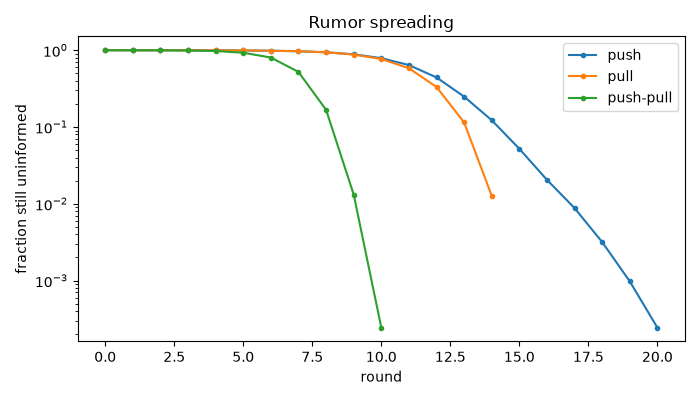
[0.43, 0.39, 0.43]
Exercise#
Demers et al. also studied rumor mongering: a peer stops pushing once it has called k peers that already knew. Implement it with a loop around random calls and measure the residue, the fraction never informed, for k = 1, 2, 3.
Total running time of the script: (0 minutes 0.392 seconds)
