Note
Go to the end to download the full example code or to run this example in your browser via JupyterLite.
Byzantine reliable broadcast: echo, then ready (Bracha 1987)#
A sender broadcasts a value, but it may be Byzantine and tell different
peers different things. Bracha’s protocol makes delivery consistent anyway:
peers echo what they received, become ready for a value once a large
quorum echoed it (or once t + 1 peers are ready for it), and deliver
once 2t + 1 peers are ready. With n > 3t, all correct peers deliver
the same value, or none delivers at all.
What to look for#
Naively trusting the sender splits the correct peers. Bracha’s quorums never do, for any split the faulty sender and its accomplices try, as long as at most a third are faulty. One faulty peer too many breaks agreement. Block gossip uses the same idea: a peer forwards what enough others vouch for.
The history behind this experiment: Breakthroughs in Peer-to-Peer Networking. See Exercises: networking for a worked solution to the exercise.
An equivocating sender#
Sender 0 is faulty and tells peers 1-3 “a” and peers 4-6 “b”.
import itertools

import matplotlib.pyplot as plt

import blockchainkit as bk

proposals = ["a", "a", "a", "a", "b", "b", "b"]
naive = {p: proposals[p] for p in range(1, 7)}
print("trust the sender:", naive)
assert len(set(naive.values())) == 2

result = bk.network.reliable_broadcast(7, {0}, proposals)
print("Bracha:", result.delivered)
assert result.agreement and result.totality
trust the sender: {1: 'a', 2: 'a', 3: 'a', 4: 'b', 5: 'b', 6: 'b'}
Bracha: {1: None, 2: None, 3: None, 4: None, 5: None, 6: None}
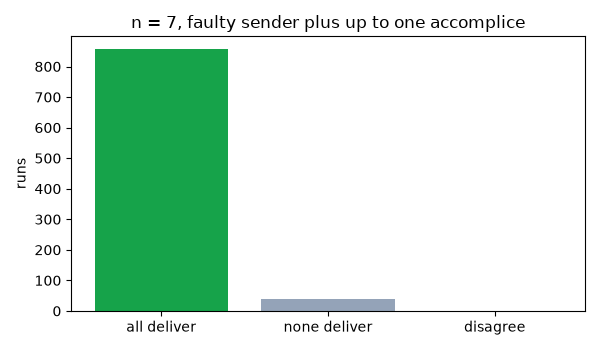
Every split, every set of faulty peers#
Check all faulty sets of size up to t and all ways to split the peers.
outcomes = {"all deliver": 0, "none deliver": 0, "disagree": 0}
for faulty in itertools.chain.from_iterable(itertools.combinations(range(7), f) for f in (1, 2)):
    if 0 not in faulty:
        continue
    for split in itertools.product("ab", repeat=7):
        r = bk.network.reliable_broadcast(7, faulty, list(split))
        delivered = set(r.delivered.values())
        if not r.agreement:
            outcomes["disagree"] += 1
        elif delivered == {None}:
            outcomes["none deliver"] += 1
        else:
            outcomes["all deliver"] += 1
print(outcomes)
assert outcomes["disagree"] == 0
{'all deliver': 856, 'none deliver': 40, 'disagree': 0}
One faulty peer too many#
With n = 4 the protocol tolerates t = 1. Two colluding faulty peers can make each correct peer see a different echo quorum.
broken = bk.network.reliable_broadcast(4, {0, 3}, ["a", "a", "b", "b"])
print(broken.delivered)
assert not broken.agreement

fig, ax = plt.subplots(figsize=(6, 3.5))
ax.bar(outcomes.keys(), outcomes.values(), color=["#16a34a", "#94a3b8", "#dc2626"])
ax.set(ylabel="runs", title="n = 7, faulty sender plus up to one accomplice")
fig.tight_layout()
{1: 'a', 2: 'b'}
Exercise#
The echo threshold is ceil((n + t + 1) / 2). Show that two sets of
that size among n peers share at least t + 1 peers, so at least one
correct peer, which echoes only one value. What goes wrong with a simple
majority threshold?
Total running time of the script: (0 minutes 0.166 seconds)
