Note
Go to the end to download the full example code or to run this example in your browser via JupyterLite.
Kademlia: routing by XOR distance (Maymounkov and Mazières 2002)#
A distributed hash table stores each key at the nodes whose identifiers are
closest to it, and lets any node find them without a central index.
Kademlia measures closeness as the XOR of two identifiers. Each node keeps
a k-bucket of contacts at every distance scale: a few nodes that share
none of its leading bits, a few that share exactly one, and so on. Every
hop toward a key at least fixes the next differing bit, so a lookup among n
nodes takes about log2 n hops at most and far fewer on average.
Ethereum’s discovery protocol and IPFS use Kademlia.
What to look for#
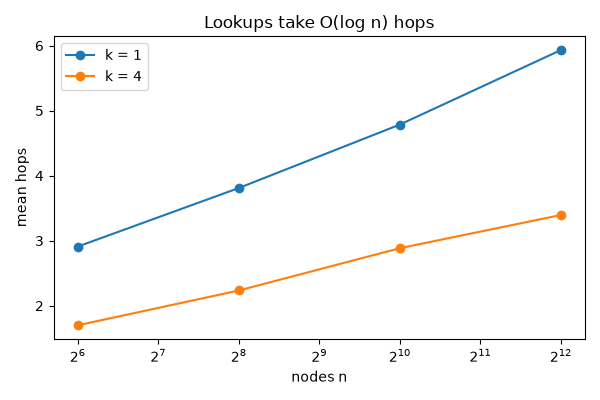
Every lookup ends at the true closest node. The number of hops grows by a constant each time n quadruples: logarithmic growth, a straight line on a log axis. Larger buckets mean fewer hops, at the price of bigger tables.
The history behind this experiment: Breakthroughs in Peer-to-Peer Networking.
Build networks of 64 to 4096 nodes#
from random import Random

import matplotlib.pyplot as plt
import numpy as np

import blockchainkit as bk

random = Random(1)
sizes = [64, 256, 1024, 4096]
mean_hops = {1: [], 4: []}
for n in sizes:
    ids = random.sample(range(2**32), n)
    for k in mean_hops:
        network = bk.network.KademliaNetwork(ids, bits=32, k=k, seed=1)
        hops = []
        for _ in range(200):
            target = random.randrange(2**32)
            result = network.lookup(random.choice(ids), target)
            assert result.found == network.closest(target, 1)[0]
            hops.append(result.hops)
        mean_hops[k].append(np.mean(hops))
print({k: [round(float(h), 2) for h in v] for k, v in mean_hops.items()})
steps = np.diff(mean_hops[1])
assert all(0.4 < step < 1.6 for step in steps)  # About one more hop per quadrupling.
{1: [2.91, 3.81, 4.79, 5.93], 4: [1.7, 2.23, 2.88, 3.4]}
One lookup, bit by bit#
Each hop shares a longer prefix with the target.
network = bk.network.KademliaNetwork(ids, bits=32, k=1, seed=1)
target = 0xDEADBEEF
for node in network.lookup(ids[0], target).path:
    shared = 32 - bk.network.xor_distance(node, target).bit_length()
    print(f"{node:032b}  shares {shared:2d} leading bits")

fig, ax = plt.subplots(figsize=(6, 4))
for k, hops in mean_hops.items():
    ax.semilogx(sizes, hops, "o-", base=2, label=f"k = {k}")
ax.set(xlabel="nodes n", ylabel="mean hops", title="Lookups take O(log n) hops")
ax.legend()
fig.tight_layout()
11101000111001111111010001001101  shares  2 leading bits
11000010111100000000101000010111  shares  3 leading bits
11010110001011101010100011011001  shares  4 leading bits
11011011100000111100110100100111  shares  5 leading bits
11011100100100110100000100111010  shares  6 leading bits
11011110011000100111111001010110  shares  8 leading bits
11011110101101011111001111100001  shares 11 leading bits
11011110101011000111001110111001  shares 15 leading bits
Exercise#
Real Kademlia queries alpha = 3 contacts in parallel and keeps the
k closest it has heard of. Why does that make a lookup robust when
some contacts are offline, and how would you count its hops?
Total running time of the script: (0 minutes 6.209 seconds)
