Note
Go to the end to download the full example code or to run this example in your browser via JupyterLite.
The Sybil attack: identities are cheap (Douceur 2002)#
In an open network, nothing stops one person from running many nodes. Douceur showed that without a trusted authority to certify identities, an attacker can always present as many as its resources allow, and any protocol that counts identities, such as voting or choosing which nodes store a key, can be taken over. Proof of work is one answer: it makes influence cost computation instead of counting identities.
What to look for#
When nodes choose their own identifiers, eight Sybils placed next to a key become the eight closest nodes, so every honest lookup lands on the attacker. When identifiers must be the hash of a public key, the attacker has to grind keys instead: the cost doubles with every extra bit it must match, but it is only a cost, not a barrier.
The history behind this experiment: Breakthroughs in Peer-to-Peer Networking.
Chosen identifiers#
from random import Random

import matplotlib.pyplot as plt

import blockchainkit as bk

bits = 20
honest = Random(2).sample(range(2**bits), 300)
key = bk.network.node_id(b"block 7", bits)
sybils = [key ^ i for i in range(1, 9) if key ^ i not in honest]
network = bk.network.KademliaNetwork(honest + sybils, bits=bits, k=4, seed=1)
captured = [network.lookup(source, key).found in sybils for source in honest]
print(f"{sum(captured)} of {len(honest)} honest lookups end at a Sybil")
assert all(captured)
assert set(network.closest(key, len(sybils))) == set(sybils)
300 of 300 honest lookups end at a Sybil
Identifiers bound to keys#
To land within d leading bits of the key, the attacker must try about 2**d public keys per Sybil.
costs = {}
for d in range(4, 15, 2):
    tries = 0
    for _ in range(4):  # Four Sybils per prefix length.
        while True:
            tries += 1
            candidate = bk.network.node_id(f"sybil key {tries}".encode(), bits)
            if (candidate ^ key) >> (bits - d) == 0:
                break
    costs[d] = tries / 4
print({d: round(c) for d, c in costs.items()})
assert costs[14] > 50 * costs[4]

nearest = min(bk.network.xor_distance(h, key) for h in honest)
print("closest honest node shares", bits - nearest.bit_length(), "leading bits with the key")

fig, ax = plt.subplots(figsize=(6, 4))
ax.semilogy(list(costs), list(costs.values()), "o", label="measured")
ax.semilogy(list(costs), [2**d for d in costs], color="black", label="2**d")
ax.set(xlabel="leading bits matched d", ylabel="key attempts per Sybil", title="Grinding cost")
ax.legend()
fig.tight_layout()
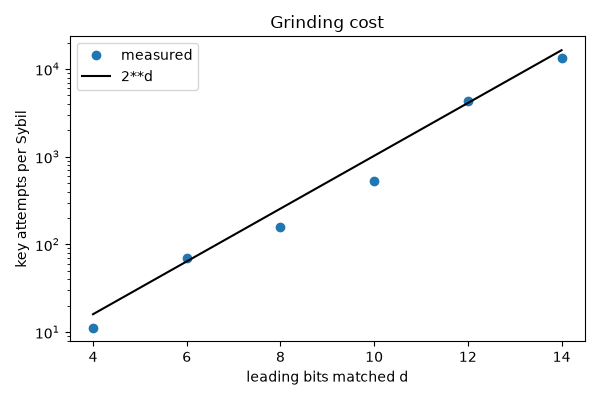
{4: 11, 6: 69, 8: 158, 10: 528, 12: 4358, 14: 13327}
closest honest node shares 7 leading bits with the key
Exercise#
S/Kademlia (2007) additionally requires each node ID to come with a proof-of-work puzzle solution. How does that change the attacker’s cost compared with the honest nodes’ cost of joining once?
Total running time of the script: (0 minutes 0.326 seconds)
