Note
Go to the end to download the full example code or to run this example in your browser via JupyterLite.
The DAO and reentrancy: checks, effects, interactions (2016)#
The DAO was an Ethereum fund holding about 14% of all ether. Its withdrawal code sent ether before updating the caller’s balance. Sending ether to a contract runs the contract’s code, so in June 2016 an attacker’s contract called back into the withdrawal from inside the payment, again and again, while its balance still showed the original deposit. About 3.6 million ether were drained, and Ethereum hard-forked to return them.
What to look for#
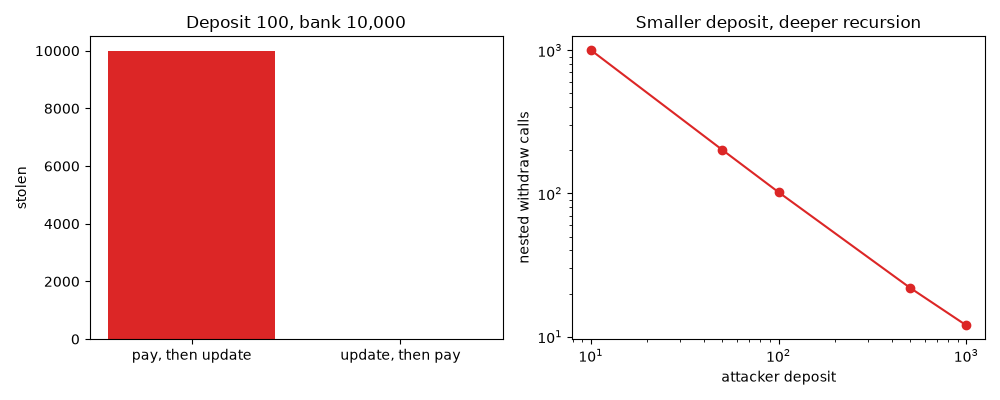
With the vulnerable order, the attacker withdraws its deposit once per nested call, until the bank is empty or the call-depth limit stops it. With the checks-effects-interactions order, the re-entrant call finds a zero balance and the attacker gets back exactly its deposit.
The history behind this experiment: Breakthroughs in Replicated Execution.
Drain a bank holding 10,000 of other people’s funds#
import matplotlib.pyplot as plt

import blockchainkit as bk

deposits = [10, 50, 100, 500, 1000]
vulnerable = [bk.vm.drain_bank(10_000, d) for d in deposits]
safe = [bk.vm.drain_bank(10_000, d, checks_effects_interactions=True) for d in deposits]
for d, v, s in zip(deposits, vulnerable, safe, strict=True):
    print(f"deposit {d:5d}: vulnerable steals {v.stolen} in {v.calls} calls, safe {s.stolen}")
assert all(s.stolen == 0 for s in safe)
assert all(
    v.withdrawn == ((10_000 + d) // d) * d for d, v in zip(deposits, vulnerable, strict=True)
)
deposit    10: vulnerable steals 10000 in 1002 calls, safe 0
deposit    50: vulnerable steals 10000 in 202 calls, safe 0
deposit   100: vulnerable steals 10000 in 102 calls, safe 0
deposit   500: vulnerable steals 10000 in 22 calls, safe 0
deposit  1000: vulnerable steals 10000 in 12 calls, safe 0
The depth limit#
Ethereum then limited calls to a depth of 1024; tiny deposits run into it.
deep = bk.vm.drain_bank(10**9, 10)
print(deep)
assert deep.calls == 1024 and deep.withdrawn == 10_240

fig, (left, right) = plt.subplots(1, 2, figsize=(10, 4))
left.bar(
    ["pay, then update", "update, then pay"],
    [vulnerable[2].stolen, safe[2].stolen],
    color=["#dc2626", "#16a34a"],
)
left.set(ylabel="stolen", title="Deposit 100, bank 10,000")
right.loglog(deposits, [v.calls for v in vulnerable], "o-", color="#dc2626")
right.set(
    xlabel="attacker deposit",
    ylabel="nested withdraw calls",
    title="Smaller deposit, deeper recursion",
)
fig.tight_layout()
ReentrancyResult(withdrawn=10240, deposited=10, calls=1024, bank_balance=999989770)
Exercise#
A reentrancy guard sets a lock flag on entry and refuses to run while it
is set. Add a guarded option to a copy of drain_bank’s loop. Why
do auditors still recommend checks-effects-interactions as well?
Total running time of the script: (0 minutes 0.267 seconds)
