Note
Go to the end to download the full example code or to run this example in your browser via JupyterLite.
Burnside’s lemma: counting necklaces#
Counts two-colored necklaces (up to rotation) and bracelets (up to rotation and reflection) by averaging fixed points, and checks each count against direct orbit enumeration.
from itertools import product

import matplotlib.pyplot as plt

from mathematicskit.abstract_algebra import CyclicGroup, DihedralGroup, count_orbits, orbits
Necklaces and bracelets of n beads#
sizes = range(3, 10)
necklaces, bracelets = [], []
for n in sizes:
    words = [tuple(w) for w in product((0, 1), repeat=n)]
    rotate = lambda g, w: w[g:] + w[:g]  # noqa: E731
    permute = lambda g, w: tuple(w[g.index(i)] for i in range(len(w)))  # noqa: E731
    necklaces.append(count_orbits(CyclicGroup(n), words, rotate))
    bracelets.append(count_orbits(DihedralGroup(n), words, permute))
    assert necklaces[-1] == len(orbits(CyclicGroup(n), words, rotate))
    print(f"n = {n}: {2**n} colorings, {necklaces[-1]} necklaces, {bracelets[-1]} bracelets")
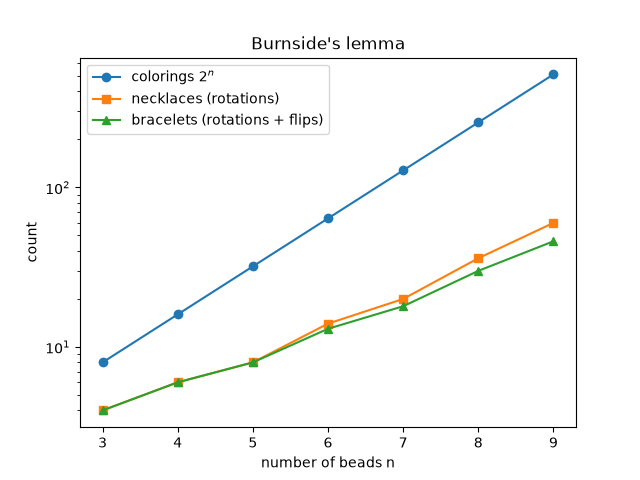
n = 3: 8 colorings, 4 necklaces, 4 bracelets
n = 4: 16 colorings, 6 necklaces, 6 bracelets
n = 5: 32 colorings, 8 necklaces, 8 bracelets
n = 6: 64 colorings, 14 necklaces, 13 bracelets
n = 7: 128 colorings, 20 necklaces, 18 bracelets
n = 8: 256 colorings, 36 necklaces, 30 bracelets
n = 9: 512 colorings, 60 necklaces, 46 bracelets
Orbit counts grow like 2^n / n#
fig, ax = plt.subplots()
ax.semilogy(list(sizes), [2**n for n in sizes], "o-", label="colorings $2^n$")
ax.semilogy(list(sizes), necklaces, "s-", label="necklaces (rotations)")
ax.semilogy(list(sizes), bracelets, "^-", label="bracelets (rotations + flips)")
ax.set_xlabel("number of beads n")
ax.set_ylabel("count")
ax.legend()
ax.set_title("Burnside's lemma")
Text(0.5, 1.0, "Burnside's lemma")
Total running time of the script: (0 minutes 0.664 seconds)
