Note
Go to the end to download the full example code or to run this example in your browser via JupyterLite.
Galois’s permutation groups: S_3 permuting the roots of x^3 - 2#
Galois turned the question “is this equation solvable?” into a question about a group of permutations of its roots. The roots of \(x^3 - 2\) are \(\sqrt[3]{2}\), \(\sqrt[3]{2}\,\omega\) and \(\sqrt[3]{2}\,\omega^2\) (with \(\omega = e^{2\pi i/3}\)). Complex conjugation swaps the two non-real roots, multiplication by \(\omega\) cycles all three, and closing these two permutations under composition gives Galois’s group – the full symmetric group \(S_3\), which is non-abelian.
import matplotlib.pyplot as plt
import numpy as np

from mathematicskit.abstract_algebra import PermutationGroup, group_properties
The roots and the two generating permutations#
roots = np.cbrt(2.0) * np.exp(2j * np.pi * np.arange(3) / 3)
print("roots of x^3 - 2:", np.round(roots, 4))
print("max |r^3 - 2|:", np.max(np.abs(roots**3 - 2)))

conjugation = (0, 2, 1)  # root 0 is real; roots 1 and 2 swap
rotation = (1, 2, 0)  # r_k -> r_{k+1}: multiply by omega
galois = PermutationGroup(3, generators=[conjugation, rotation])
print(f"closure of the 2 generators: {galois.order} permutations")
print(f"equals the full symmetric group S_3: {galois.order == PermutationGroup(3).order}")
roots of x^3 - 2: [ 1.2599+0.j     -0.63  +1.0911j -0.63  -1.0911j]
max |r^3 - 2|: 2.975562852466339e-15
closure of the 2 generators: 6 permutations
equals the full symmetric group S_3: True
Non-commutativity – the feature Galois’s theory turns on#
ab = galois.operate(conjugation, rotation)
ba = galois.operate(rotation, conjugation)
print(f"conj . rot = {ab},  rot . conj = {ba},  equal: {ab == ba}")
print(f"abelian: {group_properties(galois).is_abelian}")
conj . rot = (2, 1, 0),  rot . conj = (1, 0, 2),  equal: False
abelian: False
Every element of the Galois group, drawn as arrows between roots#
fig, axes = plt.subplots(2, 3, figsize=(10, 6.5))
circle = np.exp(1j * np.linspace(0, 2 * np.pi, 200)) * np.cbrt(2.0)
for ax, perm in zip(axes.flat, galois.elements, strict=False):
    ax.plot(circle.real, circle.imag, color="0.85", lw=1)
    ax.scatter(roots.real, roots.imag, s=60, color="C0", zorder=3)
    for k, z in enumerate(roots):
        ax.annotate(f"$r_{k}$", (z.real * 1.25, z.imag * 1.25), ha="center", va="center")
        target = roots[perm[k]]
        if perm[k] != k:
            ax.annotate(
                "",
                xy=(target.real, target.imag),
                xytext=(z.real, z.imag),
                arrowprops=dict(arrowstyle="->", color="C3", connectionstyle="arc3,rad=0.25", shrinkA=6, shrinkB=6),
            )
    ax.axhline(0, color="0.9", lw=0.8, zorder=0)
    ax.set_title(str(perm), fontsize=10)
    ax.set_aspect("equal")
    ax.set_xlim(-1.8, 1.8)
    ax.set_ylim(-1.8, 1.8)
    ax.axis("off")
fig.suptitle(r"Galois group of $x^3-2$: the 6 permutations of its roots ($S_3$)")
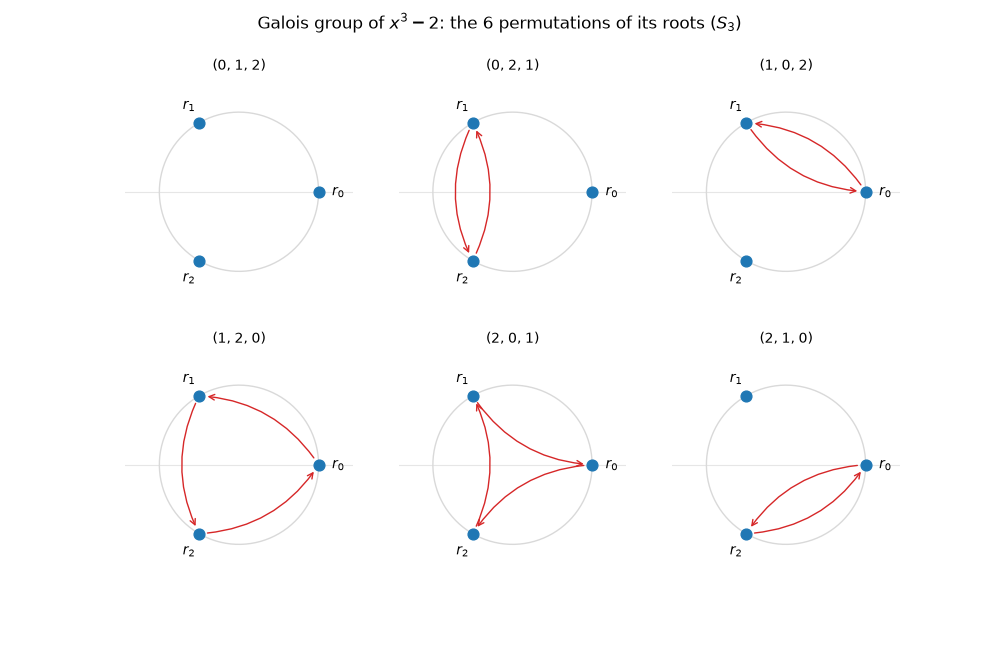
Text(0.5, 0.98, 'Galois group of $x^3-2$: the 6 permutations of its roots ($S_3$)')
Which pairs commute?#
els = galois.elements
commute = np.array([[galois.operate(a, b) == galois.operate(b, a) for b in els] for a in els])
fig, ax = plt.subplots(figsize=(5, 4.5))
ax.imshow(commute, cmap="RdYlGn", vmin=0, vmax=1)
labels = [str(e) for e in els]
ax.set_xticks(range(len(els)), labels, rotation=45, fontsize=8)
ax.set_yticks(range(len(els)), labels, fontsize=8)
ax.set_title(r"$ab = ba$? (green: commute, red: do not)")
fig.tight_layout()
print(f"commuting ordered pairs: {commute.sum()} of {commute.size}")
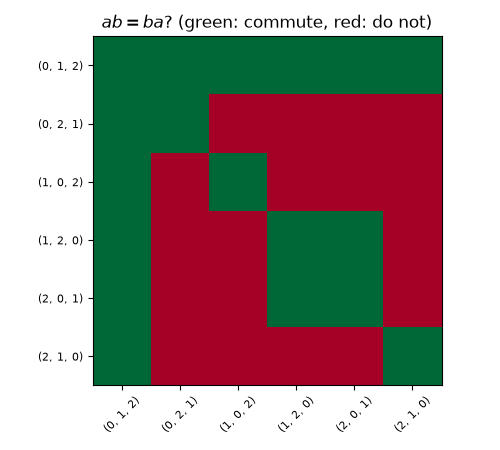
commuting ordered pairs: 18 of 36
Total running time of the script: (0 minutes 0.103 seconds)
