
Note
Go to the end to download the full example code or to run this example in your browser via JupyterLite.
Hamilton’s quaternions: the group Q_8#
Verifies Hamilton’s relations i^2 = j^2 = k^2 = ijk = -1 in the quaternion group, shows that it is non-abelian, and prints its multiplication table.
from mathematicskit.abstract_algebra import QuaternionGroup, all_subgroups, is_normal_subgroup
from mathematicskit.abstract_algebra.visualizers.plots import plot_cayley_table
Hamilton’s relations#
i^2 = -1
j^2 = -1
k^2 = -1
ijk = -1
ij = k, but ji = -k
Multiplication table#
print("\n      " + "".join(f"{b:>4}" for b in q.elements))
for a in q.elements:
    print(f"{a:>4}  " + "".join(f"{q.operate(a, b):>4}" for b in q.elements))
       1  -1   i  -i   j  -j   k  -k
 1     1  -1   i  -i   j  -j   k  -k
-1    -1   1  -i   i  -j   j  -k   k
 i     i  -i  -1   1   k  -k  -j   j
-i    -i   i   1  -1  -k   k   j  -j
 j     j  -j  -k   k  -1   1   i  -i
-j    -j   j   k  -k   1  -1  -i   i
 k     k  -k   j  -j  -i   i  -1   1
-k    -k   k  -j   j   i  -i   1  -1
Non-abelian, yet every subgroup is normal#
subgroups = all_subgroups(q)
print(f"\n{len(subgroups)} subgroups, all normal: {all(is_normal_subgroup(q, h) for h in subgroups)}")
plot_cayley_table(q)
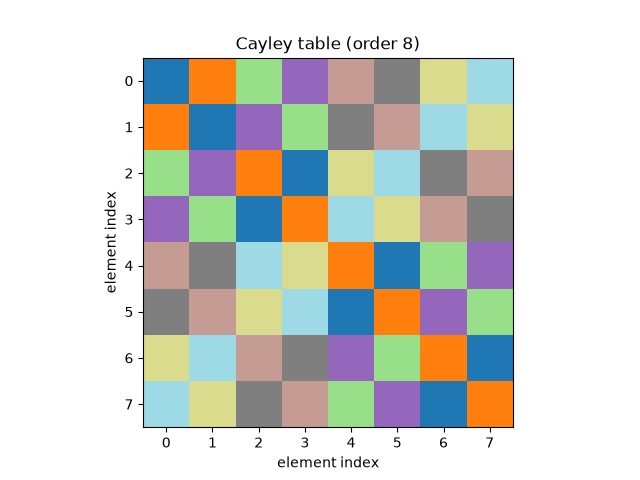
6 subgroups, all normal: True

<Axes: title={'center': 'Cayley table (order 8)'}, xlabel='element index', ylabel='element index'>
Total running time of the script: (0 minutes 0.023 seconds)
