
Note
Go to the end to download the full example code or to run this example in your browser via JupyterLite.
The complex-step derivative: no cancellation#
Compares the central difference with the complex-step derivative Im f(x + ih)/h as the step shrinks. The central difference is ruined by subtractive cancellation, while the complex step stays accurate to machine precision at any tiny step.
import matplotlib.pyplot as plt
import numpy as np

from mathematicskit.calculus import central_difference, complex_step_derivative
Error against step size#
def f(x):
    return np.exp(x) / np.sqrt(np.sin(x) ** 3 + np.cos(x) ** 3)  # Squire and Trapp's test function


x0 = 1.5
reference = complex_step_derivative(f, x0, h=1e-200)
hs = np.logspace(-20, -1, 60)
central = [max(abs(central_difference(f, x0, h=h) - reference), 1e-17) for h in hs]
complex_step = [max(abs(complex_step_derivative(f, x0, h=h) - reference), 1e-17) for h in hs]
print(f"f'({x0}) = {reference:.15f}")

fig, ax = plt.subplots()
ax.loglog(hs, central, "o-", ms=3, label="central difference")
ax.loglog(hs, complex_step, "s-", ms=3, label="complex step")
ax.set_xlabel("step h")
ax.set_ylabel("|error| (floored at 1e-17)")
ax.legend()
ax.set_title("Complex-step differentiation (Lyness and Moler, 1967)")
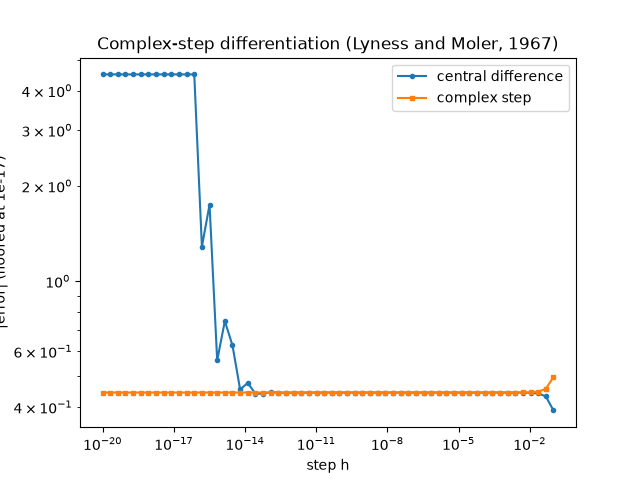
f'(1.5) = 4.497780053946161

Text(0.5, 1.0, 'Complex-step differentiation (Lyness and Moler, 1967)')
Total running time of the script: (0 minutes 0.048 seconds)
