
Note
Go to the end to download the full example code or to run this example in your browser via JupyterLite.
Euler’s officers: orthogonal Latin squares#
Builds a pair of orthogonal Latin squares of order 5 and superimposes them so that every (rank, regiment) pair appears exactly once, the arrangement Euler’s 36-officers problem asks for. It then checks by brute force that no such pair exists for order 2.
from itertools import permutations

import matplotlib.pyplot as plt
import numpy as np

from mathematicskit.combinatorics import are_orthogonal, is_latin_square, orthogonal_latin_square_pair
An orthogonal pair of order 5#
ranks, regiments = orthogonal_latin_square_pair(5)
print("ranks:\n", ranks)
print("regiments:\n", regiments)
print(f"orthogonal: {are_orthogonal(ranks, regiments)}")

fig, axes = plt.subplots(1, 2, figsize=(8, 4))
for ax, square, title in zip(axes, (ranks, regiments), ("rank", "regiment"), strict=False):
    ax.imshow(square, cmap="tab10")
    for (i, j), v in np.ndenumerate(square):
        ax.text(j, i, str(v), ha="center", va="center", color="w")
    ax.set_title(title)
    ax.axis("off")
fig.suptitle("Every (rank, regiment) pair appears exactly once")
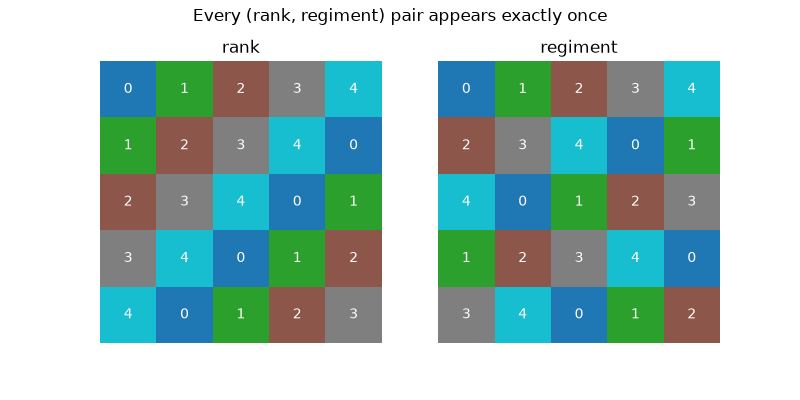
ranks:
 [[0 1 2 3 4]
 [1 2 3 4 0]
 [2 3 4 0 1]
 [3 4 0 1 2]
 [4 0 1 2 3]]
regiments:
 [[0 1 2 3 4]
 [2 3 4 0 1]
 [4 0 1 2 3]
 [1 2 3 4 0]
 [3 4 0 1 2]]
orthogonal: True

Text(0.5, 0.98, 'Every (rank, regiment) pair appears exactly once')
No orthogonal pair of order 2#
squares = [np.array(rows) for rows in permutations(permutations(range(2)), 2)]
latin = [s for s in squares if is_latin_square(s)]
found = any(are_orthogonal(a, b) for a in latin for b in latin)
print(f"order 2: {len(latin)} Latin squares, orthogonal pair exists: {found}")
order 2: 2 Latin squares, orthogonal pair exists: False
Total running time of the script: (0 minutes 0.029 seconds)
