Note
Go to the end to download the full example code or to run this example in your browser via JupyterLite.
The Erdős-Szekeres theorem: monotone subsequences#
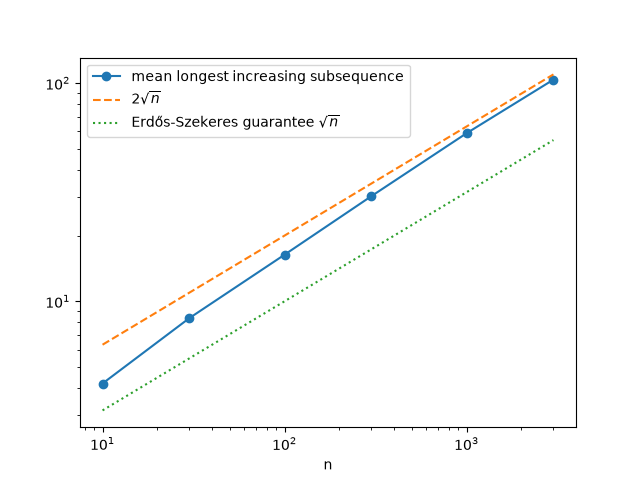
Any sequence of (r-1)(s-1)+1 distinct numbers contains an increasing subsequence of length r or a decreasing one of length s. This example finds the longest monotone subsequences of random permutations and shows that their length grows like 2 sqrt(n).
import matplotlib.pyplot as plt
import numpy as np

from mathematicskit.combinatorics import longest_decreasing_subsequence, longest_increasing_subsequence
Every 10-term sequence has a monotone run of length 4#
rng = np.random.default_rng(1)
for _ in range(5):
    seq = rng.permutation(10).tolist()
    up, down = longest_increasing_subsequence(seq), longest_decreasing_subsequence(seq)
    print(f"{seq}: increasing {up}, decreasing {down}")
[8, 4, 7, 0, 1, 2, 5, 9, 6, 3]: increasing [0, 1, 2, 5, 6], decreasing [8, 7, 6, 3]
[0, 1, 8, 6, 5, 7, 9, 2, 3, 4]: increasing [0, 1, 2, 3, 4], decreasing [8, 6, 5, 4]
[3, 1, 5, 6, 9, 0, 7, 2, 8, 4]: increasing [1, 5, 6, 7, 8], decreasing [9, 8, 4]
[0, 7, 9, 3, 2, 6, 4, 8, 5, 1]: increasing [0, 2, 4, 5], decreasing [9, 8, 5, 1]
[3, 1, 9, 2, 8, 4, 0, 5, 7, 6]: increasing [1, 2, 4, 5, 6], decreasing [9, 8, 7, 6]
A sequence that meets the bound exactly#
sharp = [7, 8, 9, 4, 5, 6, 1, 2, 3]
print(f"\n{sharp}: longest runs {len(longest_increasing_subsequence(sharp))} and {len(longest_decreasing_subsequence(sharp))}")
[7, 8, 9, 4, 5, 6, 1, 2, 3]: longest runs 3 and 3
Growth for random permutations#
sizes = [10, 30, 100, 300, 1000, 3000]
means = [np.mean([len(longest_increasing_subsequence(rng.permutation(n).tolist())) for _ in range(40)]) for n in sizes]
fig, ax = plt.subplots()
ax.loglog(sizes, means, "o-", label="mean longest increasing subsequence")
ax.loglog(sizes, 2 * np.sqrt(sizes), "--", label=r"$2\sqrt{n}$")
ax.loglog(sizes, np.sqrt(sizes), ":", label=r"Erdős-Szekeres guarantee $\sqrt{n}$")
ax.set_xlabel("n")
ax.legend()
<matplotlib.legend.Legend object at 0x1133478c0>
Total running time of the script: (0 minutes 0.059 seconds)
