
Note
Go to the end to download the full example code or to run this example in your browser via JupyterLite.
Elementary cellular automata and Conway’s Game of Life#
Rule 30 (chaotic) and rule 90 (a discrete Sierpinski triangle) from a single seed cell, plus a glider gun-free Game of Life demonstration using the classic “glider” spaceship.
import numpy as np

from mathematicskit.fractals_chaos import ElementaryCA, GameOfLife
from mathematicskit.fractals_chaos.visualizers.plots import plot_ca_spacetime
Rule 30: chaotic, used as a pseudo-random number generator by Wolfram’s Mathematica#
rule30 = ElementaryCA(rule=30, width=101)
history30 = rule30.run(60)
plot_ca_spacetime(history30)
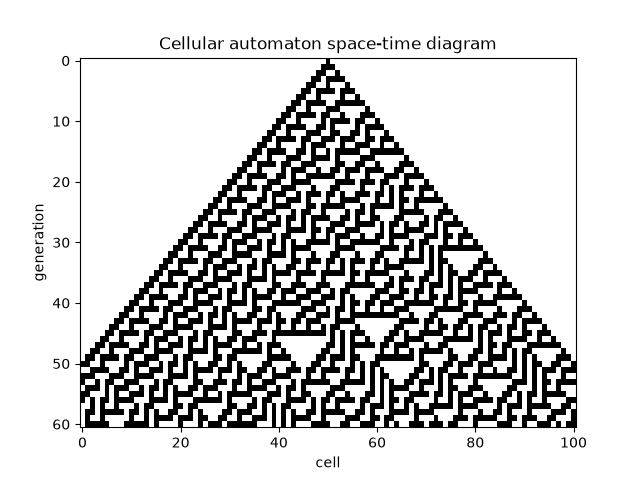
<Axes: title={'center': 'Cellular automaton space-time diagram'}, xlabel='cell', ylabel='generation'>
Rule 90: XOR of the two neighbors, a discrete Sierpinski triangle#
rule90 = ElementaryCA(rule=90, width=101)
history90 = rule90.run(60)
plot_ca_spacetime(history90)
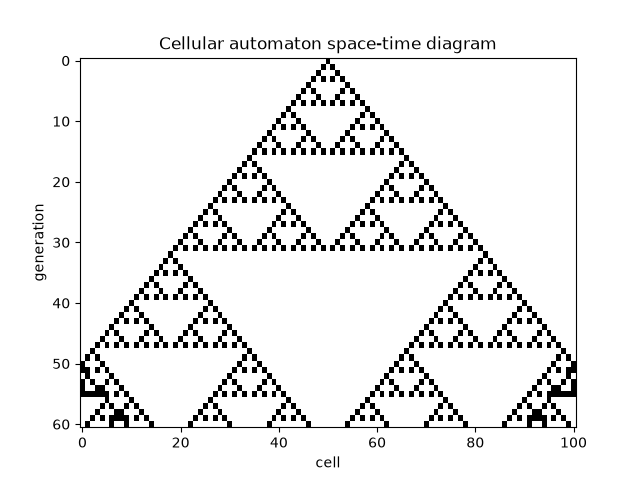
<Axes: title={'center': 'Cellular automaton space-time diagram'}, xlabel='cell', ylabel='generation'>
Conway’s Game of Life: the “glider” spaceship#
A glider translates by (1, 1) every 4 generations.
grid = np.zeros((20, 20), dtype=np.int64)
glider = [(0, 1), (1, 2), (2, 0), (2, 1), (2, 2)]
for i, j in glider:
    grid[i, j] = 1

life = GameOfLife(grid)
history_life = life.run(4)
print("glider translated by one cell diagonally after 4 generations:", bool(np.array_equal(history_life[4, 1:, 1:], history_life[0, :-1, :-1])))
glider translated by one cell diagonally after 4 generations: True
Total running time of the script: (0 minutes 0.220 seconds)
