
Note
Go to the end to download the full example code or to run this example in your browser via JupyterLite.
Diffusion-limited aggregation#
Grows a cluster by releasing random walkers that stick on first contact, and measures its fractal dimension from the mass-radius relation N(r) ~ r^D.
import matplotlib.pyplot as plt
import numpy as np

from mathematicskit.fractals_chaos import dla_cluster
Grow and draw the cluster#
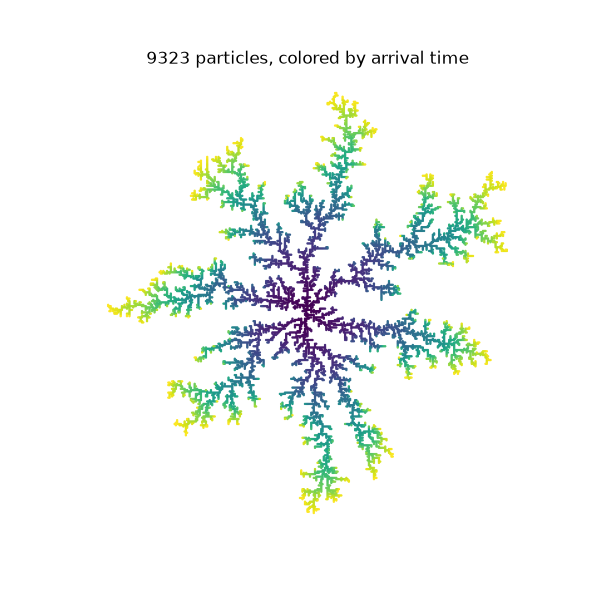
Text(0.5, 1.0, '9323 particles, colored by arrival time')
Mass-radius scaling#
r = np.sqrt((cluster**2).sum(axis=1))
radii = np.logspace(np.log10(5), np.log10(r.max() / 2), 12)
mass = np.array([(r < rho).sum() for rho in radii])
slope = np.polyfit(np.log(radii), np.log(mass), 1)[0]
print(f"mass-radius dimension D = {slope:.3f} (Witten and Sander: about 1.7)")

fig, ax = plt.subplots()
ax.loglog(radii, mass, "o", label="particles within radius r")
ax.loglog(radii, mass[0] * (radii / radii[0]) ** slope, "--", label=f"slope {slope:.2f}")
ax.loglog(radii, mass[0] * (radii / radii[0]) ** 2, ":", label="slope 2 (compact disk)")
ax.set_xlabel("r")
ax.set_ylabel("N(r)")
ax.legend()
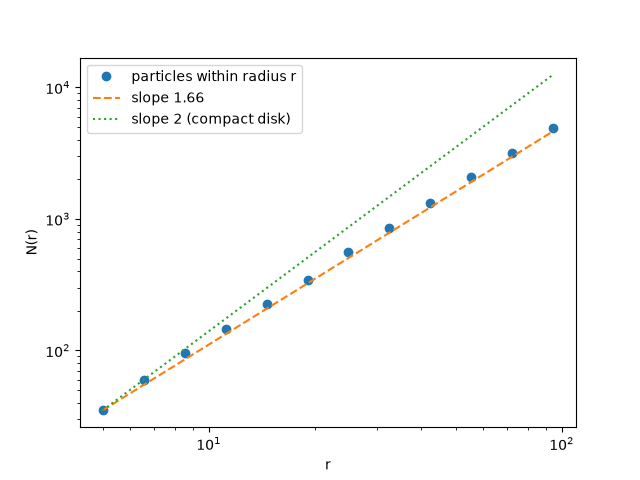
mass-radius dimension D = 1.663 (Witten and Sander: about 1.7)

<matplotlib.legend.Legend object at 0x113149d30>
Total running time of the script: (0 minutes 0.767 seconds)
