Note
Go to the end to download the full example code or to run this example in your browser via JupyterLite.
The Hausdorff distance between shapes#
Compares a circle with approximating polygons. The Hausdorff distance measures the worst-case gap between the two shapes and shrinks like 1/n^2 as the polygon gains sides; a single stray point makes it large even though every other point matches.
import matplotlib.pyplot as plt
import numpy as np

from mathematicskit.geometry import hausdorff_distance
A circle against inscribed polygons#
t = np.linspace(0, 2 * np.pi, 4000, endpoint=False)
circle = np.column_stack([np.cos(t), np.sin(t)])
sides = [4, 8, 16, 32, 64]
gaps = []
for n in sides:
    corners = np.column_stack([np.cos(2 * np.pi * np.arange(n + 1) / n), np.sin(2 * np.pi * np.arange(n + 1) / n)])
    polygon = np.vstack([np.linspace(corners[k], corners[k + 1], 200) for k in range(n)])
    gaps.append(hausdorff_distance(circle, polygon))
    print(f"{n:2d}-gon: Hausdorff distance {gaps[-1]:.5f}, exact 1 - cos(pi/n) = {1 - np.cos(np.pi / n):.5f}")

fig, ax = plt.subplots()
ax.loglog(sides, gaps, "o-", label="Hausdorff distance")
ax.loglog(sides, [np.pi**2 / (2 * n**2) for n in sides], "--", label=r"$\pi^2 / 2n^2$")
ax.set_xlabel("polygon sides n")
ax.legend()
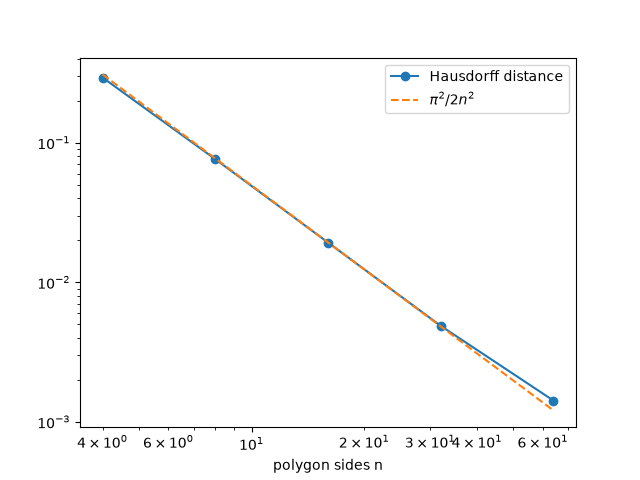
 4-gon: Hausdorff distance 0.29291, exact 1 - cos(pi/n) = 0.29289
 8-gon: Hausdorff distance 0.07614, exact 1 - cos(pi/n) = 0.07612
16-gon: Hausdorff distance 0.01924, exact 1 - cos(pi/n) = 0.01921
32-gon: Hausdorff distance 0.00486, exact 1 - cos(pi/n) = 0.00482
64-gon: Hausdorff distance 0.00142, exact 1 - cos(pi/n) = 0.00120

<matplotlib.legend.Legend object at 0x113ebc2f0>
One outlier dominates#
circle vs. circle plus one far point: 2.000
Total running time of the script: (0 minutes 0.115 seconds)
