
Note
Go to the end to download the full example code or to run this example in your browser via JupyterLite.
Kuhn’s Hungarian method: the assignment problem#
Assigns workers to jobs at minimum total cost. Brute force would check n! assignments; the Hungarian method solves the problem in polynomial time, and matches brute force on a small instance.
import time
from itertools import permutations

import matplotlib.pyplot as plt
import numpy as np

from mathematicskit.graph_theory import solve_assignment
A small instance, checked by brute force#
rng = np.random.default_rng(0)
cost = rng.integers(1, 30, size=(6, 6))
result = solve_assignment(cost)
brute = min(sum(cost[i, p[i]] for i in range(6)) for p in permutations(range(6)))
print(cost)
print(f"optimal assignment: {dict(zip(result.rows.tolist(), result.cols.tolist(), strict=False))}, cost {result.total_cost} (brute force {brute})")

fig, ax = plt.subplots()
ax.imshow(cost, cmap="Blues")
ax.plot(result.cols, result.rows, "rx", ms=14, mew=3)
ax.set_xlabel("job")
ax.set_ylabel("worker")
ax.set_title("Chosen entries (red): one per row and column")
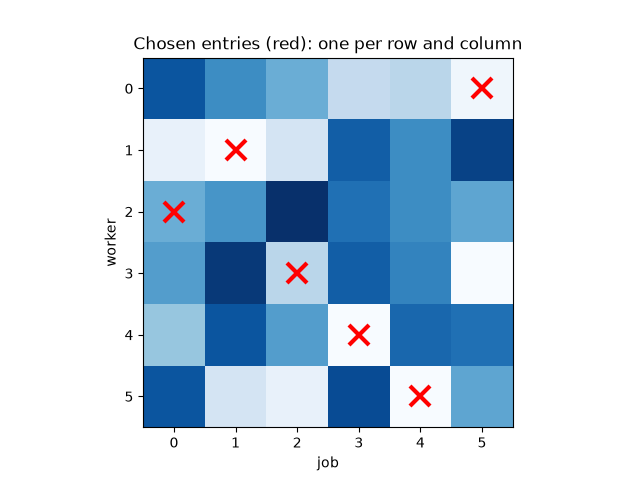
[[25 19 15  8  9  2]
 [ 3  1  6 24 19 27]
 [15 18 29 22 19 16]
 [17 28  9 24 20  1]
 [12 25 17  1 23 22]
 [25  6  3 26  1 16]]
optimal assignment: {0: 5, 1: 1, 2: 0, 3: 2, 4: 3, 5: 4}, cost 29.0 (brute force 29)

Text(0.5, 1.0, 'Chosen entries (red): one per row and column')
Large instances are fast#
for n in (100, 400, 1600):
    big = rng.random((n, n))
    start = time.perf_counter()
    total = solve_assignment(big).total_cost
    print(f"n = {n:4d}: optimal cost {total:.3f} in {time.perf_counter() - start:.3f} s ({n}! assignments)")
n =  100: optimal cost 1.721 in 0.000 s (100! assignments)
n =  400: optimal cost 1.604 in 0.003 s (400! assignments)
n = 1600: optimal cost 1.651 in 0.073 s (1600! assignments)
Total running time of the script: (0 minutes 0.106 seconds)
