Note
Go to the end to download the full example code or to run this example in your browser via JupyterLite.
Turán’s theorem: the densest clique-free graphs#
Builds the Turán graph T(n, r), checks that it has no clique of size r + 1, and shows that adding any missing edge creates one. For r = 2 this is Mantel’s theorem: a triangle-free graph on n vertices has at most n^2/4 edges.
import matplotlib.pyplot as plt

from mathematicskit.graph_theory import clique_number, random_graph, turan_graph, turan_number
Turán graphs#
for n, r in [(8, 2), (9, 3), (12, 4)]:
    g = turan_graph(n, r)
    print(f"T({n}, {r}): {len(g.edges())} edges = turan_number {turan_number(n, r)}, largest clique {clique_number(g)}")
T(8, 2): 16 edges = turan_number 16, largest clique 2
T(9, 3): 27 edges = turan_number 27, largest clique 3
T(12, 4): 54 edges = turan_number 54, largest clique 4
Random graphs above the Turán number contain big cliques#
n, r = 12, 3
counts, cliques = [], []
for seed in range(300):
    g = random_graph(n, 0.55, seed=seed)
    counts.append(len(g.edges()))
    cliques.append(clique_number(g))

fig, ax = plt.subplots()
ax.scatter(counts, cliques, alpha=0.4)
ax.axvline(turan_number(n, r), color="tab:red", ls="--", label=f"Turán number t({n}, {r}) = {turan_number(n, r)}")
ax.set_xlabel("edges")
ax.set_ylabel("clique number")
ax.legend()
ax.set_title("Every graph right of the line has a clique of size 4")
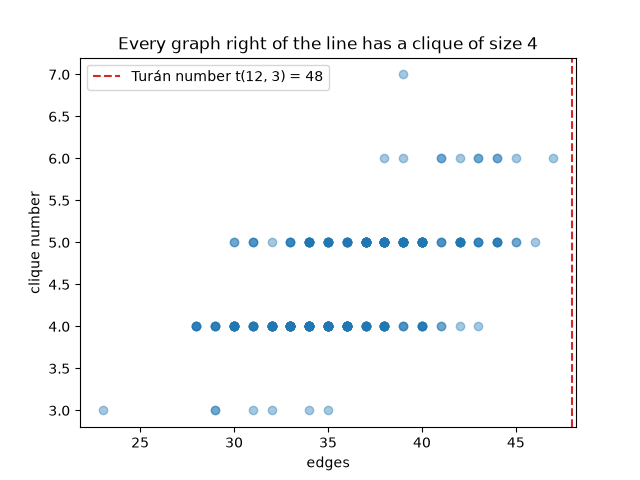
Text(0.5, 1.0, 'Every graph right of the line has a clique of size 4')
Total running time of the script: (0 minutes 0.044 seconds)
