Note
Go to the end to download the full example code or to run this example in your browser via JupyterLite.
Floyd-Warshall: all-pairs shortest paths#
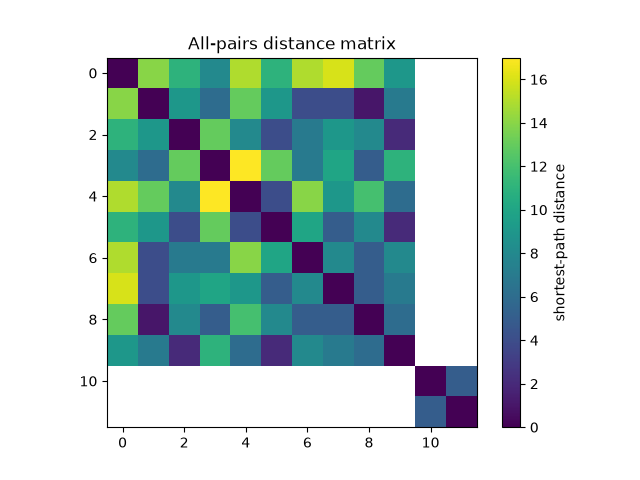
Computes every shortest-path distance in a weighted graph at once with the Floyd-Warshall algorithm, and checks that it agrees with running Dijkstra’s algorithm from every vertex.
import matplotlib.pyplot as plt
import numpy as np

from mathematicskit.graph_theory import Graph, dijkstra_shortest_paths, floyd_warshall_shortest_paths
A small road network#
rng = np.random.default_rng(1)
n = 12
g = Graph(n)
for u in range(n):
    for v in range(u + 1, n):
        if rng.random() < 0.3:
            g.add_edge(u, v, weight=float(rng.integers(1, 10)))

all_pairs = floyd_warshall_shortest_paths(g).distances
from_each = dijkstra_shortest_paths(g).distances
print(f"Floyd-Warshall agrees with n Dijkstra runs: {np.allclose(all_pairs, from_each)}")
print(f"diameter (longest shortest path): {np.max(all_pairs[np.isfinite(all_pairs)]):.0f}")

fig, ax = plt.subplots()
image = ax.imshow(all_pairs, cmap="viridis")
fig.colorbar(image, ax=ax, label="shortest-path distance")
ax.set_title("All-pairs distance matrix")
Floyd-Warshall agrees with n Dijkstra runs: True
diameter (longest shortest path): 17

Text(0.5, 1.0, 'All-pairs distance matrix')
Total running time of the script: (0 minutes 0.029 seconds)
