
Note
Go to the end to download the full example code or to run this example in your browser via JupyterLite.
Elias’ universal code for the integers (1975)#
To send a positive integer of unknown size, Elias’ gamma code writes \(\lfloor\log_2 n\rfloor\) zeros, then \(n\) in binary: the zeros announce the length. It is a prefix code for all integers at once, at most twice the optimal length, and universal: on any decreasing distribution it codes within a constant factor of the entropy.
import matplotlib.pyplot as plt
import numpy as np

from mathematicskit.information_theory import elias_gamma_decode, elias_gamma_encode, entropy

for n in (1, 2, 3, 4, 7, 8, 100):
    print(f"{n:>4} -> {elias_gamma_encode(n)}")
stream = "".join(elias_gamma_encode(n) for n in (5, 1, 17, 2))
print(f"{stream} -> {elias_gamma_decode(stream)}")
   1 -> 1
   2 -> 010
   3 -> 011
   4 -> 00100
   7 -> 00111
   8 -> 0001000
 100 -> 0000001100100
001011000010001010 -> [5, 1, 17, 2]
Codeword length, and universality#
n = np.arange(1, 1025)
fig, (ax1, ax2) = plt.subplots(1, 2, figsize=(11, 4))
ax1.plot(n, [len(elias_gamma_encode(int(k))) for k in n], drawstyle="steps-post", label="Elias gamma")
ax1.plot(n, np.log2(n), label=r"$\log_2 n$")
ax1.set_xscale("log", base=2)
ax1.set_xlabel("n")
ax1.set_ylabel("bits")
ax1.legend()

ratios = []
qs = np.linspace(0.05, 0.95, 19)
for q in qs:  # geometric source P(n) = (1-q) q^(n-1)
    pmf = (1 - q) * q ** (n - 1)
    ratios.append(sum(pmf * [len(elias_gamma_encode(int(k))) for k in n]) / entropy(pmf))
ax2.plot(qs, ratios, "o-")
ax2.set_xlabel("geometric source parameter q")
ax2.set_ylabel("average length / entropy")
ax2.set_title("Bounded overhead without knowing the source")
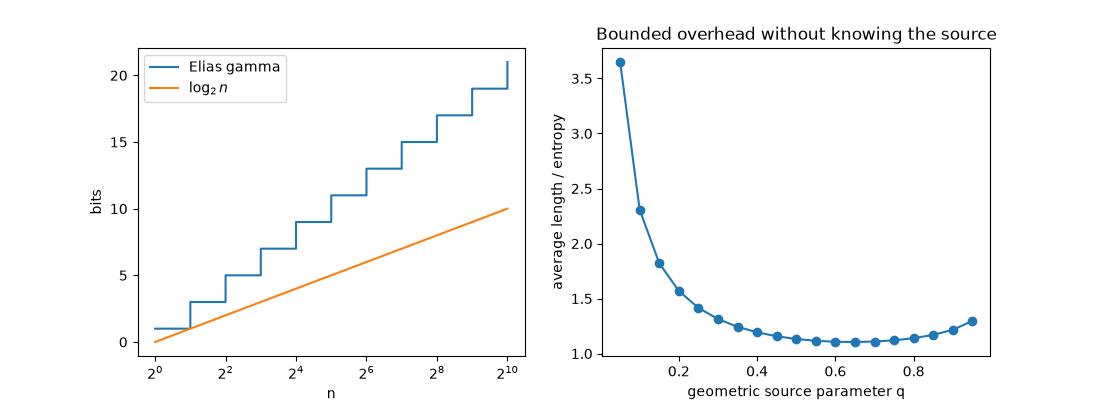
Text(0.5, 1.0, 'Bounded overhead without knowing the source')
Total running time of the script: (0 minutes 0.775 seconds)
