
Note
Go to the end to download the full example code or to run this example in your browser via JupyterLite.
Lempel-Ziv compression (1977-1978)#
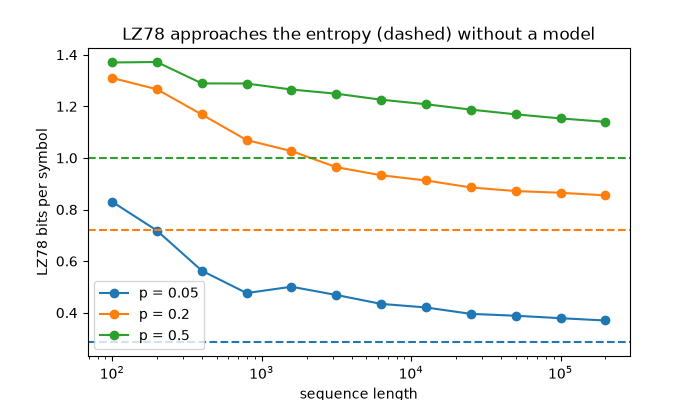
Ziv and Lempel’s LZ78 parses a sequence into phrases, each the longest
earlier phrase plus one new symbol, and sends (phrase index, symbol)
pairs. It knows nothing about the source, yet for any stationary
ergodic source its rate approaches the entropy rate: a universal code,
the ancestor of LZW, GIF and zip.
import matplotlib.pyplot as plt
import numpy as np

from mathematicskit.information_theory import binary_entropy, lz78_compressed_bits, lz78_decode, lz78_encode

text = "ABBABBABBBAABABAA"
pairs = lz78_encode(text)
print(pairs)
print("".join(lz78_decode(pairs)) == text)
[(0, 'A'), (0, 'B'), (2, 'A'), (2, 'B'), (1, 'B'), (4, 'A'), (5, 'A'), (3, 'A')]
True
Rate against sequence length for Bernoulli sources#
rng = np.random.default_rng(0)
lengths = np.logspace(2, 5.3, 12).astype(int)
fig, ax = plt.subplots(figsize=(7, 4))
for p, color in ((0.05, "C0"), (0.2, "C1"), (0.5, "C2")):
    x = (rng.random(lengths[-1]) < p).astype(int).tolist()
    rates = [lz78_compressed_bits(lz78_encode(x[:n]), 2) / n for n in lengths]
    ax.plot(lengths, rates, "o-", color=color, label=f"p = {p}")
    ax.axhline(binary_entropy(p), color=color, ls="--")
ax.set_xscale("log")
ax.set_xlabel("sequence length")
ax.set_ylabel("LZ78 bits per symbol")
ax.set_title("LZ78 approaches the entropy (dashed) without a model")
ax.legend()
<matplotlib.legend.Legend object at 0x113599a90>
Total running time of the script: (0 minutes 0.242 seconds)
